
 US
US Australia
 United Kingdom
 Europe
Does lifting a Subaru damage CV axles
Lifting a Subaru increases the operating angle of the CV joints, and sustained angle under load is what wears them, not lift height by itself. A moderate lift, a rear subframe spacer kit, front camber correction, retained factory droop travel and a proper four-wheel alignment keep those angles close to factory and axle life close to stock.
Ask whether a lift kit will hurt your CV joints and you mostly get opinion, because the loudest answers come from threads where nobody has the data to settle it. We will give you the mechanism instead. Lifting a Subaru does change CV axle geometry, that change is real, and it is manageable within a sensible height. At Whiteline we design our lift kits around holding driveline geometry rather than ignoring it, and this page explains what we publish and what we do not.
What actually happens to a CV joint when you raise the car
A constant velocity joint transmits drive through an angle. On a strut suspended Subaru the axle shaft runs from the differential outboard to the hub, and at factory ride height each joint works through a modest angle that varies as the suspension moves.
Raise the body and the hub drops relative to the differential, so the static angle both joints work through increases, and it stays increased for every mile you drive. That is the difference between a lift and a pothole. Suspension travel already swings CV angles through a far wider range than any lift adds, but travel does that momentarily and returns to center, while a lift moves the center itself.
Wear follows from that. A joint pushed through a higher angle for sustained periods sees the balls and cage working further along the races, grease heating more, and the boot flexing through a tighter arc. Angle plus load plus time is the wear equation, and lift height only sets the starting point.
Why we do not quote you a number in degrees
We publish no CV operating angle figure for any of our kits, so we are not going to invent one, and you should be skeptical of anyone who quotes one without saying how it was measured, on which trim, at what ride height and with what load in the car. Those variables move the answer enough that a bare number is marketing rather than engineering.
What we do publish on every kit page is the lift height, the install time, whether an alignment is required, what is in the box and what the warranty is. Those are facts you can check for yourself.
What changes as lift height climbs
Framed qualitatively, because the honest version of this is a trend rather than a table of degrees.
|
Lift band on a unibody crossover |
Driveline geometry |
Alignment |
What it needs to stay healthy |
|
Up to about 1.2 inches |
Near factory |
Correctable with camber bolts |
Subframe spacer kit, front camber correction, retained droop travel, four-wheel alignment |
|
About 1.5 to 1.75 inches |
Noticeably away from factory |
Needs adjustable hardware |
Alignment hardware, closer attention to axle and boot condition |
|
About 2 to 3 inches |
Well away from factory |
Needs supporting parts |
Subframe or differential drop hardware, extended brake and ABS lines |
|
Beyond 3 inches |
Not a spring and strut proposition |
Beyond bolt-on correction |
Fabricated correction, and a frank talk about the platform |
The line to take is not that small lifts are safe and big lifts kill axles. It is that a bigger lift on a unibody crossover buys clearance and spends geometry, and past a point you pay for that clearance in parts you add back to keep the driveline honest.
What genuinely reduces the risk
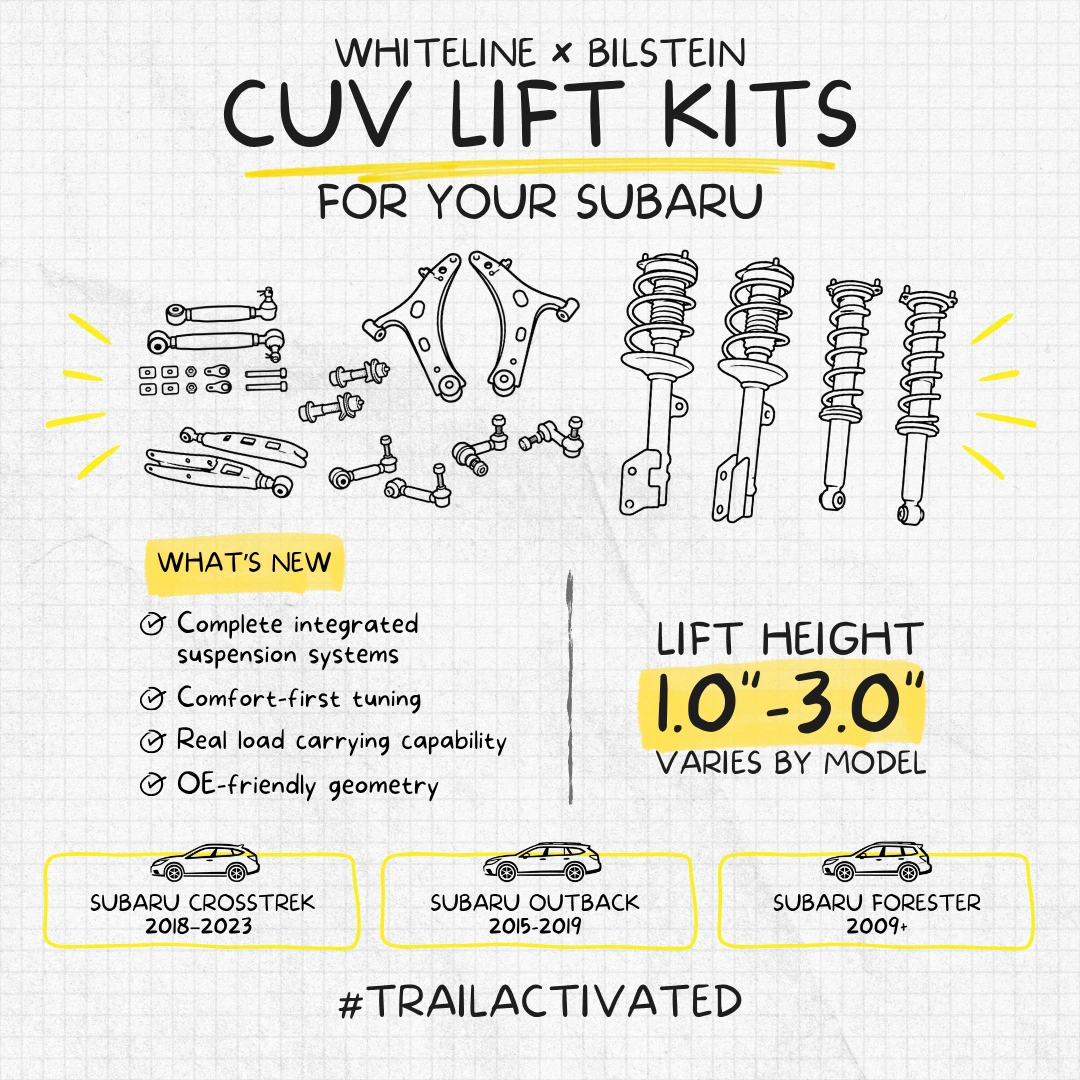
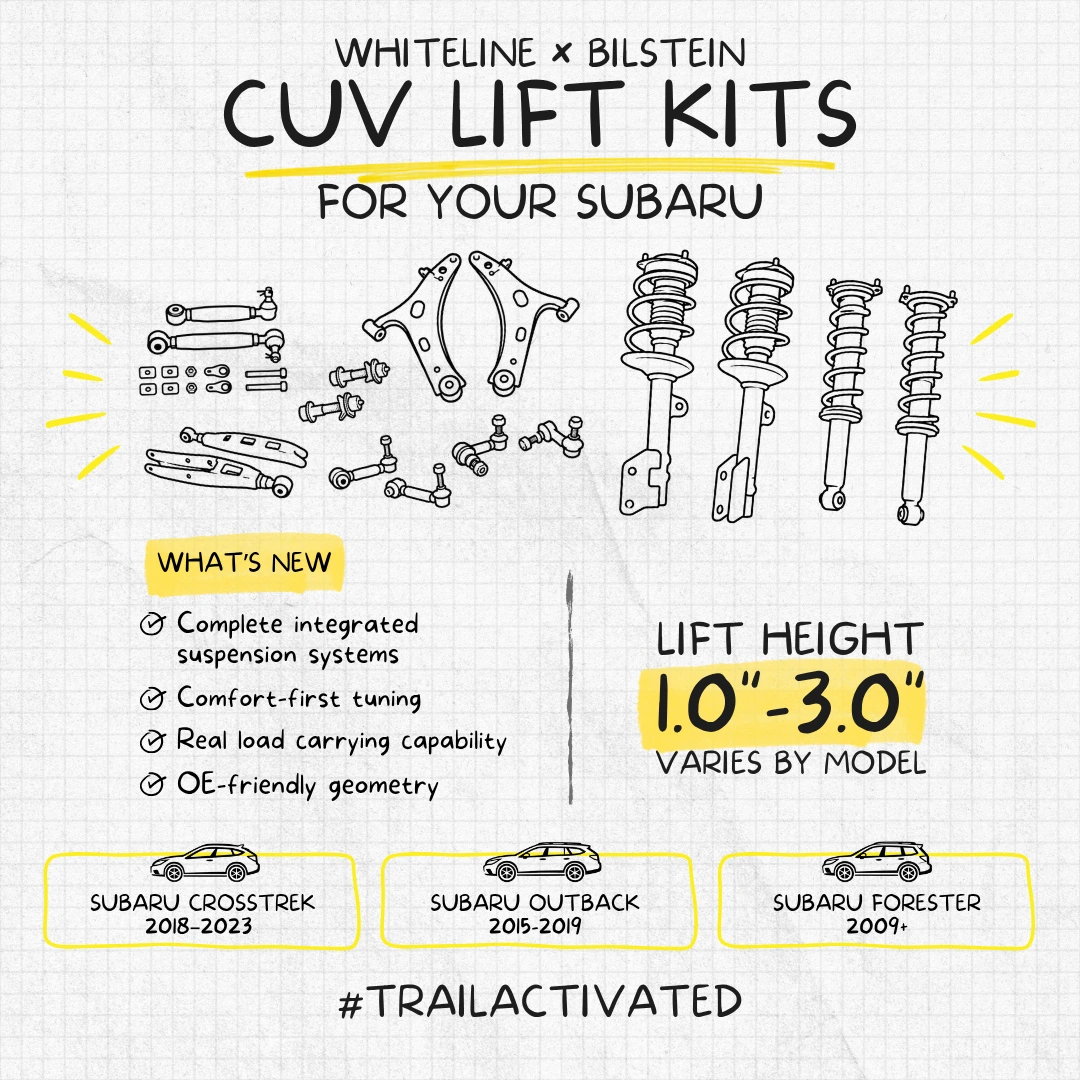
Choosing a moderate lift height is the largest lever, because everything downstream scales with it. Our Trail Activated kit for the 2024 to 2026 Crosstrek GU lifts 1.2 inches front and rear, which sits at the conservative end of the crossover market on purpose. It is enough to change what the car can do and small enough that the driveline stays in familiar territory.
Keeping the travel the factory gave you is the next lever, and it is the one owners rarely think to ask about. We build these kits as a complete engineered suspension system for modern crossover platforms, not a spacer sitting on top of a factory strut, and retained factory droop travel is a confirmed design property of both the Crosstrek GU and RAV4 XA50 kits. A spacer raises the body on a standard length damper and eats extension travel, so the suspension tops out early on rough ground and the axle is forced through its steepest angles at full extension far more often. Keep the droop and that stops being the car's everyday condition. It is a geometry benefit rather than a ride quality promise, and we publish no travel figure, so we will not quote you one.
Restoring rear geometry matters too. Our Crosstrek kit includes a rear subframe spacer kit, which repositions the rear subframe to bring the rear driveline and suspension pickup points back toward their factory relationship instead of leaving them rotated by the new ride height. Not every kit in this class includes one. Our RAV4 XA50 kit does not, which is a genuine difference worth knowing.
Front camber correction comes in the box on both kits, and on this subject it earns its place. The camber bolts are the mechanism, and they give the alignment technician the range to pull front camber back into specification rather than reporting it out and leaving it there. Camber left uncorrected accelerates tire wear and feeds load through the hub and outer joint unevenly.
The alignment itself closes it out. We specify a front and rear wheel alignment after installation, because a front-only alignment on an all-wheel drive car with a raised rear leaves half the geometry unchecked. Both kits are also designed to work with a Whiteline sway bar upgrade if you want to take body roll out once the car sits higher, which changes roll stiffness without asking anything more of the driveline.
Standard Duty or Heavy Duty, and why it matters here
Load changes the picture, because torque at angle is what wears a joint. A car permanently carrying a roof tent, drawers, tools or a trade load sits lower at the rear on a standard spring, and a rear end settled toward the bump stops holds the driveline further from the geometry it was designed around. Our Heavy Duty version answers that with a rear spring built for a constant load of roughly 440 lb.
The other half of that advice matters just as much. Heavy Duty kits are built for consistently loaded vehicles and are not intended for regular unloaded use, so a car that is normally empty should be on Standard Duty. Check your model year, trim and drivetrain against the listing before you order either version.
Signs your axles are actually unhappy
Clicking on full lock at low speed is the classic outer joint complaint. A vibration that appears under acceleration and disappears when you lift off usually points at the inner joint.
Grease flung around the inside of the wheel well means a split boot, which is the real killer, because a joint that loses grease and takes in grit fails on a timeline measured in weeks. Inspect the boots at every oil change and replace a torn one immediately.
FAQs
Looking for more information about lifting a Subaru and CV axle life? Below we answer the most commonly asked questions
Does lifting a Subaru damage CV axles?
Will a lift kit hurt my CV joints on a Crosstrek?
How many degrees of CV angle is too much?
What is a rear subframe spacer kit and do I need one?
Does front camber correction fix CV angle?
Does keeping factory droop travel help my axles?
Should I buy the Heavy Duty kit for a lifted daily driver?
How long do CV axles last on a lifted Subaru?
Do I have to get an alignment after a lift?
Is a 3 inch lift safe on a crossover?
Get the lift with the geometry hardware in the box. See the Whiteline Trail Activated 1.2 inch lift kit for the 2024 to 2026 Crosstrek GU.


