
 US
US Australia
 United Kingdom
 Europe
Strut spacers or a full strut and spring kit: which lift does a Subaru actually need
Lift kit vs strut spacers on a Subaru comes down to what you want the suspension to do. Spacers raise ride height on a standard length damper and spend droop travel doing it. A complete strut and spring assembly changes ride height, spring rate and damping together, retains factory droop travel and is the only one of the three that adds load capacity.
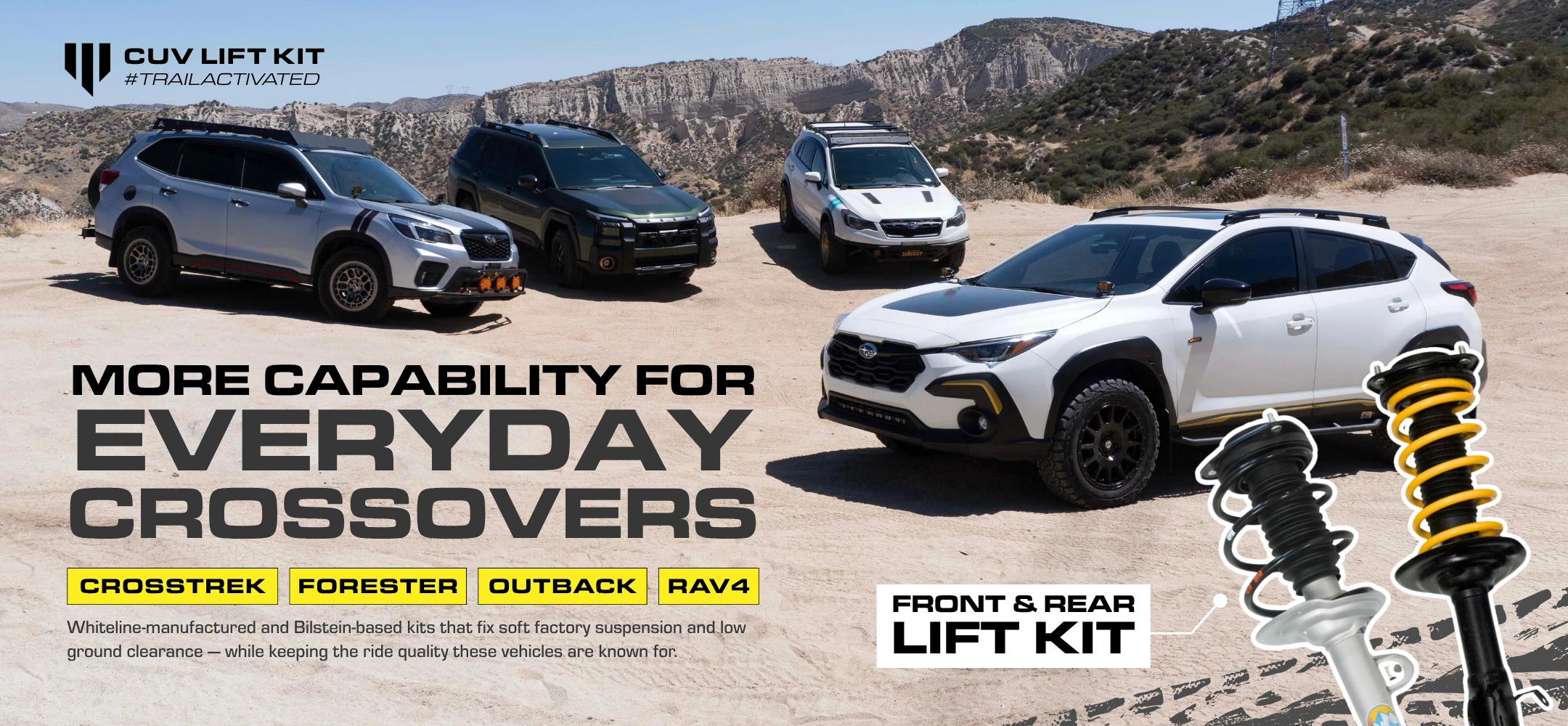
Search this question and you mostly find forum threads. Five of the nine results ranking for lift kit vs strut spacers subaru are user discussions, and the brands that do rank each argue hard for the one method they happen to sell. We build complete assembled strut and spring units at Whiteline, so you know which way we lean, and we will still tell you where a spacer is the honest answer. Our range of lift kits covers Crosstrek, RAV4, Outback and Forester, and the two kits compared against a spacer on this page are the crossover systems we build for the Subaru Crosstrek GU from 2024 onward and the Toyota RAV4 A50 from 2019 to 2025.
The three ways to lift a Subaru, and what each one physically does
Every product in this space belongs to one of three families. They are not three price points for the same outcome, because they change different parts of the suspension.
Strut top spacers
A spacer is a machined plate between the top of the strut assembly and the strut tower. Bolt it in and the body sits higher relative to the wheel, with nothing else altered. The spring is the factory spring at the factory rate, and the damper keeps its factory valving and stroke, so pavement ride quality stays close to untouched.
The catch sits in the droop travel, and it is the part almost nobody selling spacers will spell out. Droop is the downward travel a wheel has available when the ground falls away from it, and it is what keeps a tire loaded through a dip, a washout or the outside of a rutted corner. A spacer raises the body on a damper that is still standard length, so the extra height is taken out of droop rather than added to the suspension. The damper reaches full extension before the suspension does, which is topping out, and it arrives as a metallic thud through the floor. The inside wheel also goes light sooner on rough ground, because there is less travel left to keep it pressed down. Compression travel is unchanged, so no bump clearance was gained, static CV angles increase, and the spring rate is untouched, so the car carries no more weight than before.
Lower lift brackets
Brackets work at the other end, sitting between the base of the strut and the steering knuckle to lengthen the assembly rather than lower it in the tower. Rear packages often add subframe or trailing arm hardware to hold rear geometry closer to where it started. The advantage over a top spacer is that the damper does not surrender its own extension travel the same way. The trade is a loaded structural component in the steering and hub path, so bracket quality and torque procedure genuinely matter. Spring rate, damping and load capacity all remain factory.
Complete assembled strut and spring units
This is what we ship for the Crosstrek GU and the RAV4 A50. The kits arrive as four assembled corners: King springs wound for the new ride height, Whiteline tuned shocks valved to match them, already built into complete units. Your fitter unbolts the factory strut and bolts ours in, so nobody puts a spring compressor on a workshop bench. Because the spring is a different spring, ride height and rate change together, and that is the mechanism that makes a heavy duty variant possible.
Underneath all of that sits the answer to the spacer question. We engineer these kits to retain factory droop travel. Damper length, valving, spring rate and ride height are developed as one package, so lifting the car does not come out of the wheel's downward travel the way it does when a plate is stacked on top of a standard strut. That is a design property of the system rather than a guarantee about how the car will feel on your road, and we publish no travel figure in inches. Front camber correction is included so your technician has the range to bring the alignment back into spec, and the kits are designed to work with a Whiteline sway bar upgrade if you want to take body roll further later. What you are buying is a complete engineered suspension system for modern crossover platforms rather than a height adjustment.
Load capability comes from the same design work. Our US listing for the heavy duty Crosstrek kit describes its rear springs as suited for 440 lb constant loads, and no plate on top of a factory spring reaches that number. Heavy Duty is built for a vehicle that carries weight consistently, and it is not intended for regular unloaded use. If your car is normally empty, Standard Duty is the correct kit and the one we would sell you.
The three approaches side by side
|
|
Strut top spacers |
Lower lift brackets |
Whiteline complete strut and spring kit |
|
Cost band |
Lowest |
Low to middle |
$1,349.99 (RAV4 A50) to $1,499.00 (Crosstrek GU) |
|
Retained factory droop travel |
No. Height comes out of droop, so the damper tops out early on rough ground |
Partly. The damper keeps its own extension travel, but nothing else is retuned |
Yes. Engineered to retain factory droop travel as part of the package |
|
Changes spring rate |
No, factory spring retained |
No, factory spring retained |
Yes, King springs wound for the new ride height |
|
Adds load capacity |
No |
No |
Yes on the HD variants, rear springs suited for 440 lb constant loads |
|
Geometry parts included |
None beyond the spacer |
Varies by maker |
Front camber correction on both kits, plus a rear subframe spacer kit on the Crosstrek |
|
Standard Duty or Heavy Duty |
Single specification only |
Single specification only |
Standard Duty for a normally empty car. Heavy Duty only for a vehicle that is consistently loaded |
|
Sway bar upgrade path |
None offered |
None offered |
Designed to work with a Whiteline sway bar upgrade |
|
Alignment required |
Any ride height change moves camber and toe |
Yes |
Yes, front and rear wheel alignment, published |
|
Install time |
Shortest of the three |
Moderate |
4 hours, published |
|
Warranty |
Varies by maker |
Varies by maker |
Limited Lifetime on our US Trail Activated kits |
Where a spacer is genuinely the right call
We would rather send you to the correct answer than the expensive one. A spacer earns its place when your dampers are healthy, your goal is clearance for a slightly taller all-terrain tire, and the car lives on pavement and graded dirt instead of surfaces that unload a wheel quickly. It buys tire room for a small outlay and leaves the factory ride intact. Droop travel only becomes the deciding factor when the road starts falling away underneath you, so a car that never sees that surface will not miss what the spacer took.
The picture changes the moment weight enters it. Roof racks, a rooftop tent, drawers, recovery gear and a loaded trunk all push the rear down onto a spring that never got stiffer, and neither spacers nor brackets do anything about that. Weight is also where the Standard Duty and Heavy Duty decision gets made for you. Gear that lives in the car permanently points to Heavy Duty. A car that is loaded for a long weekend twice a year and runs empty the rest of the time points to Standard Duty, because Heavy Duty springs are built around a load that is always there.
What our kits include that a spacer cannot
The Crosstrek GU kit for 2024 onward ships with four assembled struts and shocks, a rear subframe spacer kit and front camber correction, at $1,499.00 for a 1.2 inch lift and a published 4 hour install. That subframe spacer separates a considered kit from a stack of plates, because it repositions the rear subframe to hold geometry closer to where Subaru put it. The camber correction hardware then gives your alignment technician the range to bring the numbers back into spec. The kit excludes the Wilderness trim.
The RAV4 A50 kit for 2019 to 2025 cars, standard and hybrid, follows the same philosophy at $1,349.99: four assembled struts and shocks, front camber correction, 1.2 inch lift, 4 hour install, alignment required, Limited Lifetime warranty. The PHEV is not covered. It carries no subframe spacer kit, because the A50 does not need one. Both kits publish lift height, install time, alignment requirement and warranty, which few competitors do, and both retain factory droop travel by design. Confirm your model year, trim and drivetrain before you order.
FAQs
Looking for more information about strut spacers and complete lift kits? Below we answer the most commonly asked questions
Do strut spacers ruin the ride on a Subaru?
Is a lift kit better than strut spacers on a Crosstrek?
Do strut spacers add load capacity?
Do I need an alignment after fitting strut spacers?
What is topping out, and why do spacers cause it?
Do spacers reduce suspension travel?
Which lift do I need if I am carrying touring weight?
Should I buy Standard Duty or Heavy Duty?
Can I add a sway bar later?
Compare the Trail Activated kits and pick the one built for your car.


