
 US
 Australia
 United Kingdom
 Europe

Axle Bushings with Fitting Position Front, Rear for 1987 Ford Bronco Eddie Bauer
IMPROVE GRIP, HANDLING & PERFORMANCE.
On a beam axle rear end, two bushings locate the entire back of the car. Everything your Ford Bronco's rear axle does under load, fore and aft, side to side and in toe, passes through that one pair of joints. When they soften, the rear of the car starts making decisions the driver did not. What a Beam Axle and Its Bushings Are A rear axle beam, ... Read more
On a beam axle rear end, two bushings locate the entire back of the car.
Everything your Ford Bronco's rear axle does under load, fore and aft, side to side and in toe, passes through that one pair of joints. When they soften, the rear of the car starts making decisions the driver did not.
What a Beam Axle and Its Bushings Are
A rear axle beam, also called a torsion beam or twist beam, is a single transverse beam with a trailing arm welded to each end.
The arms run forward and mount to the body through two large bushings. The beam itself twists to allow the wheels to move independently, which is why it is called a torsion beam, and the whole assembly pivots on those two front mounting points.
A rear beam axle is a simple, light and compact arrangement, which is why it is used so widely on front drive platforms. The compromise is that the two pivot bushings have to do every locating job on their own.
A solid beam front axle works on the same principle at the other end, hinged on pivot bushings carrying vertical, lateral and braking loads through one joint each side.
What Ford Bronco Beam Axle Bushings Control
They control three things at once, and the third is the one that matters most.
Fore and aft location, stopping the axle moving backward under braking and forward under acceleration.
Lateral location, keeping the axle centered under the car since there is no track bar or watts link on most beam setups.
Rear toe, which is the one that changes how the car behaves. The angle of those bushings decides where the rear wheels point as the suspension loads up in a corner.
That third function is why a beam axle bushing is a handling component rather than a wear item.
Passive Rear Steer and Why Factory Bushings Are Soft
This is the part that explains everything else about them.
Manufacturers deliberately design compliance into these bushings from the start. Many are voided or angled so that when cornering load comes on, the bushing deflects in a controlled way and the rear axle toes in slightly.
That toe-in makes the car feel stable and understeer gently, which is what a manufacturer wants a family hatch to do. It is passive rear steer, engineered in on purpose.
The problem arrives once those bushings start to age. Once the rubber hardens, cracks or separates from its sleeve, that controlled deflection becomes uncontrolled movement. The rear axle still steers, and it no longer does it predictably.
A car that used to feel planted starts moving around mid corner, and the driver has no way of knowing when it will happen.
Bad Beam Axle Bushing Symptoms on Your Ford Bronco
- The rear feeling like it steps sideways over mid corner bumps
- A car that tramlines or wanders at highway speed
- Vague, delayed rear end response on turn in
- A clunk from the rear mounting points over bumps or driveways
- Rear tire wear on the inner edges with no alignment fault found
- Rear alignment that will not hold its settings between services
- Visible cracking, splitting or separation in the rubber
- The axle visibly moving at the mount when the car is rocked
A rear axle beam bushing that has gone soft shows up first as alignment that drifts, which is the most reliable indicator of the lot. The beam's position is set entirely by those bushings, so a rear toe reading that moves between visits means the bushings are moving rather than the alignment being wrong.
Why Polyurethane Beam Axle Bushings Change How Your Ford Bronco Drives
Replacing soft rubber with polyurethane does something more fundamental here than on most bushings.
On a control arm, a firmer bushing holds a geometry setting more precisely. On a beam axle, it removes the passive rear steer the factory built in.
That sounds like a loss and it is usually a gain. Designed-in compliance makes a car forgiving at the cost of precision, and the deflection that produces it is also what makes an aging car unpredictable.
With firm bushings the rear axle stays where it is pointed. Turn in is sharper, the rear follows the front rather than steering independently, and what the car does in a corner is the same every time.
The trade is more road noise and more sensation from the rear suspension, which on a car being driven for handling is a reasonable exchange.
Ford Bronco Offset Beam Axle Bushings
Some applications offer offset versions, and they do more than restore the original position.
An offset bushing places the beam's pivot point away from center, which rotates the whole assembly slightly and changes the rear toe or camber setting.
That matters on a beam axle because there is usually no other adjustment available. The geometry is set by where the beam mounts, with no arms to lengthen and no eccentrics to turn.
A lowered car running excessive rear camber or toe has very few options, and an offset bushing is often the only practical correction.
Check what your current rear alignment reads before choosing, since the correction needs to match the gap rather than a figure picked in advance.
Ford Bronco Beam Axle Bushings Against Other Rear Suspension Bushings
Worth drawing the comparison, because the job these do is unusual.
On a multi link rear end, several arms share the locating work. Each bushing handles part of it, and one worn bushing degrades its share rather than the whole axle.
On a beam axle there are two joints and they do everything. There is no redundancy, which is why a worn pair changes the car's behavior so noticeably and why replacing them transforms it.
That also means the quality of what goes back in matters more. A soft replacement simply restores the factory compromise. A firm one changes what the rear axle is capable of.
It is one of the few single changes on a front drive car that alters the balance rather than just tidying it up.
Checking Ford Bronco Beam Axle Bushings
A visual check tells you a lot, and a load check tells you more.
With the car on a hoist, look at the rubber at both front mounting points for cracking, splitting or separation from the metal sleeve.
Lever against the arm and watch the mounting point. Movement there is the bushing deflecting, and any visible shift means the beam is not being held.
Check both sides of the car and compare them. Bushings rarely wear evenly, and a difference between them is what produces a car that behaves differently turning each way.
Look at the rear tires while you are there. Inner edge wear on a car with no alignment fault recorded usually points back to these.
Replacing Ford Bronco Beam Axle Bushings
This is a bigger job than most bushing work, and knowing that up front helps.
An axle beam bushing sits in the forward end of each trailing arm, which usually means supporting the beam and dropping it at least partially to get access. On many platforms the brake lines, handbrake cables and ABS wiring all have to be accounted for.
They are a heavy interference fit in a thick housing, so a press and the correct sleeves are required. Hammering distorts the housing and cracks the new bushing.
Replace both sides of the car together without exception. One firm bushing against one perished one gives the rear axle different behavior on each side, which is worse than leaving both alone.
Use silicone or PTFE based grease rather than petroleum, which degrades polyurethane over time.
Torque the mounting bolts with the car on its wheels at ride height rather than hanging, since the bushing takes its set from the position it is clamped in.
Why Ford Bronco Beam Axle Bushings Always Need an Alignment After
The rear geometry on a beam axle is defined by these bushings and nothing else.
Fitting new ones changes where the beam sits, which changes rear toe and camber immediately. A car that was aligned before the job is not aligned after it.
Have the rear measured and set once the car is back on its wheels and has been driven a short distance to settle.
Record the readings somewhere you can find them. On a beam axle those numbers are the only record of where the geometry actually is, and comparing them at the next service tells you whether anything has moved.
Find Beam Axle Bushings for Your Ford Bronco
Axle bushings sit within our bushings lineup, with track bar bushings for the other big axle pivot.
Select your Ford Bronco to see the beam axle bushings and axle pivot bushings available for it. If the rear of the car moves around over bumps or the alignment will not hold, these two joints are where to look, since on a beam axle they are doing every locating job on their own.
1 item
-
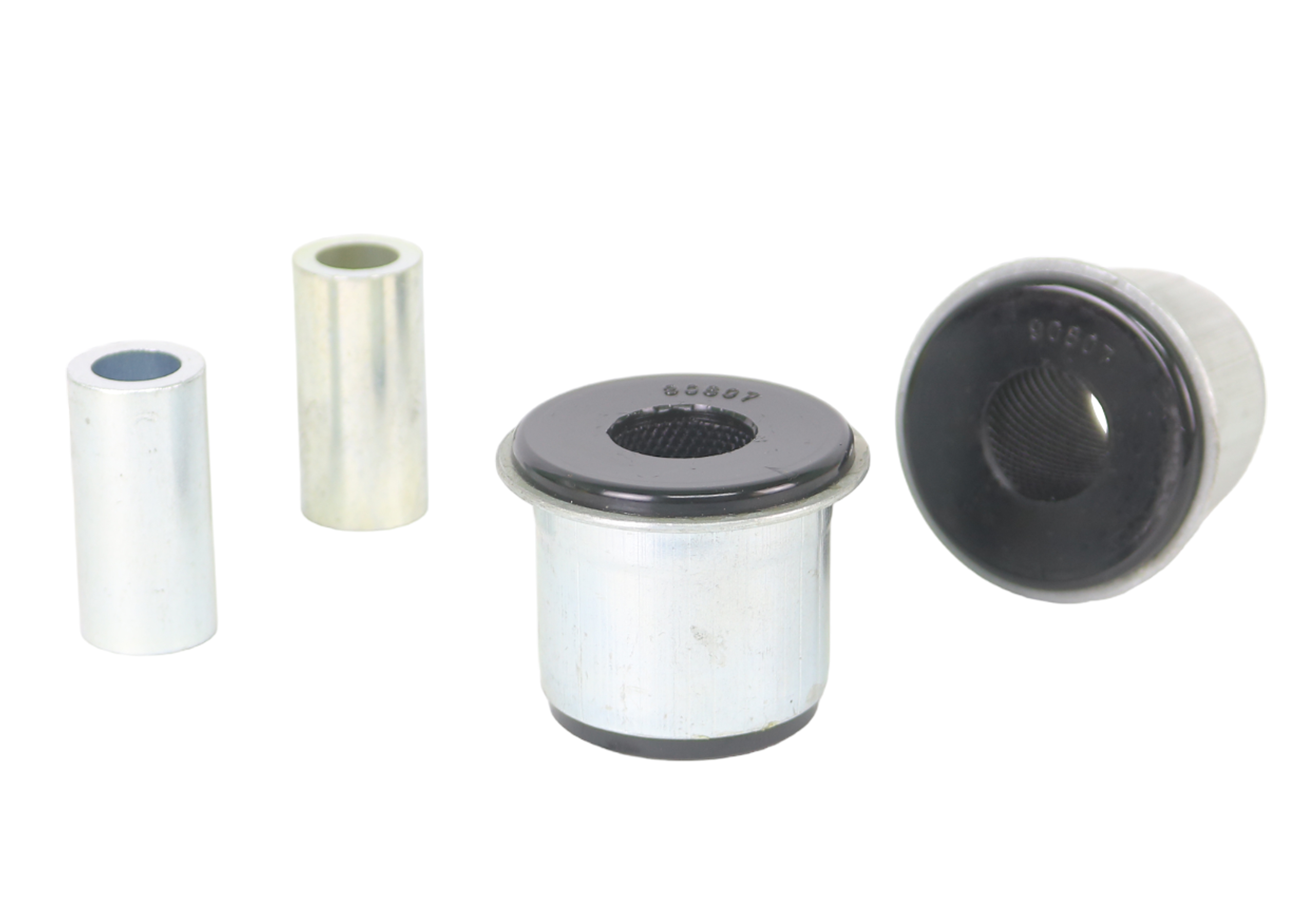
Axle Pivot Bushing - Ford
✅ Fits 1987 Ford Bronco Eddie Bauer In StockShips within 24hrs.Ships within 24hrs.SKU: W63622Axle Pivot Bushing - Ford
✅ Fits 1987 Ford Bronco Eddie BauerIn StockShips within 24hrs.Ships within 24hrs.Qty Required 1Kit Contents 2 Shell Bushings, 2 Tubes, Grease$39.88
Your vehicle
Matching vehicles
No match — try selecting it below.
Refine your search
Clear allNo categories match.
Can’t find what you’re looking for?
Our team can help you find the right part — or tell us what was missing so we can improve the site.
Call Us +1 909-476-2860 Give Feedback (opens in a new tab)


