
 US
 Australia
 United Kingdom
 Europe

Bushings with Fitting Position Front and Rear, Rear for 2015 Mitsubishi Lancer Evolution Final Edition
IMPROVE GRIP, HANDLING & PERFORMANCE.
Bushings are the flexible sleeves sitting between the metal parts of your Mitsubishi Lancer. They let each joint pivot, keep metal off metal, and control how far the component is allowed to move under load. Almost every pivot and mounting point has one, which is why a single vehicle carries dozens, and why worn bushings change how a car drives m... Read more
Bushings are the flexible sleeves sitting between the metal parts of your Mitsubishi Lancer. They let each joint pivot, keep metal off metal, and control how far the component is allowed to move under load.
Almost every pivot and mounting point has one, which is why a single vehicle carries dozens, and why worn bushings change how a car drives more than almost any other part. Most of them are suspension bushings. Plenty of them are not, and this range covers both.
What Are Bushings on Your Mitsubishi Lancer?
If you have never thought about them, here is the short version.
Your suspension is a set of arms and links pivoting on the chassis. Every one of those pivots needs to move freely in one direction while staying put in every other, and a bushing is what makes that possible. The metal sleeve on the outside locates in the arm, the crush tube on the inside takes the bolt, and the material between them allows controlled movement.
Car bushings do two jobs at once, and that is where the compromise lives. They isolate road noise and vibration from the cabin, and they hold your suspension geometry in place. Soft material does the first job well. Firm material does the second. Every bushing on your Mitsubishi Lancer is a decision somebody made about where to sit between those two.
Factory engineers weight that decision toward quiet. Whiteline weights it toward control.
Mitsubishi Lancer Bushings vs Bearings
Worth clearing up, since we sell both.
A bearing carries load with as little friction as possible, using balls, rollers or a machined spherical surface. A bushing is not spinning. It handles a limited arc of movement, usually a few degrees back and forth as the suspension cycles, and it is built to resist load and locate a component rather than minimize friction.
Most positions want a bushing. A handful want a bearing, which is why bearing upgrade kits exist for specific control arm positions where compliance costs more than it gives back. The listings say which is which.
Polyurethane Mitsubishi Lancer Bushings Against Factory Rubber
Rubber bushings are what your car left the factory with, chosen because they are quiet and cheap to mold at volume.
The price you pay is deflection and lifespan. Rubber compresses under load and never fully returns, it dries out and cracks through heat cycling and UV exposure, and oil contamination finishes off whatever is left. Factory rubber is also specified for a stock car on stock tires carrying stock loads, so the moment you lower it, add power, run stickier tires or take it near a track, that bushing is working way outside its brief.
Polyurethane bushings hold their shape where rubber gives up, and every bushing in this range is polyurethane.
- Less deflection, so your alignment stays where the shop set it under load instead of drifting around
- Far longer service life, since polyurethane does not dry rot, crack or perish the way rubber does
- Resistance to the oil, grease, ozone and weathering that live under every car
- Steering response you can predict, because the amount of movement does not change with load
- Load capacity for the grip, power and track use the original rubber was never rated for
The objection people raise about polyurethane bushings is harshness, and it deserves a straight answer. Bushing design and durometer decide ride quality far more than the material itself, and where a kit is firm enough to add noticeable noise or vibration, the listing says so.
Mitsubishi Lancer Suspension Positions
Suspension bushings are where most of the range sits.
Control arm bushings cover upper and lower arms, inner and outer locations, and forward and rearward positions on arms with two inner pivots. Front lower control arm bushings take the heaviest load of the set, and upper control arm bushings do the same job at the top of the knuckle. Rear control arm bushings handle camber and location at the back.
Sway bar bushings are the most replaced bushings on any car. They hold the bar to the chassis across a wide span of bar diameters, in vehicle specific and universal fitments, with heavy duty options where the loads justify them. Sway bar link bushings keep the link ends tight so the load actually reaches the bar, and sway bar to control arm bushings cover the designs that mount that way.
Solid axle and leaf sprung vehicles take leaf spring bushings at the eye and shackle, trailing arm bushings in upper and lower positions, radius arm and strut tension bushings, and panhard rod bushings, which Americans will also find listed as track bar bushings.
Beyond the arms there are shock absorber bushings at upper and lower mounts and where the shock meets the control arm, strut rod to chassis and strut rod to control arm bushings, strut mount kits, coil spring pad bushings including versions that add ride height, and spring saddles.
Mitsubishi Lancer Steering Positions
The positions most people overlook, and the ones that decide how direct your car feels.
Steering rack and pinion mount bushings locate the rack to the chassis or subframe, and they are the single biggest improvement in on center feel available for the money. Rack and pinion shaft guide bushings and rack slider bushings control the rack internally. Idler arm bushings remove the free play that develops on recirculating ball systems.
Bump steer correction kits sit here too, addressing toe change through suspension travel on cars whose ride height has moved.
Mitsubishi Lancer Engine, Driveline and Chassis Positions
Same principle, applied away from the suspension.
Differential mount bushings reduce driveline movement so power delivery stays clean and tailshaft angles hold. Subframe mount bushings stop the subframe moving relative to the body, which on a lot of platforms is where the geometry is quietly going. Engine pitch mounts, gearbox mounts and gearbox crossmember pads control how far the engine and transmission rotate against their own torque before it reaches the driveline.
Body mount bushings isolate the cabin from the frame, and door jam bushings take up the movement in a door frame that has loosened with age, which does more for structural feel on an older car than people expect.
Alignment Correction Versions for the Mitsubishi Lancer
A large part of this range is not a straight replacement.
Double offset, caster, camber and anti lift kits have the offset machined into the bushing, so fitting them shifts the arm pivot and hands the aligner range the car never had. That is what a lowered car needs once the factory adjustment has been used up, and it is how you dial in a performance alignment rather than accepting the factory numbers.
Because the offset is directional, those bushings can also correct one side differently from the other, which is the only practical fix for a car that pulls with tires and pressures ruled out.
Mitsubishi Lancer Single Kits, Essential Kits and Service Kits
Single position kits target one joint, which suits a diagnosed fault where everything else is sound.
Essential Vehicle Kits group the positions that matter most for how the car drives, available front, rear or front and rear, and Essential Driveline Kits do the same for the engine, gearbox and differential mounts. These are the practical choice for most people, since they target what you feel without dismantling every mounting point on the car.
Service kits refresh the wear parts in Whiteline sway bars, sway bar links and control arms, so a component that has covered serious miles gets rebuilt rather than replaced.
Symptoms of Bad Mitsubishi Lancer Bushings
- Squeaking from the front that changes with the weather, which usually means sway bar bushings
- Clunking or knocking from the suspension over bumps and driveways
- Steering that feels vague and wanders, needing constant correction
- More body roll in corners with a floaty, unsettled feel
- Uneven tire wear, usually concentrated on one edge
- An alignment that will not hold spec between services
- The car pulling to one side under braking
- Driveline shunt, a thud on shifts, or vibration through the floor and pedals
- Visible cracking, splitting, perishing or material squeezed out of a bushing
- Everything getting noticeably worse under load or on track
If you are chasing a noise nobody can find, worn bushings are worth checking before anything else. They fail quietly and gradually, which is exactly why they get overlooked.
What Mitsubishi Lancer Replacement Costs
The bushings are the cheap part of the job. Getting to them is not.
Almost every position needs the component off the car and the old bushing pressed out, and that work takes the same time whether you replace one bushing or every bushing on that corner. Pay for the teardown, the press work and an alignment today for one position, then pay for all three again next year, and the labor has cost you far more than the parts ever did.
That is the argument for doing a whole corner, or a whole end of the car, in one hit. It is also why fitting bushings during any other suspension work costs almost nothing extra in labor.
If you are comparing shop quotes, the variables that move the number are how many positions are being done, whether components have to come off the car, and whether an alignment is included.
Pressing, Greasing and Torque at Ride Height on Your Mitsubishi Lancer
Most positions need a press, and a correct diameter press tool is what keeps the mounting eye intact. A damaged eye cannot be repaired and costs far more than the tool.
Check the eye while the old bushing is out. A bore worn oval will not hold a new bushing and means that component needs replacing rather than rebushing.
Install the crush tubes and sleeves supplied, because the tube carries clamping load from the bolt and a bushing fitted without one gets crushed the moment the fastener is torqued.
Grease on assembly with a lubricant made for polyurethane. Silicone and PTFE based greases are correct, while ordinary lithium and petroleum based greases can degrade the material over time.
Watch orientation on any offset bushing. Installed backwards it moves the angle the wrong way and leaves the alignment further out than when you started.
Torque with the car on its wheels at ride height rather than hanging at full droop. Whatever position a bushing is clamped in becomes its neutral position, so one tightened at droop spends its life twisted and binds from the first mile. More new bushings are ruined by this than by anything else.
Finish with an alignment on anything affecting wheel position.
Find Bushings for Your Mitsubishi Lancer
Select your Mitsubishi Lancer to see every bushing position available for it, from a single kit through to a complete Essential Vehicle Kit, or search by bushing size if you are building something the fitment guide does not cover. Every Whiteline component is backed by our warranty, a fitment guarantee and 60 day returns.
6 items
-
Rear Sway Bar Mount - Bushing Kit
✅ Fits 2015 Mitsubishi Lancer Evolution Final EditionIn StockShips within 24hrs.Ships within 24hrs.SKU: KSK003-27Rear Sway Bar Mount - Bushing Kit
✅ Fits 2015 Mitsubishi Lancer Evolution Final EditionImproves stability and control, transforming vehicle performance the perfect, complete upgrade. Includes: 2 BushingsIn StockShips within 24hrs.Ships within 24hrs.Qty Required 1Kit Contents 2 Bushings$29.88 -
Rear Control Arm Upper - Inner Rear Bushing Kit
✅ Fits 2015 Mitsubishi Lancer Evolution Final EditionIn StockShips within 24hrs.Ships within 24hrs.SKU: KCA470Rear Control Arm Upper - Inner Rear Bushing Kit
✅ Fits 2015 Mitsubishi Lancer Evolution Final EditionDelivers a balanced mix of comfort, precision, and durability; the perfect, complete upgrade. Includes: 2 Shell BushingsIn StockShips within 24hrs.Ships within 24hrs.Qty Required 1Kit Contents 2 Shell Bushings$179.88 -
Rear Differential Mount - Bushing Kit
✅ Fits 2015 Mitsubishi Lancer Evolution Final EditionIn StockShips within 24hrs.Ships within 24hrs.SKU: KDT963Rear Differential Mount - Bushing Kit
✅ Fits 2015 Mitsubishi Lancer Evolution Final EditionBoosts handling and performance, while optimising suspension geometry; the perfect, complete upgrade. Includes: 1 Shell Bushing, 4 Bushings, 3 Tubes & 3 WashersIn StockShips within 24hrs.Ships within 24hrs.Qty Required 1Kit Contents 1 Shell Bushing, 4 Bushings, 3 Tubes, 3 Washers$58.88 -
Rear Rear Trailing Arm Bushings for Stability and Even Tire Wear
✅ Fits 2015 Mitsubishi Lancer Evolution Final EditionPre-OrderAvailable for Preorder. Ships within 4-6 weeks.Available for Preorder. Ships within 4-6 weeks.SKU: W63350Rear Rear Trailing Arm Bushings for Stability and Even Tire Wear
✅ Fits 2015 Mitsubishi Lancer Evolution Final EditionDelivers a balanced mix of comfort, precision, and durability; the perfect, complete upgrade. Includes: 2 Shell Bushings, 2 Pins, 2 Washers, 2 Spacers, 2 NutsPre-OrderAvailable for Preorder. Ships within 4-6 weeks.Available for Preorder. Ships within 4-6 weeks.Qty Required 1Kit Contents 2 Shell Bushings, 2 Pins$175.74 -
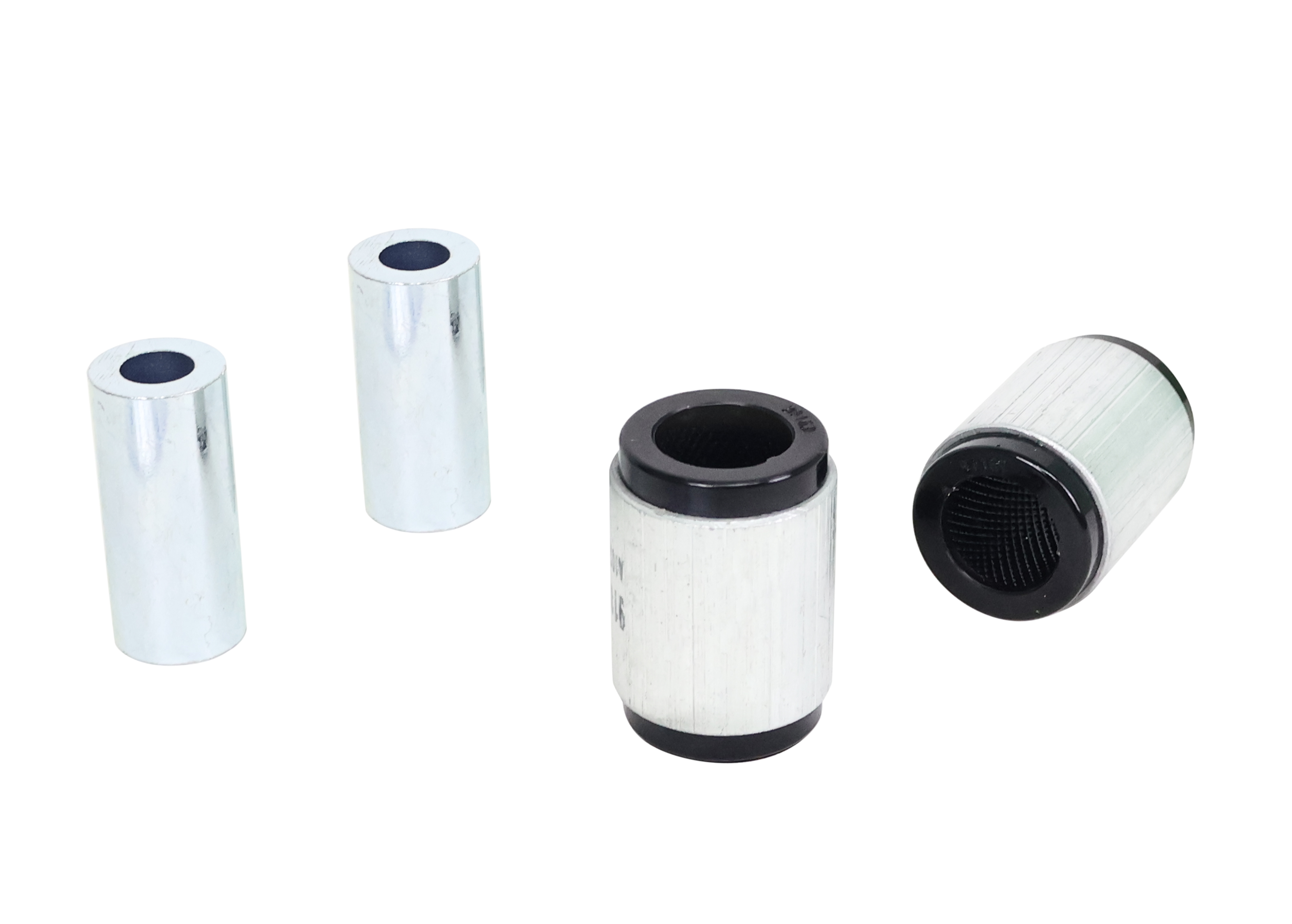
Rear Control Arm Upper - Inner Bushing Kit
✅ Fits 2015 Mitsubishi Lancer Evolution Final Edition In StockShips within 24hrs.Ships within 24hrs.SKU: W63751Rear Control Arm Upper - Inner Bushing Kit
✅ Fits 2015 Mitsubishi Lancer Evolution Final EditionIn StockShips within 24hrs.Ships within 24hrs.Qty Required 1Kit Contents 2 Shell Bushings, 2 Tubes$37.88 -
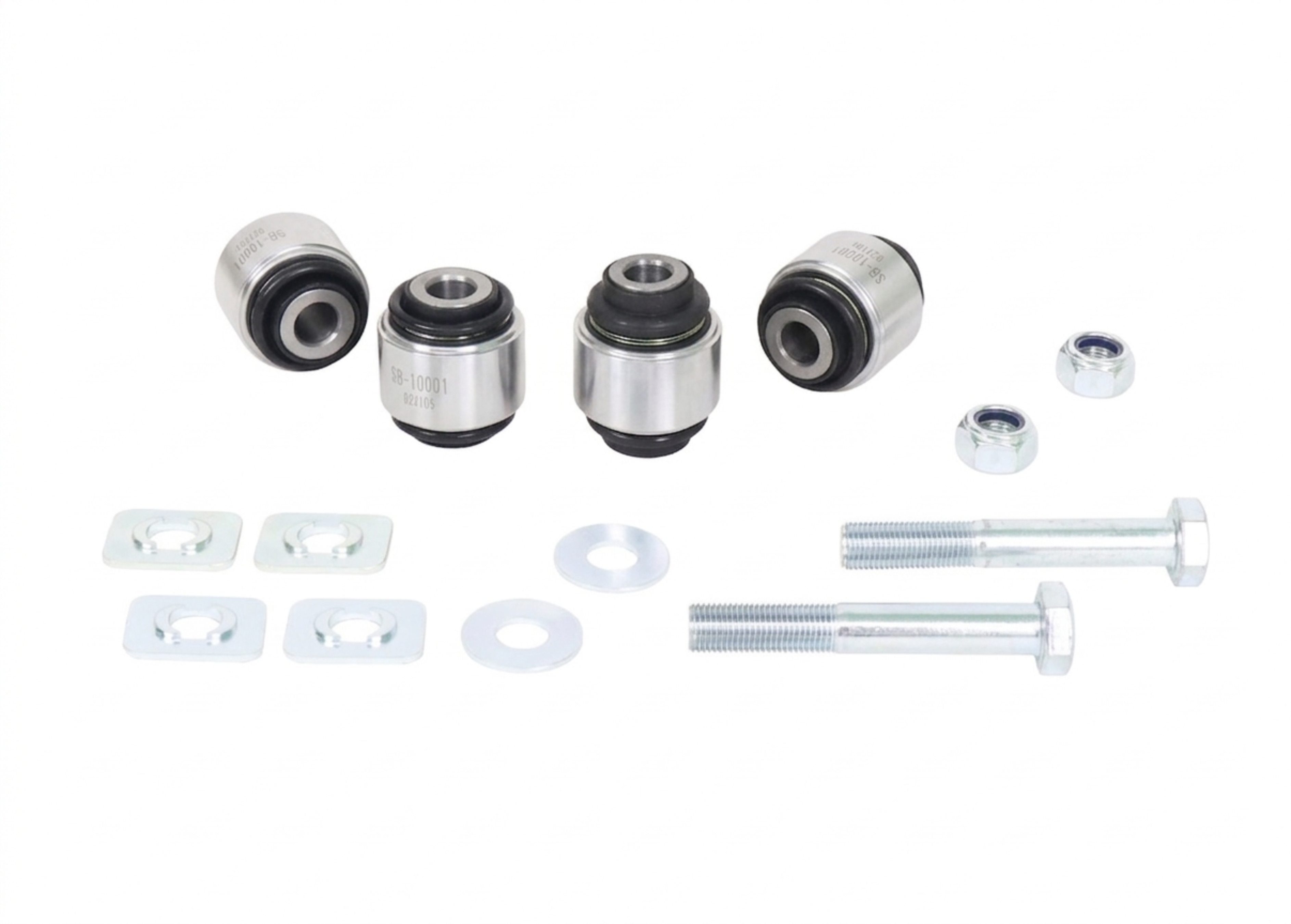
Rear Service kit for Whiteline KTA135 rear lower control arms
✅ Fits 2015 Mitsubishi Lancer Evolution Final Edition In StockShips within 24hrs.Ships within 24hrs.SKU: KSK135Rear Service kit for Whiteline KTA135 rear lower control arms
✅ Fits 2015 Mitsubishi Lancer Evolution Final EditionIn StockShips within 24hrs.Ships within 24hrs.Qty Required 1Kit Contents 4 Bearings, 4 Lockout Washers, 2 Bolts, 2 Washers, 2 Nuts$128.88
Your vehicle
Matching vehicles
No match — try selecting it below.
Refine your search
Clear allCan’t find what you’re looking for?
Our team can help you find the right part — or tell us what was missing so we can improve the site.
Call Us +1 909-476-2860 Give Feedback (opens in a new tab)


