
 US
 Australia
 United Kingdom
 Europe

Leaf Spring Bushings with Fitting Position Front for 2000 Ford F-350 Super Duty XL
IMPROVE GRIP, HANDLING & PERFORMANCE.
Four bushings hold each leaf spring to your Ford F-350 Super Duty, and no two of them are doing the same job. One takes the entire braking load of that corner. Two more pivot constantly as the spring flexes. The fourth bolts the whole arrangement to a chassis bracket that is usually rusted. Four Positions, Three Different Jobs Start at the front... Read more
Four bushings hold each leaf spring to your Ford F-350 Super Duty, and no two of them are doing the same job.
One takes the entire braking load of that corner. Two more pivot constantly as the spring flexes. The fourth bolts the whole arrangement to a chassis bracket that is usually rusted.
Four Positions, Three Different Jobs
Start at the front end of the spring. The main leaf curls into a formed eye that bolts to a fixed hanger on the chassis, and the bushing inside that eye is the anchor point for everything the axle does.
Move to the rear and the spring ends in a second eye, connected to a swinging shackle. That gives two more bushings, one leaf spring eye bushing where the spring meets the shackle and one where the shackle meets the chassis.
The shackle exists because a leaf spring gets longer as its arc flattens under load. Without somewhere for that length to go, the spring could not flex.
So the front bushing is a fixed pivot carrying load, and the two shackle bushings are moving joints allowing the spring to change length. Treating them as the same part is where most diagnosis goes wrong.
The Front Spring Eye Does the Heavy Work
Every bit of braking torque from that wheel passes through the front spring eye bushing.
Hit the brakes and the axle wants to keep going forward. The leaf spring resists that, and the force ends up concentrated in a single bushing roughly the size of your fist.
Acceleration loads it the other way, and on a leaf sprung vehicle under power the axle also tries to rotate, winding the spring up and pushing harder against the same joint.
When that bushing softens, the axle moves fore and aft under load. The wheelbase changes slightly on that side, the vehicle tracks crooked, and the steering develops a vagueness that appears under braking and disappears afterward.
It is also the bushing most likely to have seized solid into its eye, which matters later.
Shackle Bushings Wear From Movement, Not Load
The two shackle bushings fail differently, and understanding why tells you what to look for.
These two pivot every time the suspension moves. Over a year they cycle hundreds of thousands of times, through road spray, mud and grit, usually with no lubrication beyond what was in there when it was built.
The result is gradual wear rather than collapse. The bore goes oval, the pin wears a groove, and play develops that lets the shackle flop around.
That shows up as a knock over driveways and speed bumps, and as a squeak at low speed once the surfaces run dry. The squeak is the most ignored noise in suspension work and it is the sound of two components destroying each other.
Because both see the same conditions, finding one worn leaf spring shackle bushing almost always means the other has gone too.
Hanger Bushings and the Bracket Behind Them
The chassis end is where corrosion does its work.
A leaf spring hanger bushing sits in the bracket welded or bolted to the chassis rail, and that bracket collects water from the road and holds it against the mounting.
What fails there is often the bracket rather than the bushing. Elongated bolt holes, a thinned bracket or cracking at the weld all mean the bushing has nothing solid to work against.
Fitting a new bushing into a bracket that has gone oval achieves very little, which is why the bracket is worth inspecting properly before ordering parts.
On vehicles where the hanger is bolted rather than welded, replacement brackets are available and worth fitting at the same time.
Why Getting Them Out Is the Real Job
Anyone who has done this before knows the parts are cheap and the extraction is not.
A leaf spring bushing sits in a formed steel eye as an interference fit, and it has usually been corroding in place for a decade. The outer sleeve effectively welds itself to the eye through rust.
Pressing them out properly is the clean method. Support the eye, push the bushing straight out with the right sleeve behind it, and the eye survives intact.
Burning the rubber out is the usual shortcut. It works, it fills the workshop with smoke, and it leaves the steel outer sleeve still seized in the eye with nothing left to push against.
From there the sleeve has to be cut with a hacksaw blade or collapsed with a chisel, and both risk scoring the bore. A scored eye will not hold a new bushing square.
A leaf spring bushing removal tool draws the bushing out using a threaded spindle against a plate, which works where a press cannot reach the eye in situ. On a heavy vehicle those tools are standard equipment rather than a luxury.
Rubber, Polyurethane and Bronze
Three different materials turn up in this position and they suit different vehicles.
Rubber is what most road vehicles leave the factory with. It isolates well, deflects under load and perishes with age, which is the familiar compromise.
Polyurethane holds its shape under the loads this joint sees, which keeps the axle located under braking and stops the shackle developing play. It transmits more noise, and it needs the correct lubricant at fitting since petroleum grease degrades it over time.
Bronze bushings appear on heavy commercial and trailer applications, running on a greased pin with a zerk fitting. They carry enormous load and last well, provided somebody actually greases them at service intervals.
For a road vehicle, polyurethane is usually the sensible upgrade. For anything carrying serious weight, check what the application was designed around before switching material.
When the Spring Itself Is the Problem
Worth ruling out before spending time on bushings, since the symptoms overlap.
A leaf pack that has flattened has lost its arc, which changes the angle the shackle sits at and loads the bushings differently to how they were designed to be loaded. New bushings in that situation wear quickly and the vehicle still sits low.
A cracked or broken leaf produces a knock that sounds very like a worn bushing, and it gets misdiagnosed regularly.
Leaves that have spread apart or shifted at the center bolt change the pack's effective length, which again moves the shackle angle.
Check the arc, the center bolt alignment and the leaves themselves while the spring is accessible. If the pack is finished, bushings alone are money spent on a spring that needs replacing anyway.
Conversely, a sound pack with worn bushings is exactly the situation these parts are for, and the vehicle transforms for very little outlay.
Measuring Before You Order
Three figures decide fitment and all three need checking against the part in the vehicle.
The eye bore is the inside diameter of the formed eye the bushing presses into, measured after any old sleeve has been removed rather than over the top of it.
The spring eye width is how thick the eye is, which sets the bushing length and determines whether it sits flush or proud.
The pin or bolt diameter is what passes through the center, and it has to match the inner sleeve rather than being close to it.
Measure the originals rather than working from a listing, especially on a vehicle that has had a spring pack changed at some point, since aftermarket springs frequently use different eye dimensions to the factory part.
Trailer and Heavy Vehicle Applications
The same component works harder on anything towed or loaded.
A trailer leaf spring bushing carries weight continuously rather than variably, with no driver moderating what the suspension sees over a rough surface.
Boat trailers add immersion to that, with salt water reaching the bushings on every launch and sitting in the eye afterward, which is why they corrode faster than anything on a road vehicle.
Semi truck and commercial leaf spring bushing replacement is a scheduled maintenance item rather than a repair, and those applications usually run bronze or heavy duty rubber designed to be serviced.
Load rating matters as much as fitment on these. A bushing sized correctly but specified for a lighter application will not last.
Doing the Job Once
The parts cost very little and the access costs a great deal, which should decide how you approach it.
A leaf spring bushing kit covering all positions on an axle is barely more expensive than two bushings bought separately, and it means the spring only comes off once.
Replace the shackles themselves if they show play or corrosion, since a new bushing in a worn shackle has the same play it started with.
New U-bolts are mandatory if the pack has come off the axle, as they stretch permanently once torqued and will not clamp the same way twice.
Torque everything at ride height with the vehicle on its wheels, because a bushing clamped while the suspension hangs is preloaded from the first bump.
Find Leaf Spring Bushings for Your Ford F-350 Super Duty
Leaf spring bushings sit within our bushings lineup, along with leaf spring pads.
Select your Ford F-350 Super Duty to see the leaf spring bushings available for it, covering spring eye, shackle and hanger positions. Measure the eye bore, width and pin diameter before ordering, and inspect the hanger brackets while the spring is off.
1 item
-
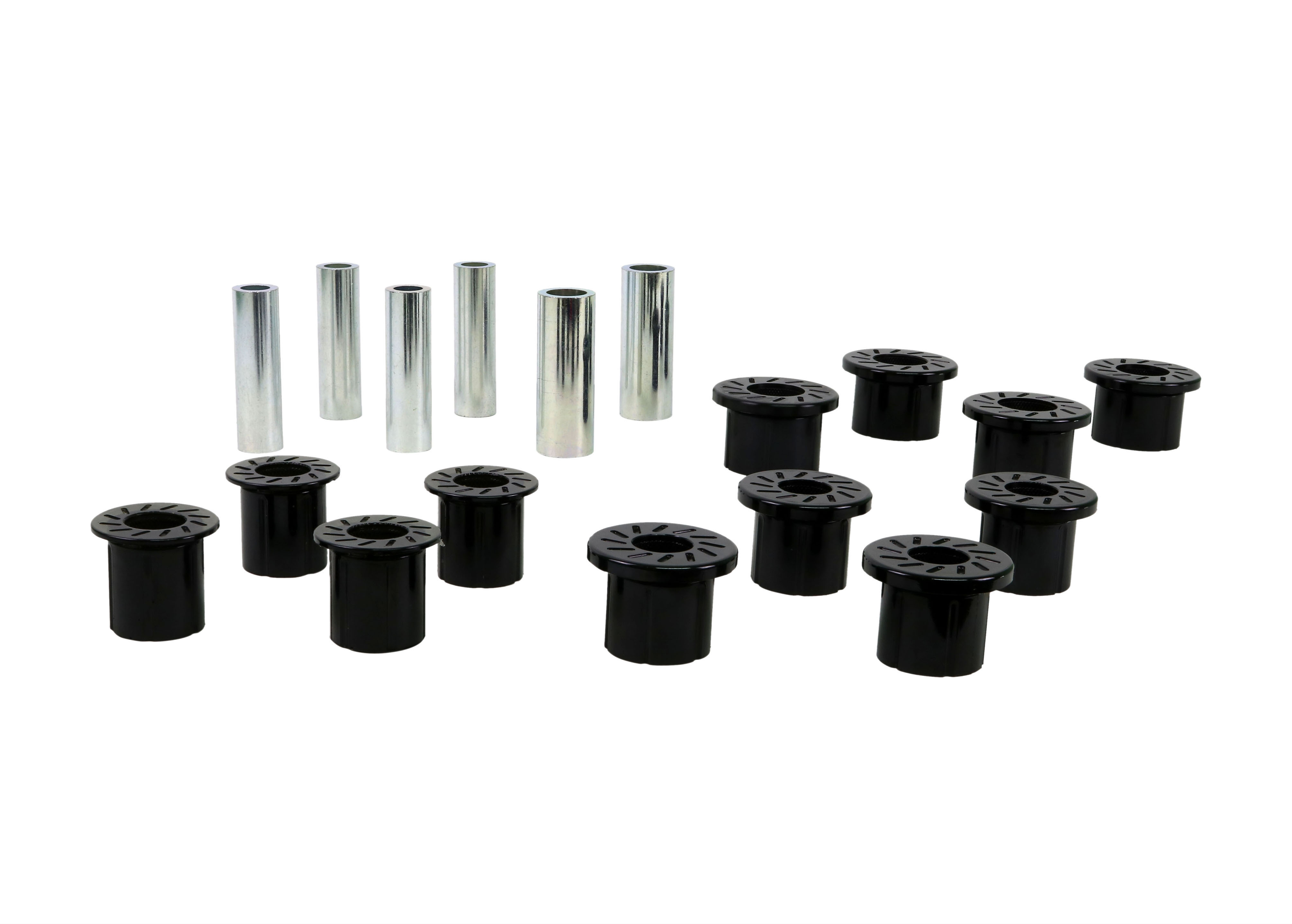
Front Spring - Eye Front And Rear Bushing
✅ Fits 2000 Ford F-350 Super Duty XL Pre-OrderAvailable for Preorder. Stock due on 08-Nov-2026.Available for Preorder. Stock due on 08-Nov-2026.SKU: W73816Front Spring - Eye Front And Rear Bushing
✅ Fits 2000 Ford F-350 Super Duty XLPre-OrderAvailable for Preorder. Stock due on 08-Nov-2026.Available for Preorder. Stock due on 08-Nov-2026.Qty Required 1Kit Contents 12 Bushings, 4 Tubes, Grease$97.88
Your vehicle
Matching vehicles
No match — try selecting it below.
Refine your search
Clear allNo categories match.
Can’t find what you’re looking for?
Our team can help you find the right part — or tell us what was missing so we can improve the site.
Call Us +1 909-476-2860 Give Feedback (opens in a new tab)


