
 US
 Australia
 United Kingdom
 Europe

Leaf Spring Shackle Bushing with Fitting Position Front, Rear for 1988 Jeep Wrangler Sahara
IMPROVE GRIP, HANDLING & PERFORMANCE.
A shackle is two plates, two pins and four bushings, and it is the only part of your Jeep Wrangler's leaf spring allowed to move. Everything else in the pack is clamped or bolted solid. The shackle swings, and the bushings are what it swings on. Four Bushings in Every Shackle Pair Count them properly and the number tends to surprise people. Each... Read more
A shackle is two plates, two pins and four bushings, and it is the only part of your Jeep Wrangler's leaf spring allowed to move.
Everything else in the pack is clamped or bolted solid. The shackle swings, and the bushings are what it swings on.
Four Bushings in Every Shackle Pair
Count them properly and the number tends to surprise people.
Each shackle carries two bushings, one at the top where it mounts to the chassis hanger and one at the bottom where it picks up the rear eye of the spring.
A vehicle with leaf springs at the rear has two shackles, which makes four bushings. On a vehicle with leaf springs front and rear, that doubles again.
Every one of them is an independent wear point, and they do not fail together. A knock from one corner is usually one bushing out of four having gone further than the others.
The Arc a Shackle Swings Through
Understanding why the shackle exists explains why its bushings matter.
A leaf spring gets longer as its arc flattens. Load the vehicle and the pack straightens out, and the distance between the two spring eyes increases.
The front eye is bolted to a fixed hanger and cannot move. So the rear eye has to, and the shackle is what lets it, swinging rearward as the spring lengthens and forward as it recovers.
That swing is an arc rather than a straight line, which means the rear of the spring also moves slightly up and down as it moves fore and aft. The whole suspension is designed around that arc.
Both bushings are pivoting through it constantly, every bump, every load change, every time somebody gets in the vehicle.
How Play in the Bushings Changes That Arc
Here is what actually goes wrong, and it is more than noise.
A new bushing holds the shackle on a defined pivot point. The arc is predictable and the spring's rear eye follows the path it was designed to.
Once the bore goes oval, the shackle has slop before the pivot takes up. The spring moves before the shackle starts swinging, which means the axle shifts fore and aft independently of the suspension actually doing anything.
That is felt as the rear stepping sideways over mid corner bumps, as a vehicle that tracks crooked, and as a wheelbase that is fractionally different left to right.
Worn badly enough, the shackle starts moving laterally as well, because the plates are no longer held square. From there it can contact the spring, the chassis or the hanger.
Why Jeep Wrangler Shackle Bushings Wear Faster
Shackle bushings fail before the spring eye bushing does, and there is a reason for it.
The front spring eye bushing carries enormous load and barely rotates. It deflects under braking and returns, which is a compression failure over years.
Shackle bushings carry less load and rotate constantly. That is a wear failure rather than a compression one, and wear accumulates with cycles rather than with force.
A vehicle doing short trips on rough roads cycles those bushings far more than mileage suggests. Every driveway, speed bump and pothole is another cycle through the arc.
Add road spray, mud and grit working into the joint with no seal to keep it out, and the bore wears oval while the spring eye bushing is still serviceable.
That is why a shackle rebuild is the common repair and a full spring bushing replacement is the less common one.
Greasable Shackles and What They Buy
Some shackles carry a grease fitting in each pin, and the difference it makes is real.
Grease reaching the bushing bore does two things. It reduces friction at the pivot, which slows the wear directly, and it displaces water and grit that would otherwise grind the surfaces.
On a vehicle that sees mud, water crossings or salt, that is the difference between a bushing lasting years and lasting a season.
The catch is that greasable hardware only works if somebody greases it. A nipple that has never seen a grease gun offers no advantage, and the grease passage can admit water if the nipple fails.
Add them to the service schedule at the point of fitting rather than afterward, and grease more often than the interval suggests on anything working in water.
Pins Wear With the Bushings
Replacing one without the other is a short term repair.
The bushing bore and the pin running through it wear as a pair. As the bore goes oval, the contact pressure concentrates and the pin develops a groove or a flat where it has been bearing.
Fit a new bushing onto a grooved pin and the new bore wears to match the old pin within months, because the pin is no longer round where it matters.
Pins are usually supplied with shackle bushing kits for exactly this reason, and where they are sold separately they are worth buying at the same time.
Check the shackle plates themselves while everything is apart. Elongated holes in the plate mean the bushing has been moving within the shackle rather than the pin moving within the bushing, and new bushings will not fix that.
Rubber Against Polyurethane at the Shackle
The material choice matters more here than at most pivots, because of how the joint fails.
Factory rubber bushings are bonded to a steel sleeve and deflect as well as rotate. That deflection absorbs noise, and at a joint that is supposed to pivot cleanly it adds movement the shackle should not have.
Polyurethane does not bond to a sleeve in the same way. It rotates on the pin rather than deflecting around it, which is what the shackle wants. The bore stays round longer and the pivot stays where it should be.
The trade comes in how much noise is transmitted. Polyurethane transmits more of what the rear suspension is doing, and a dry polyurethane bushing squeaks more readily than rubber does, which is precisely why greasable hardware and polyurethane are so often paired.
Using the correct lubricant matters a great deal at fitting. Petroleum grease degrades polyurethane over time, so silicone or PTFE based products are what the job needs.
On a working vehicle the durability is the argument. On a quiet daily driver, the noise is worth weighing.
Replacing Them as a Set on Your Jeep Wrangler
The economics point one way on this job.
Access is what costs the money on this job. Getting to one shackle bushing means supporting the vehicle, releasing the shackle and dealing with pins that have usually seized, and three of the four are within arm's reach once you are there.
Expect seized pins on anything with age behind it. Penetrating fluid applied the day before works better than force applied on the day, and a pin that has sat dry for a decade frequently needs cutting out.
Shackle plates are worth replacing alongside the bushings where they show corrosion, distortion or elongated holes, since a new bushing in a worn plate has the same play it started with.
Torque everything at ride height with the vehicle on its wheels rather than hanging, because a bushing takes its set from the position it is clamped in and one set at full droop is preloaded from the first bump.
Extended Shackles and Bushing Load
Lifting the rear with longer shackles changes what the bushings see.
A longer shackle sweeps a greater arc, which means more rotation through the bushing for the same amount of suspension travel. More rotation through the bore means more wear.
It also changes the angle the shackle sits at, which alters how the load divides between the two bushings. One of the pair typically ends up working harder than it did at standard length.
Greasable hardware becomes more worthwhile in that situation, since the wear rate has gone up and the service access is the same.
Check the bushings more often on a lifted vehicle than the standard interval suggests, particularly in the first year after the change.
Finding a Worn Shackle Bushing
The test takes two minutes and is more reliable than listening for the noise.
With the vehicle supported so the suspension hangs, get a bar between the shackle and the chassis and lever against it while watching the bushing.
Movement at the pivot means the bore has gone. Movement of the whole shackle plate means the mounting has gone, which is a different and more serious problem.
Lever test all four of them in turn. They wear independently, and finding the worst one tells you nothing about the other three.
The squeak is worth listening for as a secondary sign, since a dry pivot squeaks before it knocks. By the time it knocks, the pin has usually worn as well.
Find Leaf Spring Shackle Bushings for Your Jeep Wrangler
Rebuilding the whole spring? Grab leaf spring bushings for the main eye from our bushings lineup too.
Select your Jeep Wrangler to see the leaf spring shackle bushings available for it, including greasable options and the pins to go with them. Replace all four across an axle rather than the one that is making noise, since the other three have done the same miles.
2 items
-
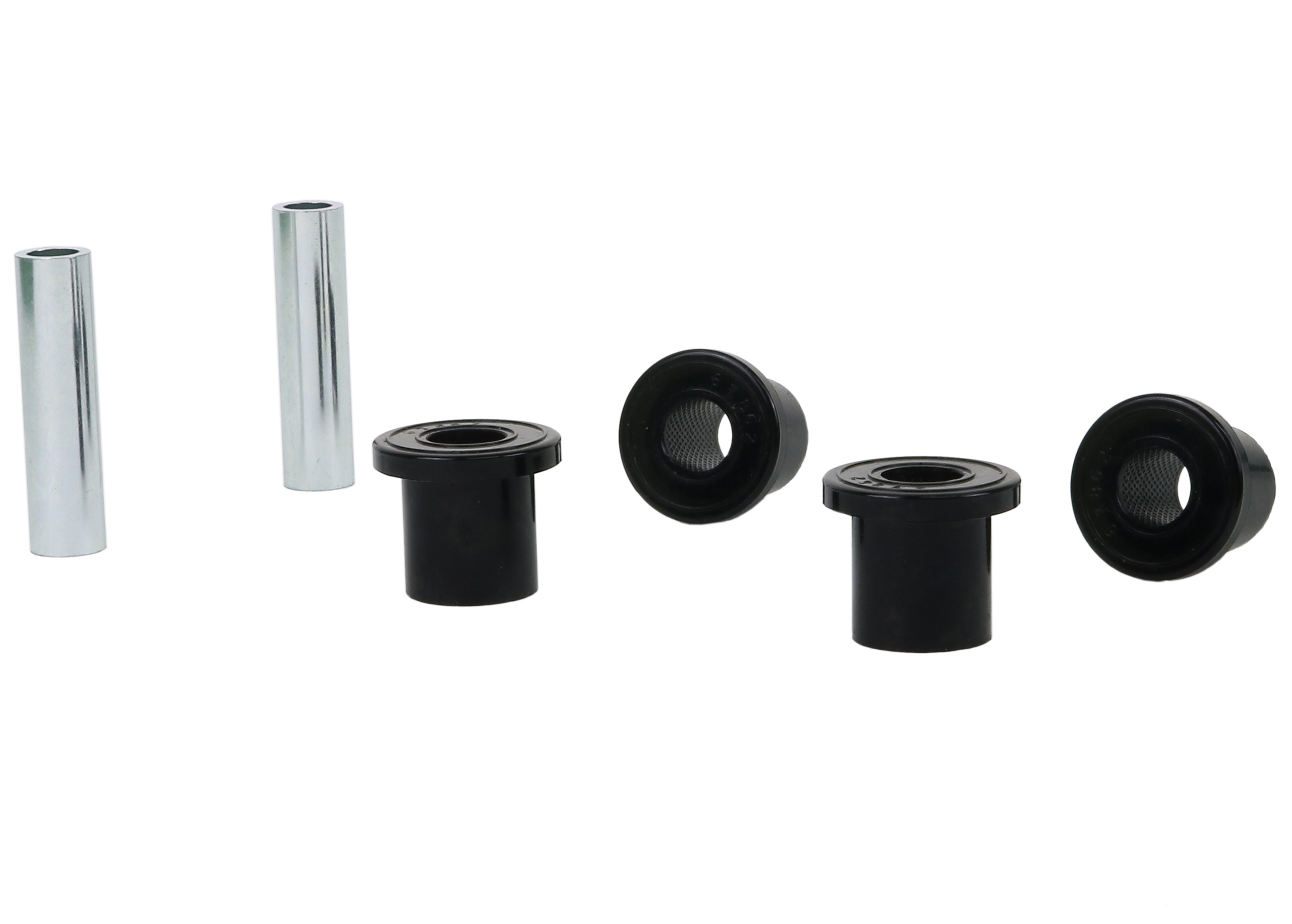
Front Spring - Shackle Bushing
✅ Fits 1988 Jeep Wrangler Sahara Pre-OrderAvailable for Preorder. Stock due on 08-Nov-2026.Available for Preorder. Stock due on 08-Nov-2026.SKU: W73818Front Spring - Shackle Bushing
✅ Fits 1988 Jeep Wrangler SaharaPre-OrderAvailable for Preorder. Stock due on 08-Nov-2026.Available for Preorder. Stock due on 08-Nov-2026.Qty Required 1Kit Contents 4 Bushings, 2 Tubes$19.88 -
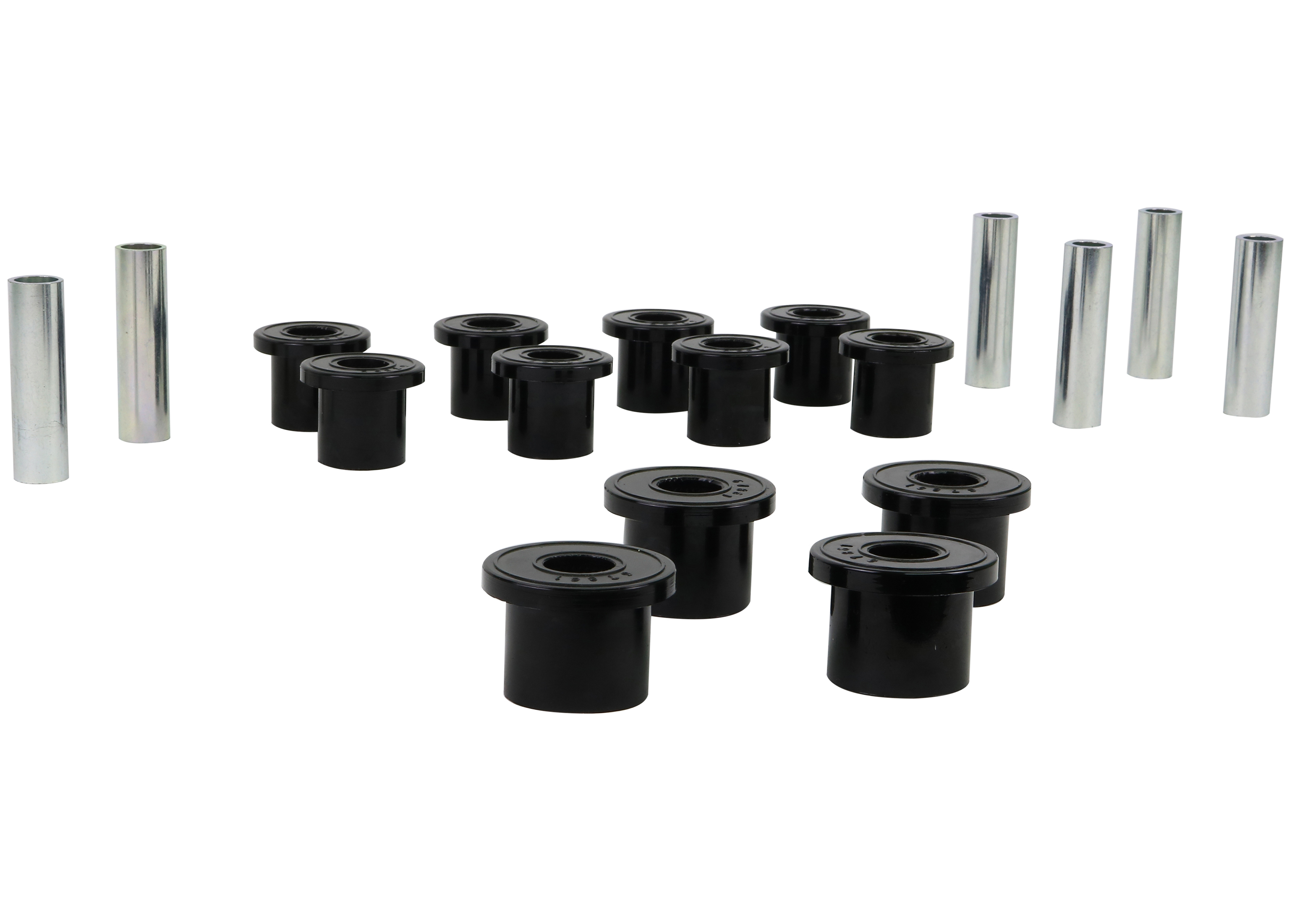
Front Spring Kit
✅ Fits 1988 Jeep Wrangler Sahara In StockShips within 24hrs.Ships within 24hrs.SKU: W73820Front Spring Kit
✅ Fits 1988 Jeep Wrangler SaharaIn StockShips within 24hrs.Ships within 24hrs.Qty Required 1Kit Contents 12 Bushings, 6 Tubes$61.88
Your vehicle
Matching vehicles
No match — try selecting it below.
Refine your search
Clear allCan’t find what you’re looking for?
Our team can help you find the right part — or tell us what was missing so we can improve the site.
Call Us +1 909-476-2860 Give Feedback (opens in a new tab)


