
 US
 Australia
 United Kingdom
 Europe

Engine Mount Bushings with Fitting Position Front, Rear for 2004 Jeep Wrangler X
IMPROVE GRIP, HANDLING & PERFORMANCE.
Open a factory motor mount and most of what you find is empty space. Those voids are deliberate, and filling them with polyurethane is what an engine mount bushing for your Jeep Wrangler does. Motor mount bushings and engine mount bushings describe the same part. How a Voided Mount Works A factory mount is a steel bracket with rubber bonded insi... Read more
Open a factory motor mount and most of what you find is empty space.
Those voids are deliberate, and filling them with polyurethane is what an engine mount bushing for your Jeep Wrangler does. Motor mount bushings and engine mount bushings describe the same part.
How a Voided Mount Works
A factory mount is a steel bracket with rubber bonded inside it, and that rubber is rarely solid.
Hollow sections are molded into it, positioned so the rubber can collapse in one specific direction while staying firm in others. That lets the engineer tune compliance precisely, soft where noise travels and firm where load does.
Under torque the engine rotates, and it rotates into the voids. The rubber folds into the empty space until the gap closes, and only then does the mount start properly resisting.
That delay is what you feel as the engine moving before the drivetrain loads up. The mount is not failing, it is doing exactly what it was designed to do.
Age makes the problem worse rather than different. As the rubber hardens and cracks, the voids open further and the collapse happens sooner.
What an Insert Bushing Actually Does
An insert fills the void rather than replacing the mount.
Shaped to match the hollow section in that specific mount, it sits in the gap the rubber was designed to collapse into. With the space occupied, the rubber cannot fold, so the mount resists from the moment torque arrives.
The original mount stays in the car throughout. Its bonded rubber still carries the load and still isolates vibration in every direction except the one being controlled.
That is why an insert changes response dramatically while changing noise relatively little. You have removed the designed collapse without removing the isolation.
It is also why fitting is so much simpler than a complete mount. On many applications the insert goes in without removing the mount at all.
Durometer and What the Numbers Mean
Polyurethane hardness is quoted in Shore A durometer, and understanding it helps when choosing between options.
Lower numbers mean softer and more compliant material. A bushing in the 70 to 80 Shore A range behaves closer to firm rubber, retaining much of the factory isolation.
Higher numbers are harder and more resistant to deflection. Something in the 90s approaches rigid, which gives maximum control and transmits considerably more.
The relationship is not linear, so a small jump in durometer produces a larger change in how the car feels than the numbers suggest.
For a street driven car, the softer end of the range usually delivers most of the response improvement for a fraction of the NVH penalty. For a track car, harder makes sense because the compromise runs the other way.
Where a manufacturer offers two durometers for the same application, that choice is the one being presented.
Checking Mounts Before You Buy Inserts
A few minutes under the hood tells you whether inserts are the right purchase.
Have someone sit in the car with the brakes firmly applied and select drive, then reverse, while you watch the engine from a safe distance. Movement of an inch or more means significant play.
On a manual, raising engine speed against the clutch at biting point produces the same information without the automatic.
Look at each mount for rubber separated from the bracket, cracks running through the material, or fluid residue around a hydraulic mount.
Check the height the mount is sitting at. An engine sitting lower than designed indicates a collapsed mount, which is a replacement rather than an insert candidate.
Note which direction the engine moves the furthest. That tells you which mount is doing the least, and therefore where the first insert should go.
Which Mount to Do First
Not every mount contributes equally, and sequencing saves money.
The mount resisting torque reaction is the one that matters most. On a transverse engine that is usually the lower torque arm below the engine. On a longitudinal layout it is whichever mount takes the rotational load rather than the weight.
The mounts carrying weight rather than torque contribute less to the vague feeling under power, so firming those first delivers less for the same money and the same NVH increase.
Working out which is which on your application is worth doing before ordering. The one that produces the biggest change is rarely the one that looks most accessible.
Doing the torque mount alone is a legitimate strategy, and plenty of owners stop there because the result is enough.
Engine and Transmission Mounts Work as a Set
Worth knowing before ordering one and expecting everything to change.
The engine and transmission are bolted together and move as one assembly. Engine mounts hold the front, the transmission mount holds the back, and the assembly pivots around whichever is firmest.
Fit inserts to the engine mounts alone and the drivetrain can still rotate around the transmission end. The movement reduces rather than disappearing, and some of it simply relocates.
That is why kits covering both ends deliver a more consistent result than either does alone, and why owners who do one and feel underwhelmed usually find the other was the limiting factor.
The same sequencing logic applies here as well. Start with whichever mount takes the torque reaction, assess the result, and add the others if the movement that remains is still bothering you.
On a manual car the transmission end matters more than people expect, since shift feel depends on the transmission staying still relative to the shifter.
Partial Filling and Why Some Kits Leave Voids
Some insert kits deliberately do not fill every cavity.
Filling every void turns a tuned mount into a near solid one, which removes compliance the engineer put there for reasons beyond noise, including accommodating thermal expansion and manufacturing tolerance.
Partial filling targets the void that collapses under torque while leaving the others working, which keeps the mount's original behavior in the directions that were not the problem.
That is why a kit may supply fewer pieces than there are cavities, and why fitting extra material into the remaining spaces is not an improvement.
Follow the kit's orientation and position instructions rather than filling everything available.
What a Bushing Cannot Fix
Worth being clear, since inserts get asked to solve problems they cannot.
A mount with the rubber separated from its bracket has lost its bond, and filling the void does not restore it. The load path is broken and the complete mount is the answer.
A hydraulic mount that has leaked its fluid is finished. Inserts cannot replace the damping that fluid provided, and the mount needs replacing.
A cracked bracket is a structural fault in its own right. No bushing compensates for metal that has failed.
And collapse, where the mount has lost enough height that the engine sits lower than designed, changes driveline angles. That needs the mount replaced rather than firmed.
Inspect what is actually there before ordering anything. Inserts suit a mount that is intact and simply too soft.
Street and Track Expectations
Being honest about the outcome avoids disappointment later.
On a street car with original mounts, inserts sharpen throttle response noticeably and tighten up shift feel. Idle vibration increases slightly and most owners describe it as acceptable.
On a tuned car making meaningfully more torque than standard, the change is larger because there was more movement to remove in the first place.
On a track car, inserts are usually a starting point rather than an endpoint, with complete mounts following once the compromise stops mattering.
Diesel and four cylinder engines transmit more at idle than a smooth six or eight, which is worth factoring into the durometer choice rather than discovering afterward.
Fitting Insert Bushings on Your Jeep Wrangler
Most applications allow fitting without removing the mount, which is the main practical advantage.
Clean the void out thoroughly before anything is fitted into it. Years of road grime builds up in those cavities and an insert seated on debris will not sit correctly.
Use the lubricant supplied or a silicone based product, since petroleum grease degrades polyurethane over time.
Observe the orientation marked on the kit itself. Inserts are frequently shaped for one position and fitting one rotated reduces or removes its effect.
Check for clearance once fitted, particularly where the mount sits close to a subframe, a driveshaft or an exhaust component.
Expect the character to change immediately rather than needing bedding in, since nothing is wearing into position.
Find Engine Mount Bushings for Your Jeep Wrangler
Want more drivetrain control? Explore the full engine bushings lineup.
Select your Jeep Wrangler to see the engine mount bushings and insert kits available for it. If the mounts are intact and simply soft, inserts are the sensible first step before considering complete replacements.
1 item
-
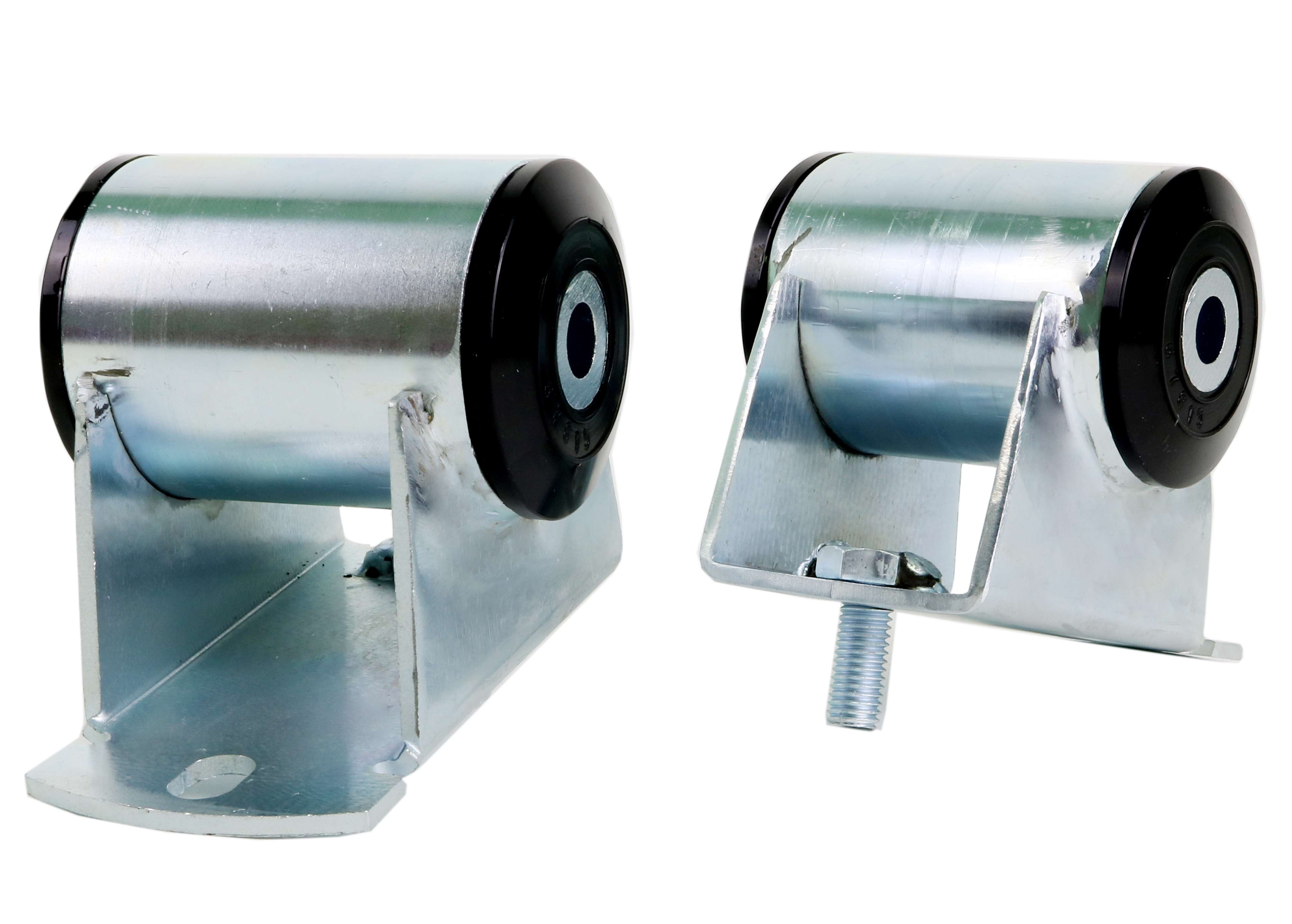
Front Engine - Mount
✅ Fits 2004 Jeep Wrangler X Pre-OrderAvailable for Preorder. Ships within 4-6 weeks.Available for Preorder. Ships within 4-6 weeks.SKU: W93530Front Engine - Mount
✅ Fits 2004 Jeep Wrangler XPre-OrderAvailable for Preorder. Ships within 4-6 weeks.Available for Preorder. Ships within 4-6 weeks.Qty Required 1Kit Contents 2 Mounts$74.88
Your vehicle
Matching vehicles
No match — try selecting it below.
Refine your search
Clear all- Bushings 10
- Coil Spring Spacers 3
- Leaf Spring Bushings 1
- Sway Bar Bushings 3
- Sway Bar Link Bushings 1
- Track Bar Bushings 1
- Trailing Arm Bushing 1
- Control Arms 1
- Control Arm Kit 1
- Control Arm Kit - Upper 1
- Engine Bushings 1
- Engine Mount Bushings 1
- Universal Auto Parts 1
- Universal Bump Stops 1
No categories match.
Can’t find what you’re looking for?
Our team can help you find the right part — or tell us what was missing so we can improve the site.
Call Us +1 909-476-2860 Give Feedback (opens in a new tab)


