
 EU
 Australia
 United Kingdom
 United States

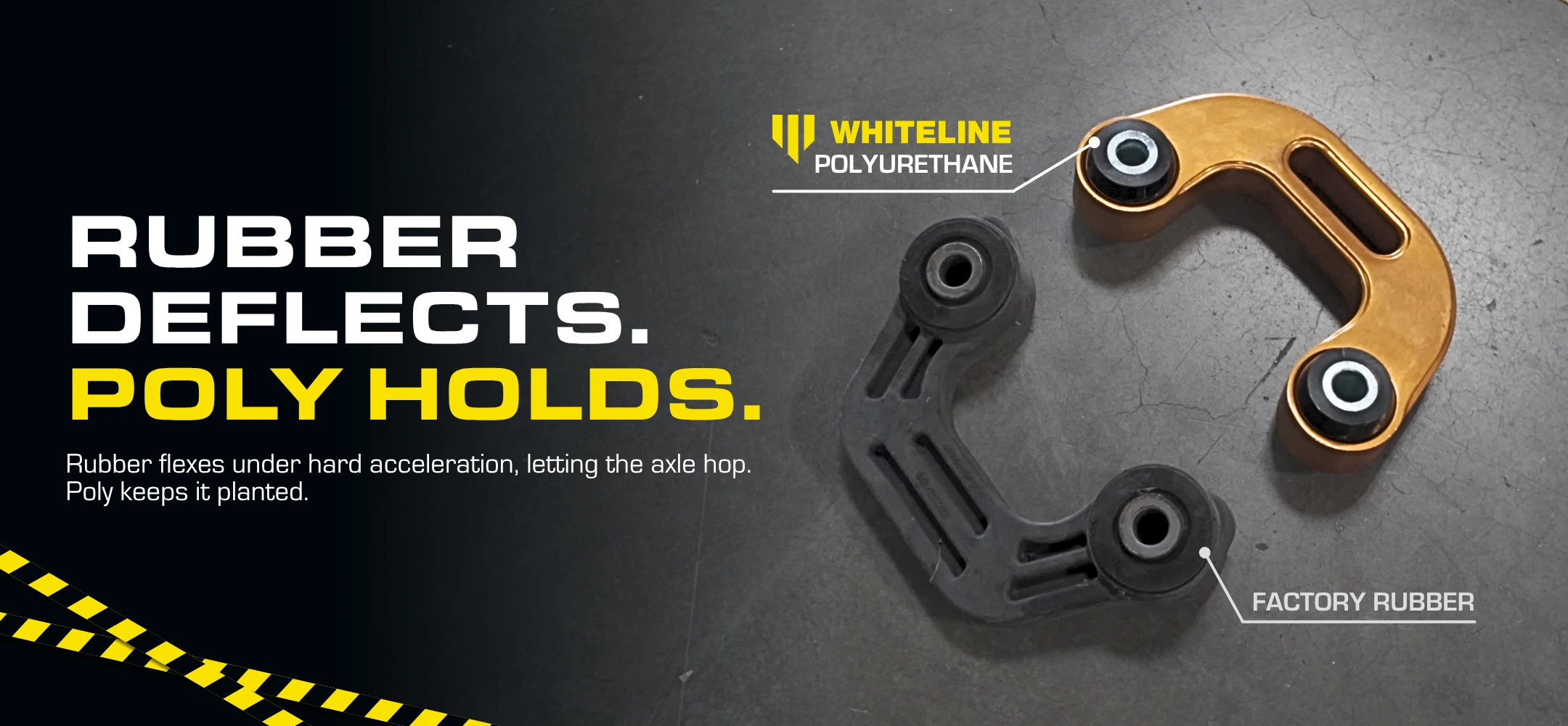

Polyurethane holds suspension geometry under load where factory rubber deflects, so the car goes where you point it on a normal street drive as well as on track. The ride gets firmer without getting harsh when hardness and design suit each position, and a correctly greased bushing stays quiet.
Every time we post about bushings, the same four comments turn up within the hour: it's placebo, poly is only for the track, it'll ruin my daily, and it's a waste of money. We welcome all of them, because each one is a fair question and deserves evidence rather than a sales line. Whether polyurethane bushings are worth it comes down to what a bushing does when the car is loaded, so we asked Mike Kojima of MotoIQ to take each objection apart on camera. Watch the video above, then read on for the detail behind every answer and the parts we recommend in the Whiteline polyurethane bushing range.
A quick note on words, because this page is read in four markets. A bushing is a bush in the UK and Australia, a sway bar is an anti-roll bar, and a control arm is a wishbone, but the parts and the physics are identical.
What does a suspension bushing actually do?
Every pivot in your suspension sits in a bushing: the control arms, the sway bar, the subframe and, on many cars, the differential. Its job is to let each arm rotate on the axis the engineers designed and to stop it moving anywhere else.
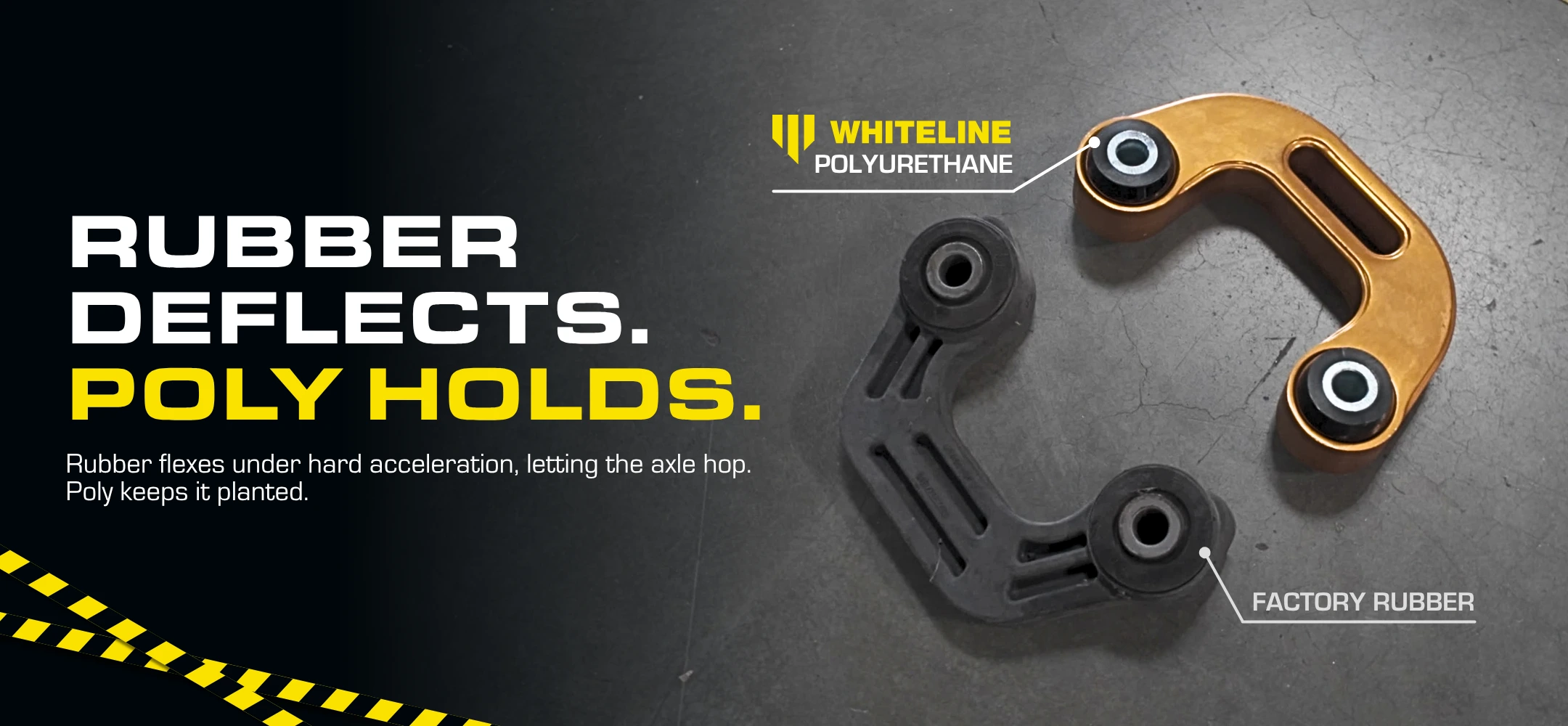
Factory rubber tries to do two jobs at once. It is bonded to an inner and outer sleeve, so it twists to allow the arm to pivot and squashes to soak up road noise. The softness that makes it quiet also lets the arm shift when cornering, braking and acceleration loads arrive. That unwanted movement is called deflection, and it is the gap between where you point the car and where it actually goes. Everything below follows from that one idea.
Is the difference from polyurethane bushings just placebo?
No, because deflection is physical and you can measure it. When a rubber bushing gives under load, your alignment changes with it: toe and camber move as you corner, and caster drops away as you brake. Turn the wheel and the bushing deflects first, and only then does the tire start building grip. Drivers describe that delay as vague turn in, and it is exactly what polyurethane shrinks, because the material is far stiffer in the directions that matter.
Mike makes the point with cars the factory built itself, comparing the Corolla against the GR Corolla and the Civic against the Civic Type R. If the difference were imaginary, the people who engineer performance models would have no reason to treat compliance differently.
Are polyurethane bushings only for the track?
Deflection does not wait for a 1g corner. It happens on every on ramp, every lane change, every hard stop at a light and every bump you hit halfway through a bend, which is where you spend almost all of your driving. On the street, polyurethane gives you sharper steering response, a car that stays settled over mid corner bumps, less dive and shimmy under braking, and less wheel hop when a powerful car launches.
The track simply makes the same effect bigger and easier to feel lap after lap. If you do run track days, we cover what changes at the limit in polyurethane vs rubber bushings on track.
Will polyurethane bushings ruin a daily driver?
Not when they are designed properly, and we won't pretend there is zero trade off. You will feel a little more road texture through the car, and the size of that change depends on design and hardness far more than on the material itself. That is the central point of the video: design matters as much as material.
Multi-link suspensions show this most clearly, because as the wheel travels each link has to move in more than one direction at once. A solid block of hard urethane would bind and transmit every ripple. We design our bushings to allow directional flex where the geometry needs to articulate and to stay firm where control counts. We also select hardness per position, because a front control arm and a differential mount solve different problems. The result is a firmer, more refined ride rather than a harsh one.
Most of the impact harshness people blame on bushings actually comes from tire sidewall, wheel size, springs and dampers. If comfort is your worry, start with the positions that give the most control for the least change in feel: the front control arm bushings and the sway bar bushings.
Do polyurethane bushings squeak?
Only when something has gone wrong at install, and the cause is almost always the grease. A urethane bushing works as a plain bearing, so a dry bore, a petroleum based grease or a bore too tight to hold lubricant makes the surfaces stick and slip. Our bushings use a knurled inner diameter that holds grease in place, and we supply the correct grease with our kits. The full explanation sits in the best grease for polyurethane bushings.
Are polyurethane bushings a waste of money?
Rubber wears out in a predictable way. Oil, ozone and heat attack it, it cracks, and it eventually tears away from its sleeve, so swapping worn rubber for new rubber starts the same cycle again. Polyurethane resists oil and ozone, it does not delaminate, and it can be serviced by regreasing the bore instead of replacing the whole part. Every Whiteline bushing is backed by our lifetime warranty.
If your factory bushings are already worn, the labor is much the same whichever material goes in, so the upgrade costs you only the difference in parts, and the car keeps steering and braking the way its geometry was set up to.
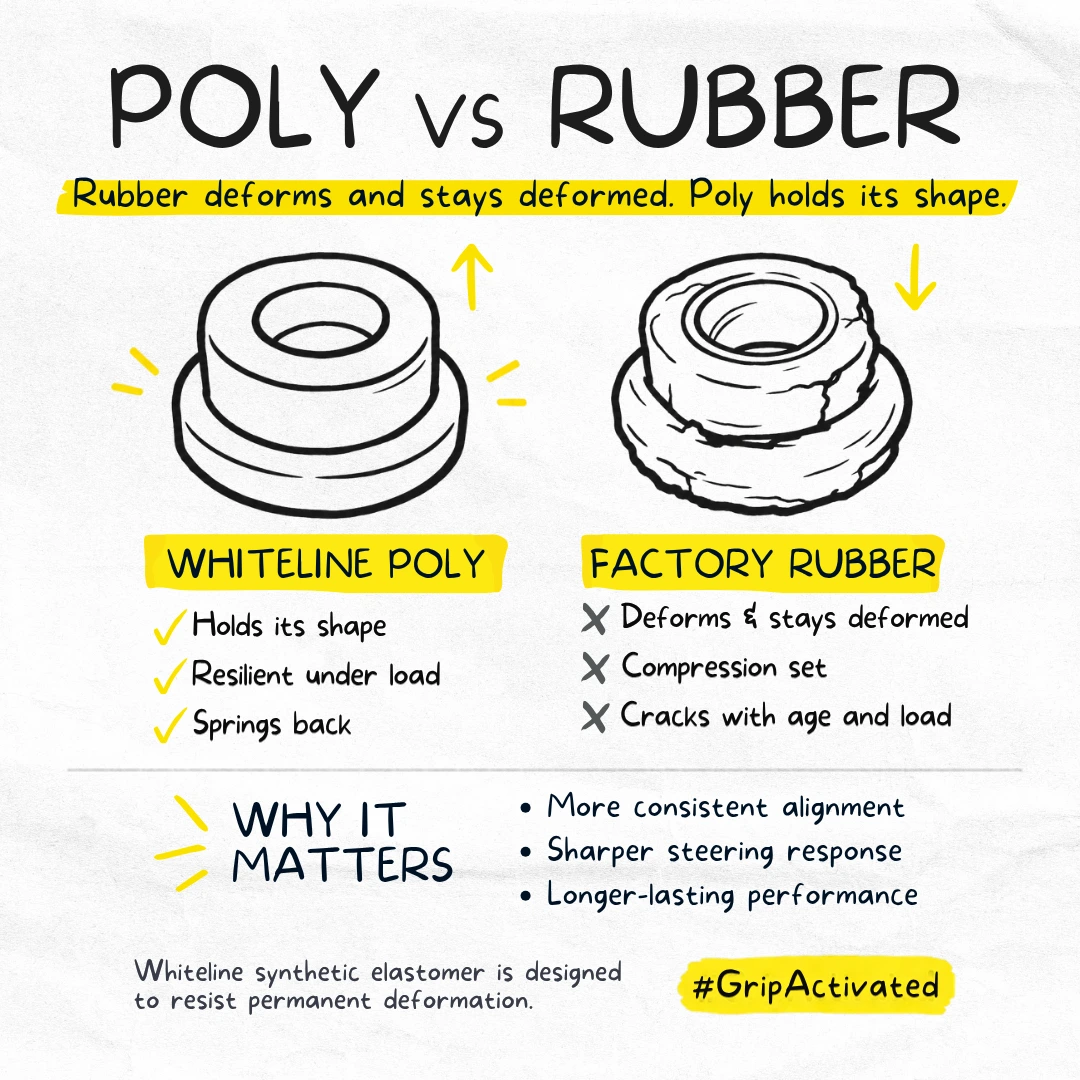
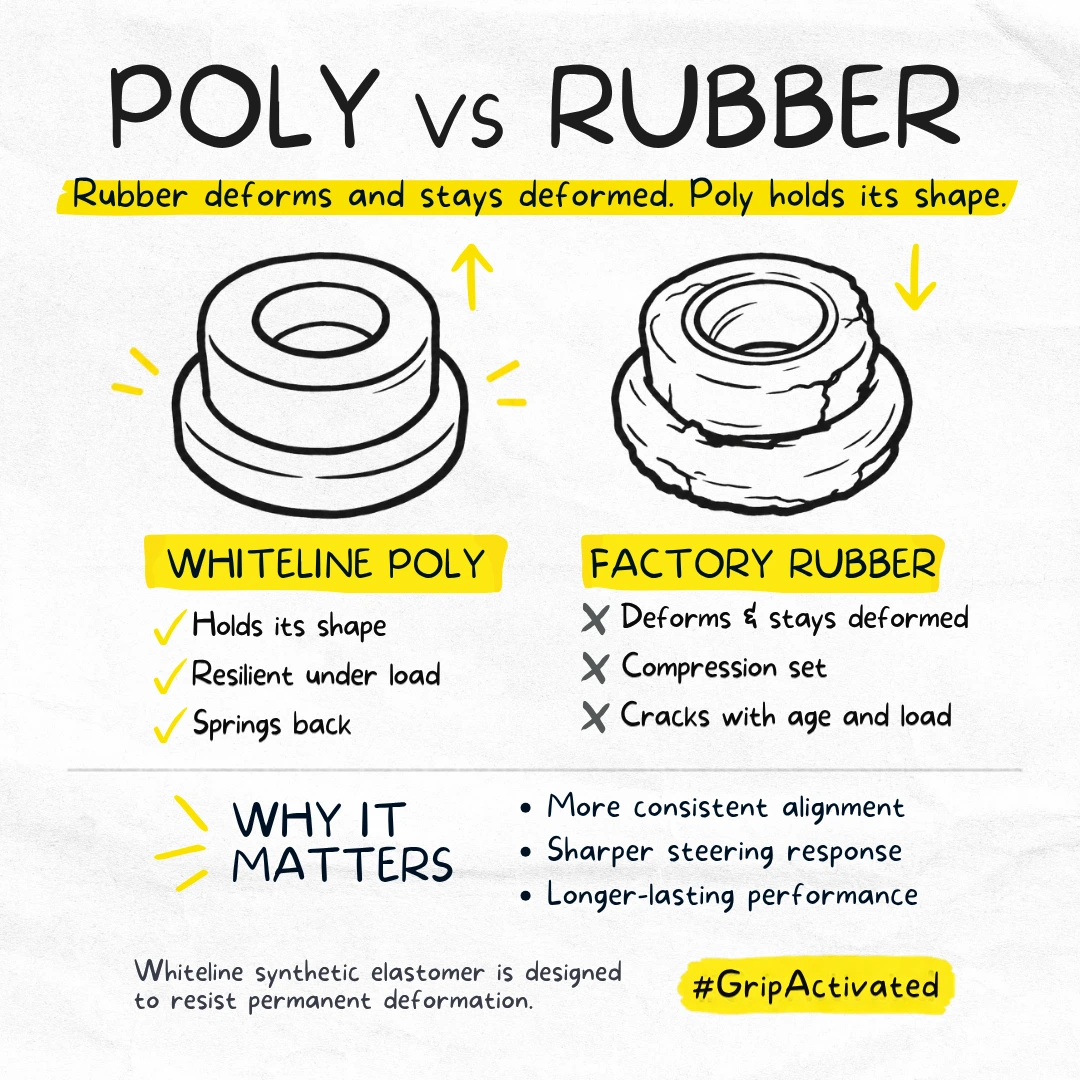
Rubber against Whiteline polyurethane on a street car
|
What you notice |
Factory bonded rubber |
Whiteline polyurethane |
|
Steering response |
Delay while the bushing deflects |
Immediate, the tire responds to the input |
|
Mid corner bumps |
Car shifts as geometry moves |
Stays settled on its line |
|
Hard braking |
Caster drops, front end can wander |
Holds the caster you set |
|
Hard launch |
Prone to wheel hop on powerful cars |
Axle held in place, less hop |
|
Road texture |
Lowest |
Slightly more, controlled by design and hardness per position |
|
Resistance to oil, ozone and heat |
Poor, cracks and softens |
High |
|
Servicing |
Replace the whole bonded part |
Regrease the bore |
|
Warranty |
Vehicle manufacturer part warranty |
Lifetime Warranty |
So, are polyurethane bushings worth it for your car?
They are worth it if you care how your car steers and brakes, if it is lowered or making more power than stock, if you do the odd track day, or if your factory rubber is worn and due for replacement anyway. Each of those owners gains control they will feel on the first drive. Choose a well designed bushing, grease it correctly, and start with the positions that matter most.
Polyurethane Bushing FAQs
Looking for more information about polyurethane bushings? Below we answer the most commonly asked questions
Are polyurethane bushings worth it on a stock car?
What are the downsides of polyurethane bushings?
Can you actually feel the difference between poly and rubber bushings?
Which is better, rubber or polyurethane bushings?
How long do polyurethane bushings typically last?
Is Red N Tacky good for polyurethane bushings?
Are poly bushes worth it on a daily driver?
Who is Mike Kojima?
Seen enough comments arguing about it? Watch the full video, tell us in the comments what you drive and what changed when you made the switch, then find the right parts for your car in the Whiteline polyurethane bushing range. Activate More Grip. #GripActivated


