
 EU
EU Australia
 United Kingdom
 United States
What actually fixes body roll on a Tesla Model 3?
When it comes to keeping your Model 3 flat through a corner, the sway bars are doing the real work. Springs and dampers help with ride quality, but they barely make a dent in body roll. That job belongs to the bars. Whiteline's 30mm 3-position adjustable front bar runs anywhere from 10.3% to 44.0% stiffer than the factory bar, depending on which mounting hole you choose, and the 24mm rear bar takes it further at 154.2% stiffer. That added stiffness is exactly what keeps the car composed and level when you push it into a bend.
Why a Model 3 leans in the first place
The car is heavy and the mass sits low, which flatters it, but there is still around two tons wanting to keep going straight when you turn the wheel. Load transfers across to the outside tires, the body rolls on its springs, and the outside front tire ends up carrying far more of the work than the inside one. Grip is not linear with load, so an unevenly loaded pair of tires generates less total grip than an evenly loaded pair.
That is the whole argument for a sway bar. Reduce roll and you spread lateral load more evenly across the tire contact patches. More even loading means more cornering grip, sharper response to steering input, and less of the delayed, leaning sensation that makes a fast Model 3 feel slower than it is.
Why springs are the wrong tool for this job?
Owners chasing flatter cornering usually reach for lowering springs first, and they are half right. Lowering the center of gravity reduces the leverage the mass has over the roll axis, so roll does reduce a little. Stiffer springs also resist roll to a degree.
The problem is that springs control every vertical movement, not just roll. Stiffen them enough to make a real difference to cornering and you have also stiffened the car's response to every bump, expansion joint and manhole cover. You get flat cornering and a punishing ride, which is the trade most people are trying to avoid.
What the numbers actually are
Whiteline publishes the effective stiffness change at every adjustment position, which almost nobody in this segment does. Here is what you are buying.
Front bar: BTF101Z
|
Setting |
Effective bar size |
Stiffer than OE |
|
Soft, comfort biased |
29mm |
+10.3% |
|
Medium, balanced |
30mm |
+26.3% |
|
Hard, maximum roll control |
31mm |
+44.0% |
Rear bar: BTR101XZ
|
Setting |
Effective bar size |
Stiffer than OE |
|
Soft |
23mm |
+82.1% |
|
Medium |
24mm |
+115.9% |
|
Hard |
25mm |
+154.2% |
Those rear figures look startling next to the front. The factory rear bar on this platform is soft, deliberately, because a soft rear bar biases the car toward understeer and understeer is the safe default for a mass market vehicle. Fitting a substantially stiffer rear bar is what unlocks rotation and neutral balance, and it is the single change that most alters how a Model 3 feels in a corner.
Front bar, rear bar, or both?
Depends what you want the car to do.
Rear bar only: The most transformative single change for the money. Reduces roll and shifts balance away from understeer, so the car turns in more willingly and settles earlier on the exit. Choose this if your complaint is that the car pushes wide and feels reluctant to change direction.
Front bar only: Reduces roll and adds a little stability, with a mild move toward understeer. Choose this if the car already feels lively at the rear and you want composure rather than agility.
Both: Roll control front and rear with balance you can tune yourself, because both bars are 3 position adjustable. Start both on medium, drive it, then move one end at a time. The BTK019 vehicle kit for the Model 3 bundles a front and rear bar with drop links, saddles and lateral locks.
Adjustability is the part people underrate
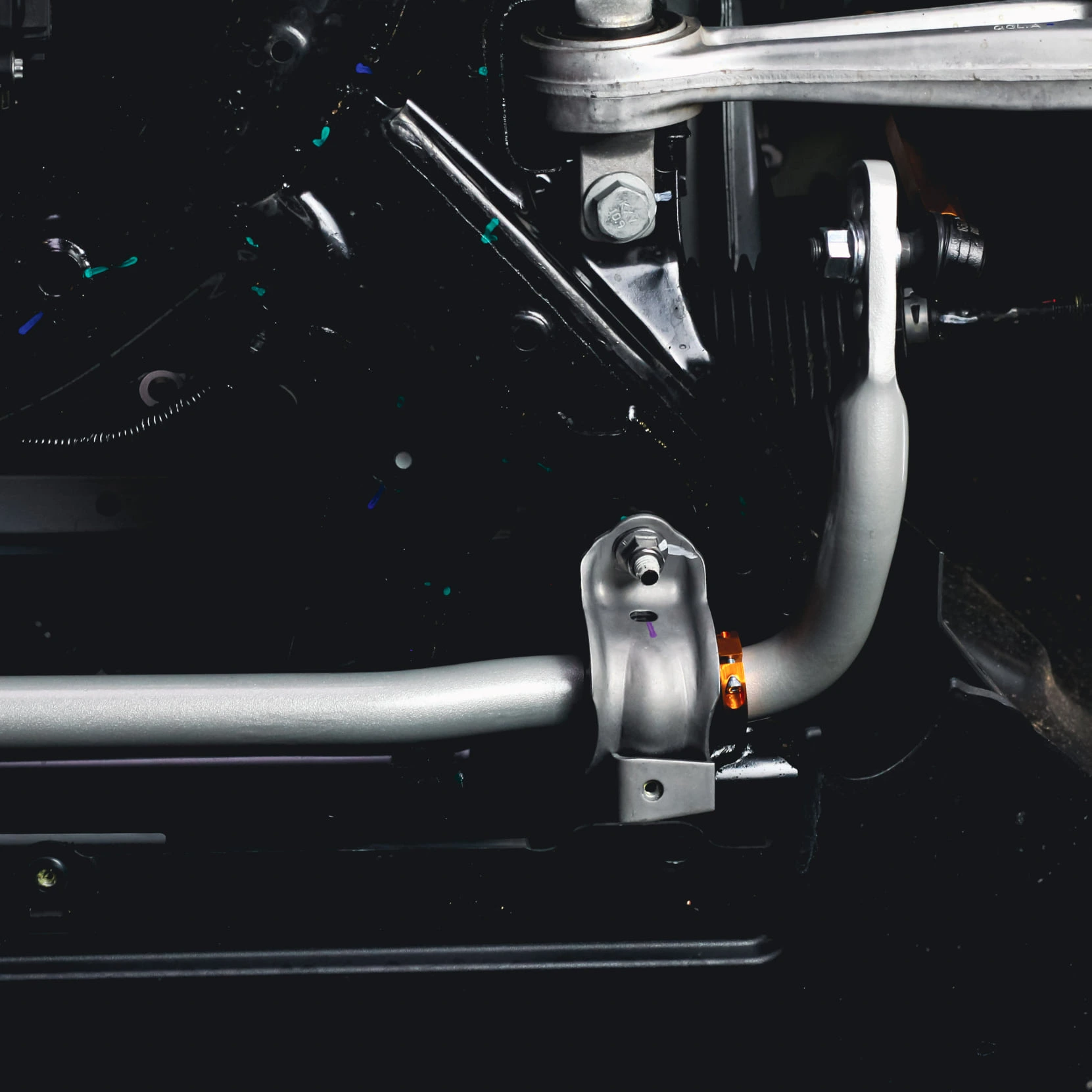
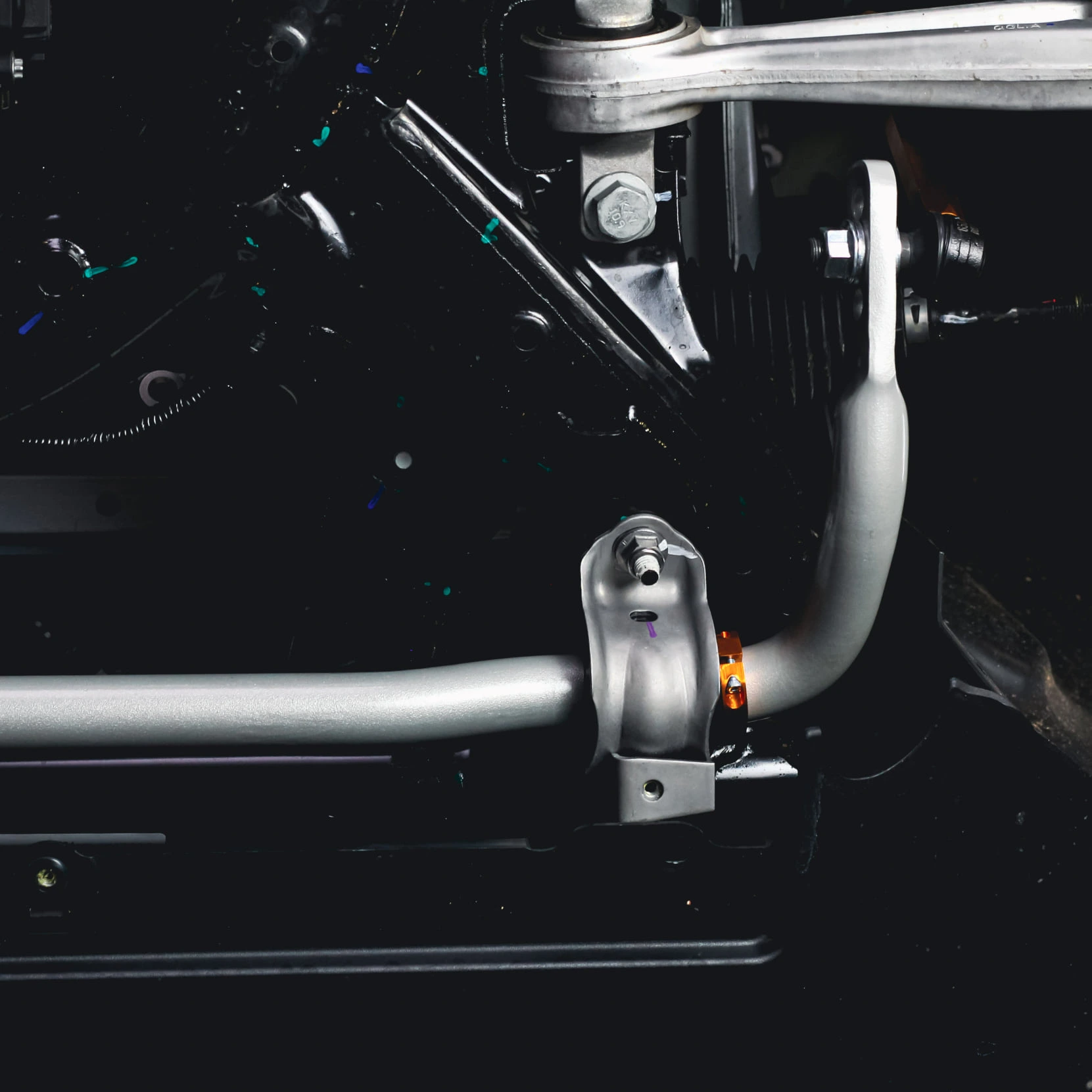
A fixed bar is one engineer's opinion about how your car should handle. A 3 position adjustable bar lets you set it for the way you actually drive, then change your mind later at no cost. Same bar, different hole, measurably different behavior. Soft for a commute on poor roads, hard for a track day, and you can reset it in the paddock.
Fit the adjustable sway bar drop links alongside them. Whiteline's KLC180-295 front and KLC102 rear links let you remove preload from the bar during installation, and a bar installed with preload works harder on one side than the other, which is precisely the imbalance you fitted it to fix.
What a sway bar does not change
It will not lower your car, it will not fix a worn bushing or a tired damper, and it will not soften a harsh ride. It also will not make a clunk go away. If your Model 3 has developed noise or a vague, loose feeling rather than a leaning feeling, the cause is more likely a worn component than a soft bar, and a stiffer bar will not disguise it.
One genuine upside worth knowing: because load is spread more evenly across the tires, sway bars typically improve tire wear rather than worsen it. Whiteline rates the front bar at two hours to install with no wheel alignment required, so there is no alignment cost attached either.
Frequently asked questions
Looking for more information about Tesla Model 3 sway bars? Below we answer the most commonly asked questions
Does a sway bar make the ride harsher on a Model 3?
Which sway bar should I fit first on a Model 3?
How much stiffer than stock is the Whiteline front bar?
Do I need an alignment after fitting a sway bar?
Will a stiffer rear sway bar make my Model 3 oversteer?
Can I fit these bars to a Model Y?
What is the sway bar made from?
Activate more grip, and pick your own balance
Flat cornering, more even tire loading, and three settings you can change whenever you like. Shop Whiteline performance sway bars, or go direct to the 30mm adjustable front bar and the 24mm adjustable rear bar.
Explore the full range of Whiteline EV suspension upgrades and select your Model 3 to confirm fitment.


