
 EU
EU Australia
 United Kingdom
 United States
How much does a Tesla Model Y control arm replacement cost?
Whiteline supplies Model Y control arms as complete assemblies with ball joints included: WA532 front lower latera, WA533 front upper, WA607 front lower compliance, all per pair. Add labor of roughly two and a half to four hours and a front wheel alignment. Service Center quotes commonly run into four figures.
Why the bill gets large
Three things stack up, and only one of them is the part.
The arms are unserviceable assemblies: The ball joint is pressed into the arm and is not designed to be replaced on its own. A worn joint therefore means a complete new arm, even though the arm itself is fine.
They tend to wear in sets: A Model Y carries around two tons through the same joints and bushings, so when one front arm has had enough, its neighbors are usually close behind. Owners frequently end up replacing several arms at once, which is how a parts bill in the hundreds becomes a total in the thousands.
An alignment is mandatory afterwards: Whiteline specifies a front wheel alignment as required for these arms, and a vehicle warranty typically excludes alignment work regardless, so that cost lands on you either way.
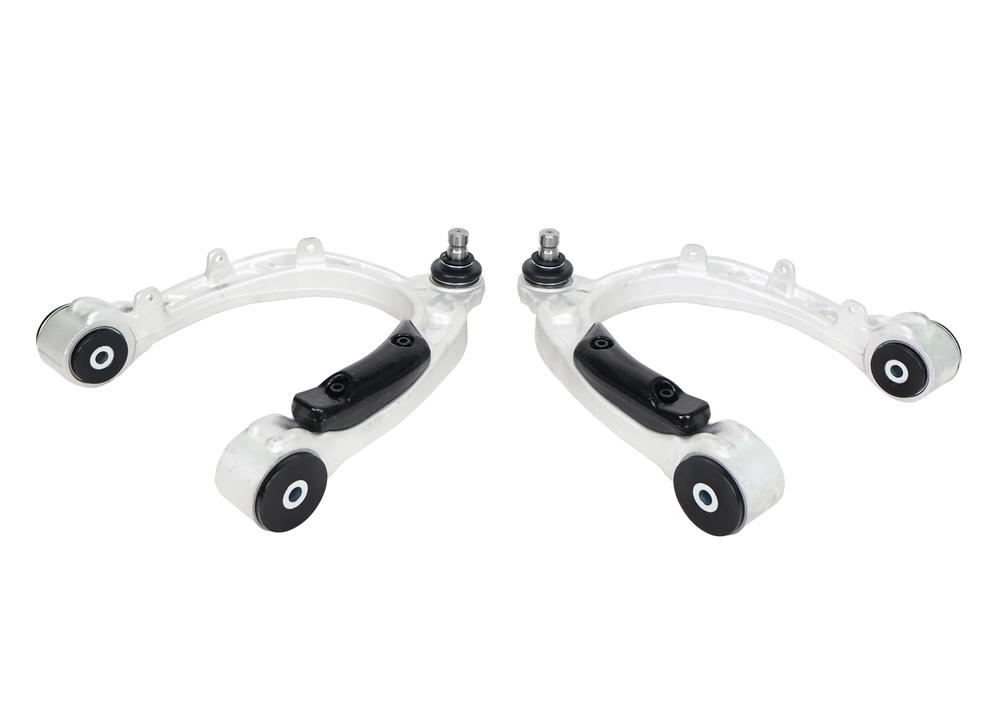
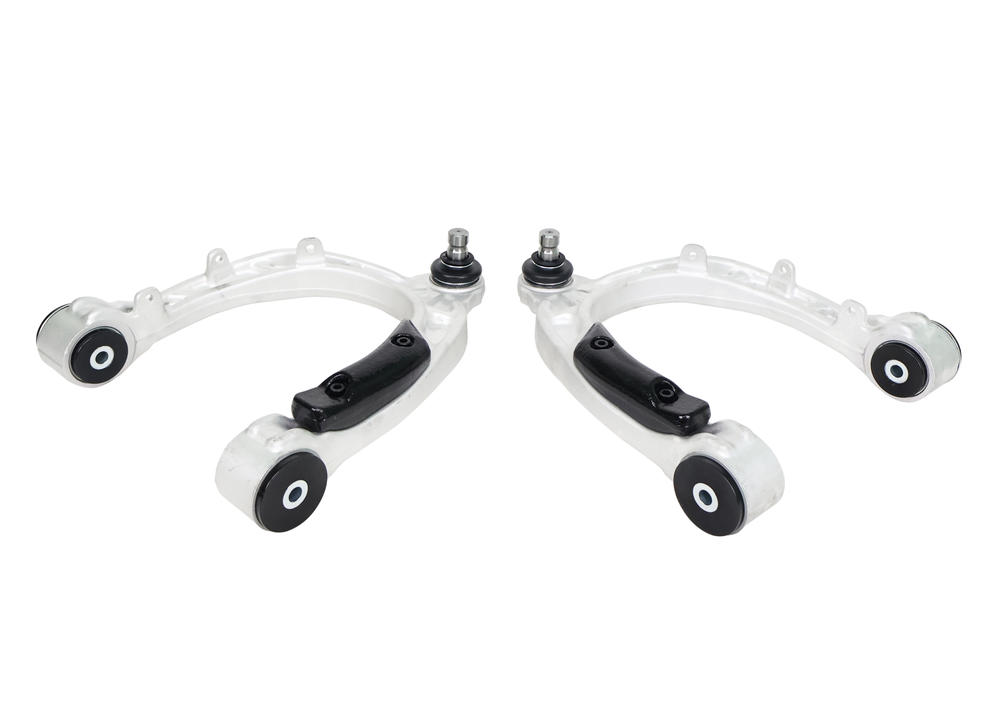
Whiteline Model Y control arm range
|
SKU |
Position |
Bushing type |
Install |
Alignment |
|
WA532 |
Front lower lateral |
OE style rubber |
2.5 hours |
Front alignment required |
|
Front upper |
Whiteline synthetic elastomer |
2.5 hours |
Front alignment required |
|
|
Front lower compliance |
Whiteline |
4 hours |
Front alignment required |
|
|
KTA368 |
Front upper, adjustable alloy |
minus 3.0 to plus 0.5 degrees camber |
Varies |
Yes |
|
Rear upper rear, adjustable camber |
Adjustable |
Varies |
Yes |
|
|
KTA328 |
Rear upper front, adjustable traction |
Adjustable |
Varies |
Yes |
|
KTA329 |
Rear lower rear, adjustable trailing |
Adjustable |
Varies |
Yes |
|
W56417 |
Front upper control arm bushing kit |
Elastomer |
Varies |
Front alignment required |
|
KCA561 |
Front lower lateral, sealed spherical bearing |
Bearing |
Varies |
Yes |
Warranty terms vary by part and region, with much of the US range covered by a Limited Lifetime warranty. Confirm for the specific part you order.
The symptoms, in the order owners usually notice them
A creak or groan turning at low speed: Reversing out of a driveway, maneuvering in a parking lot. Typically the front upper control arm ball joints. Tesla has published its own procedure to reseal these on earlier vehicles and described the condition in its own words as a noise issue.
A crunch or grinding when turning sharply at low speed, or turning lock to lock while stationary. More often the front lower compliance or radius arm bushing.
Steering that has gone vague, or a car that wanders slightly on the highway and needs constant small corrections. This is bushing deflection. The wheel is no longer held precisely where the geometry intends.
Inner shoulder tire wear: Often blamed entirely on alignment, frequently caused by a worn bushing letting camber and toe move under load. Covered in our guide to Model Y inner edge tire wear.
A knock or clunk from one corner over a sharp bump. Have this inspected promptly by a qualified workshop. A knock can be a worn bushing and it can also be something requiring immediate attention, and the two are indistinguishable from the driver's seat. This is not a symptom to research and monitor.
Owners commonly begin reporting wear in these components past roughly 40,000 miles, though driving conditions and road quality move that considerably.
Why replacing like for like sometimes means doing it twice
This is the part rarely said out loud. If the original arm design is what wore out, fitting the same design again delivers the same service life. Owners on their second or third set of front arms are not unlucky, they are running into a characteristic.
Whiteline gives you a way out of that loop, and the choice is deliberate:
WA532 uses high durometer rubber bushings. The straight replacement if your goal is stock feel with no change in noise or compliance.
WA533: uses Whiteline polyurethane bushings. Which resists deflection under load far better than rubber, which is exactly the weakness the original design has on a vehicle of this weight. You get wheel location that stays accurate as cornering loads build, steering that stops going vague, and a bushing that does not progressively soften. Whiteline developed the material specifically for the higher curb weights and load spikes that electric vehicles generate, with NVH kept in mind so the cabin stays quiet.
The usual objection is that a firmer bushing must mean a noisier car. A well engineered elastomer is tuned rather than simply hardened, so what you notice is precision returning, not harshness arriving.
Should you upgrade to adjustable arms while you are in there?
Worth considering, because the labor is already being paid for.
KTA368 adjustable alloy front upper arms give minus 3.0 to plus 0.5 degrees of camber adjustment. Useful if the car is lowered, if it is wearing inner tire shoulders, or if you want alignment control the factory arms cannot provide.
KTA326, KTA328 and KTA329 add adjustable rear camber, traction and trailing arm settings. On a platform where factory rear camber tolerance spans a wide range, being able to set a number rather than accept whatever falls inside that range is what makes rear tire life predictable.
KCA561 replaces the front lower lateral bushing with a sealed spherical bearing, removing deflection at that position entirely. This is the choice for owners who want the alignment they paid for to stay put.
Frequently asked questions
Looking for more information about Tesla Model Y control arms? Below we answer the most commonly asked questions
How much does Model Y control arm replacement cost?
What does a worn Model Y control arm sound like?
Can the ball joint be replaced without the whole arm?
At what mileage do Model Y control arms wear out?
Is a wheel alignment needed after replacing control arms?
Will fitting aftermarket control arms affect my Tesla warranty?
Do Model 3 control arms fit a Model Y?
Is it safe to keep driving with a creaking control arm?
Replace it with a better part than the one that wore out
Complete arms, ball joints included, elastomer bushings engineered for EV loads, backed by Whiteline warranty. Shop Whiteline control arms and suspension bushings, or go direct to the Model Y front upper control arm.
See the full range of Whiteline EV suspension upgrades and select your Model Y to confirm fitment.


