
 EU
EU Australia
 United Kingdom
 United States
Tesla Model Y inner edge tire wear: camber, toe, or something else?
Feathered or scuffed inner edges usually mean toe. Smooth, even wear across just the inner shoulder usually means camber. Rear camber tolerance on this platform is wide enough that minus 2.0 degrees can be declared in specification while still consuming tires, which is why so many owners get a clean alignment report and keep wearing rubber.
Read the tire before you book anything
The wear pattern tells you the cause. Run your hand across the tread from outside to inside, then from inside to outside.
|
What you find |
Likely cause |
Fix |
|
Inner shoulder worn smoothly and evenly, rest of the tread fine |
Excessive negative camber |
Correct camber, or fit adjustable arms if range has run out |
|
Inner edge feathered, sharp one way and smooth the other |
Incorrect toe |
Alignment, corrected properly |
|
Inner shoulder worn AND the car has developed a creak or vagueness |
Worn bushing or ball joint allowing geometry to move under load |
Replace the worn component, then align |
|
Both shoulders worn, center fine |
Chronic underinflation |
Pressure |
|
Center worn, shoulders fine |
Chronic overinflation |
Pressure |
|
Patchy, cupped or scalloped |
Damper condition or wheel balance |
Inspect dampers, rebalance |
Toe is the most destructive of these by a wide margin. A small toe error scrubs a tire sideways with every rotation and can ruin a set in a few thousand miles. Camber wear is slower and more gradual.
The number that explains most of the arguments
Tesla's factory specification for this generation of platform sets rear camber at minus 1.00 degrees with a tolerance of plus or minus 1.0 degrees. Read that carefully. It means a rear camber measurement of minus 2.0 degrees sits inside factory specification.
Minus 2.0 degrees of static rear camber will wear an inner shoulder. Not immediately, but reliably. So a Service Center can measure your car, report it as within specification, and be entirely correct, while your tires continue to disappear on the inside edge. Both things are true at once, and knowing that changes the conversation from a dispute about whether the car is faulty into a decision about whether you want control of the number.
Front specification for the same generation is camber minus 0.50 degrees plus or minus 0.45, caster 5.70 degrees plus or minus 1.0, front individual toe 0.05 degrees out and rear individual toe 0.20 degrees in.
The other thing most alignments get wrong
Tesla's service documentation requires 150lb of ballast in the vehicle while alignment is measured, and states that without it the real world accuracy of the adjustment is compromised. Most shops align an empty car.
On a Model Y, with substantial weight and a tall body, the difference between empty and loaded geometry is real. An empty alignment can read perfectly and then shift the moment two people get in. If you are on your second set of prematurely worn tires despite a clean alignment report, ask whether the car was ballasted. It very likely was not.
When it is not alignment at all
An alignment measures where the wheel sits when the car is stationary on a rack. It says nothing about where the wheel goes when the car is loaded up mid corner or braking hard.
That is bushing territory. As bushings soften and deflect, the wheel moves under load even though the static measurement is perfect. The tire is then running at an angle nobody ever measured. This is why a car can be aligned correctly, twice, and still wear tires, and it is the diagnosis most commonly missed.
Two tells that point here rather than at the alignment rack:
· The wear appeared or accelerated on a car with meaningful mileage on it, particularly past roughly 40,000 miles.
· There is a noise or a new vagueness in the steering alongside the wear. Wear plus noise is nearly always a
component, not a setting.
The parts that let you fix it properly
Rear adjustment. KTA326 adjustable rear upper camber arms give you camber control, KTA327 gives adjustable rear toe and KTA329 adjustable trailing arm setting. Given how wide the factory rear camber tolerance is, this is the difference between accepting whatever your car happened to be built with and specifying a number you chose.
Front camber. KTA368 adjustable alloy front upper control arms provide minus 3.0 to plus 0.5 degrees of adjustment, which covers a lowered street car through to a track setup from a single part.
Bushing accuracy. W56417 replaces the front upper control arm bushings with Whiteline synthetic elastomer, which holds its shape under the loads a two ton vehicle generates instead of deflecting progressively like rubber. KCA561 goes further at the front lower lateral position, replacing the bushing with a sealed spherical bearing so the geometry simply does not move. If you want the alignment you paid for to still be there in a year, that is the part.
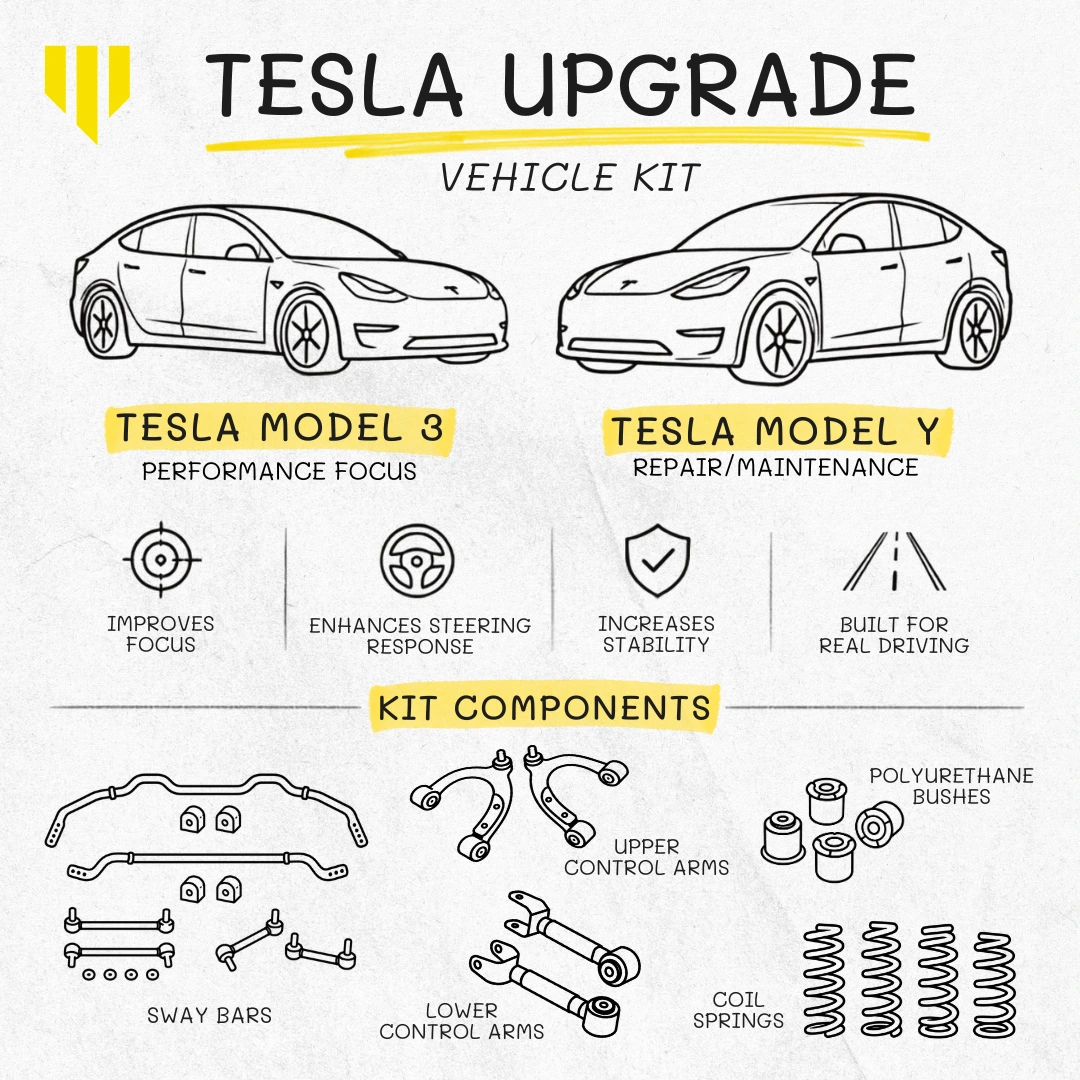
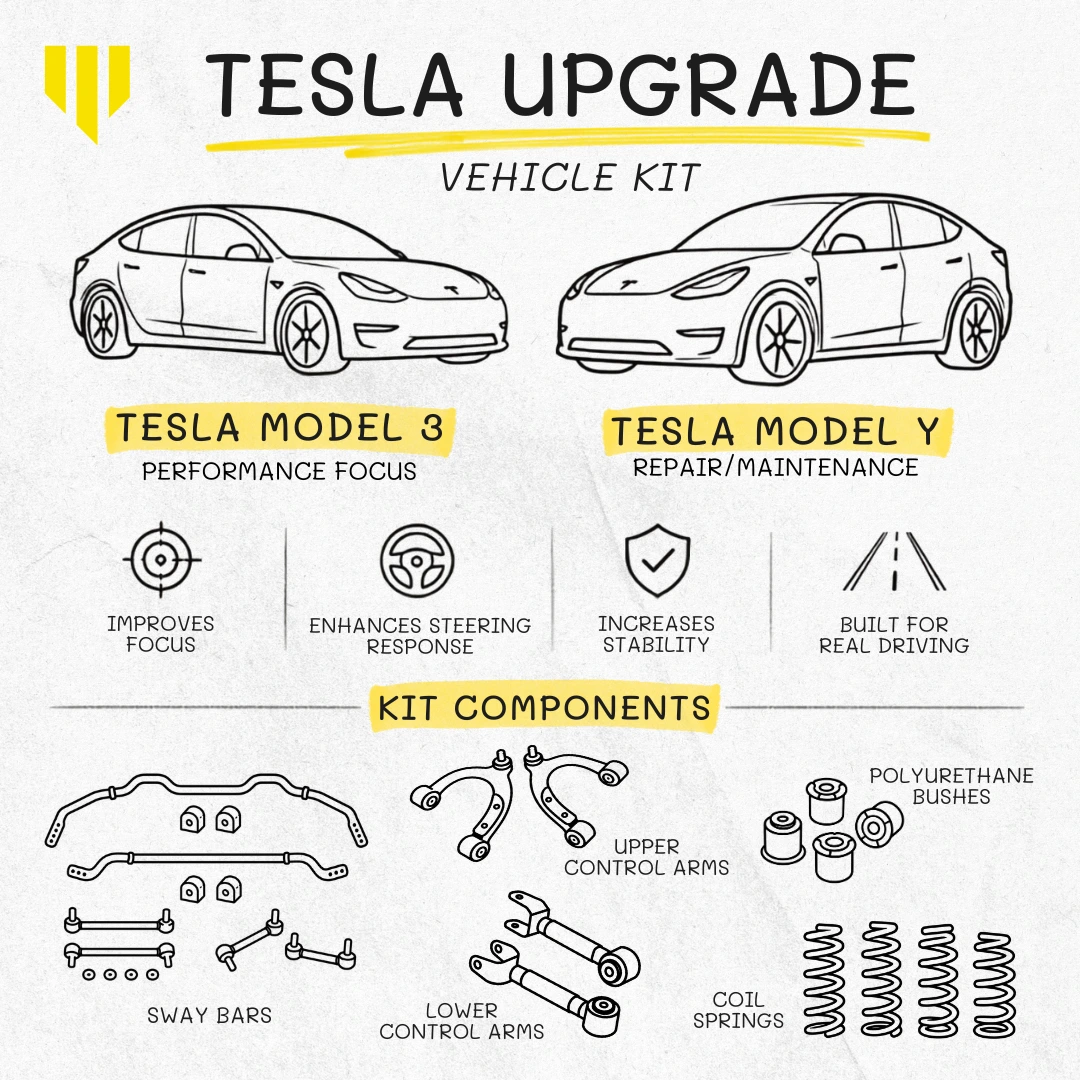
Caster. KCA531 adds 0.75 degrees of caster with anti lift geometry, KCA532 adds 0.7 degrees. Caster does not cause inner edge wear directly, but it improves straight line stability and steering self centering, which reduces the small constant corrections that scrub tread.
Worn arms. If the wear is accompanied by noise, replace the arm rather than chase the setting. Whiteline supplies complete Model Y arms with ball joints included, covered in our guide to Model Y control arm replacement.
A sensible sequence
1. Check and correct tire pressures cold, and confirm what your placard actually specifies.
2. Inspect for play and listen for noise. Any noise means the component comes first, before the alignment.
3. Get an alignment, ballasted, with the numbers printed before and after. Prioritize toe accuracy.
4. If camber cannot be brought where you want it, the factory adjustment range has run out and adjustable arms are
the answer, not another alignment.
5. Rotate tires on schedule and re check geometry after any suspension work or a significant impact.
The alignment specification detail and what to hand your technician is in our guide to Model 3 and Model Y alignment after lowering
Frequently asked questions
Looking for more information about Tesla Model Y tire wear and alignment? Below we answer the most commonly asked questions
Why is my Tesla Model Y wearing the inside edge of its tires?
Is minus 2 degrees of rear camber acceptable on a Model Y?
Will a wheel alignment fix uneven tire wear?
Why do my tires still wear after two alignments?
Do I need adjustable control arms on a Model Y?
Can tire pressure cause inner edge wear?
How often should a Model Y be aligned?
Stop replacing tires, start controlling the geometry
Adjustable arms, elastomer bushings and sealed spherical bearings that hold their setting. Shop Whiteline control arms, camber bolts and suspension bushings, or go direct to the adjustable rear upper camber arms.
Explore the full range of Whiteline EV suspension upgrades and select your Model Y to confirm fitment.


