
 US
 Australia
 United Kingdom
 Europe

Transfer Case Bushings for 1980 Jeep CJ5 Golden Eagle
IMPROVE GRIP, HANDLING & PERFORMANCE.
A transfer case hangs off a crossmember behind the transmission, carrying the drive to both axles and taking the reaction from both. In low range it is multiplying torque several times over, and the mount bushings are what hold all of that in place in your Jeep CJ5. What the Transfer Case Mount Carries The transfer case bolts to the back of the ... Read more
A transfer case hangs off a crossmember behind the transmission, carrying the drive to both axles and taking the reaction from both.
In low range it is multiplying torque several times over, and the mount bushings are what hold all of that in place in your Jeep CJ5.
What the Transfer Case Mount Carries
The transfer case bolts to the back of the transmission and is supported at the rear by a mount into a chassis crossmember.
That mount is doing the usual two jobs at once. It carries the weight of a heavy cast assembly, and it isolates the cabin from the gear noise and driveline vibration a transfer case produces.
What makes it different to a transmission mount is what passes through it. Two driveshafts leave the transfer case, one forward and one rearward, and the torque reaction from driving both arrives at the case before it reaches the mount.
Factory bushings are rubber, specified around keeping noise out of the vehicle rather than around holding position under load.
Low Range Is Where the Loads Live
This is the part that explains why these fail on working vehicles.
In high range the transfer case passes torque through roughly one to one, so the mount sees loads comparable to any other driveline mounting.
Select low range and the case multiplies torque, often by a factor of two to four depending on the design. That multiplied torque has to be reacted somewhere, and a good share of it arrives at the mount.
A vehicle that spends its life in high range on sealed roads barely works these bushings. One doing low range work, rock crawling, towing up steep ground or recovery, loads them far harder and far more often.
Add the shock loading that comes with traction breaking and regaining on loose surfaces, and it becomes clear why 4WDs eat transfer case mounts while road vehicles rarely do.
Driveline Angles and Why Position Matters
The transfer case is not just hanging there, it is setting the angles the driveshafts run at.
Both shafts leave the case at a designed angle to the differentials they feed. Universal joints tolerate a working angle, and they tolerate it best when the angles at each end of a shaft are matched.
If the mount bushings compress or collapse, the transfer case drops. Both output angles change at once, and the universal joints start running steeper than they were designed to.
That produces vibration at speed, accelerated joint wear, and on a driveline already working hard it can produce enough to be felt through the floor.
It also means a sagging mount is a driveline problem rather than a noise problem, which is why it is worth measuring rather than guessing.
Transfer Case Drop Kits
Lifting a vehicle creates the same problem from the opposite direction, which is what these kits address.
Raise the body and the transfer case rises with the chassis while the differentials stay down with the axles. The driveshaft angles steepen at both ends as a result.
A transfer case drop kit lowers the case on its mounting by a known amount, using spacers at the crossmember, which brings the output angles back toward standard.
The principle is identical to a differential drop at the front, and on a lifted vehicle the two are often fitted together since they are correcting the same geometry from different ends.
The trade comes in the ground clearance given up. Lowering the transfer case gives back a little of what the lift provided at a point under the center of the vehicle, so there is a balance between driveline angle and clearance.
Most kits are sized around that compromise rather than dropping the case as far as possible.
Shift Linkage Bushings and Range Selection
A different failure entirely, and one that strands people.
Where the transfer case is shifted mechanically, a linkage runs from the lever in the cabin to the selector on the case, pivoting on a transfer case linkage bushing at each joint along the way.
Those bushings are small, often plastic, and they live underneath the vehicle in the same conditions as everything else down there.
As those bushings wear, the linkage develops play. The lever moves without the selector following, which means the case does not fully engage the range you have selected.
Symptoms are a lever that feels vague or sloppy, difficulty engaging low range, a case that will not shift back out of four wheel drive, or one that pops out of range under load.
A transfer case shifter bushing is an inexpensive part, and it is frequently the actual fault where someone suspects an expensive internal problem.
Symptoms Worth Separating
Mount wear and linkage wear produce different complaints, and telling them apart saves money.
Mount failure shows as a clunk from under the center of the vehicle when taking up drive or lifting off, vibration at speed, and the case visibly sitting lower than it should.
Linkage wear shows as a shifter that moves without the vehicle responding, ranges that will not engage cleanly, and no noise at all from underneath.
Both can produce a rattle, which is why the distinction matters. A rattle with a vague lever is linkage. A rattle with a solid lever and driveline vibration is the mount.
Visible cracking, separation or a case sitting low all point at the mount.
Polyurethane and the Noise Question
Firming these up changes the vehicle in a way worth understanding before ordering.
A transfer case is a gearset, and gearsets make noise. The factory rubber mount is there partly to stop that reaching the cabin, and replacing it with something firmer lets more of it through.
What you gain in exchange is a case that stays put. The case stays where it was mounted under torque, so the driveshaft angles stay constant and the clunk on take up disappears.
On a working 4WD that trade is usually worth making, since the vehicle already transmits driveline noise and the benefit under load is real.
On a quiet dual cab used mainly on road, the noise increase is more noticeable and worth weighing against how often low range actually gets used.
Where the original has failed rather than merely softened, the decision is easier. A collapsed mount is not isolating anything anyway.
What Else to Check While You Are There
Access is the expensive part, so a few things are worth doing at the same time.
Both driveshaft universal joints sit within reach once the case is supported, and they wear from the same steep angles that kill the mount.
The transmission mount is usually accessible too, and it fails from the same loads at a similar age. A firm transfer case mount against a collapsed transmission mount leaves the assembly still moving.
Check the crossmember itself for corrosion and elongated bolt holes, since a sound mount bolted to a tired crossmember achieves little.
On a lifted vehicle, check the front differential drop and the sway bar relocation at the same time, since all of these are corrections for the same change in ride height.
Fitting Jeep CJ5 Transfer Case Bushings
Support the transfer case before releasing the mount, since it is heavy and the transmission will take the load awkwardly if it is left hanging.
A transmission jack with a cradle is the right tool. Supporting a cast case on a single point risks cracking the housing.
Note the position of everything carefully before dismantling. The case has to go back at the same height and angle or the driveshaft angles change.
Where a drop kit is being fitted, use the longer fasteners supplied rather than the originals, since the spacer adds to the stack and factory bolts will run short.
Check both driveshaft angles after fitting, and check for driveline vibration on a road test before calling the job finished.
Linkage bushings are far simpler, usually clipping or pressing into the lever ends, and the whole job is a few minutes once access is sorted.
Find Transfer Case Bushings for Your Jeep CJ5
Transfer case bushings are part of our bushings lineup. Transmission mounts support the rest of the driveline.
Select your Jeep CJ5 to see the transfer case mount bushings, drop kits and linkage bushings available for it. If the vehicle has been lifted and vibrates at speed, the driveline angles are where to start rather than the shafts themselves.
1 item
-
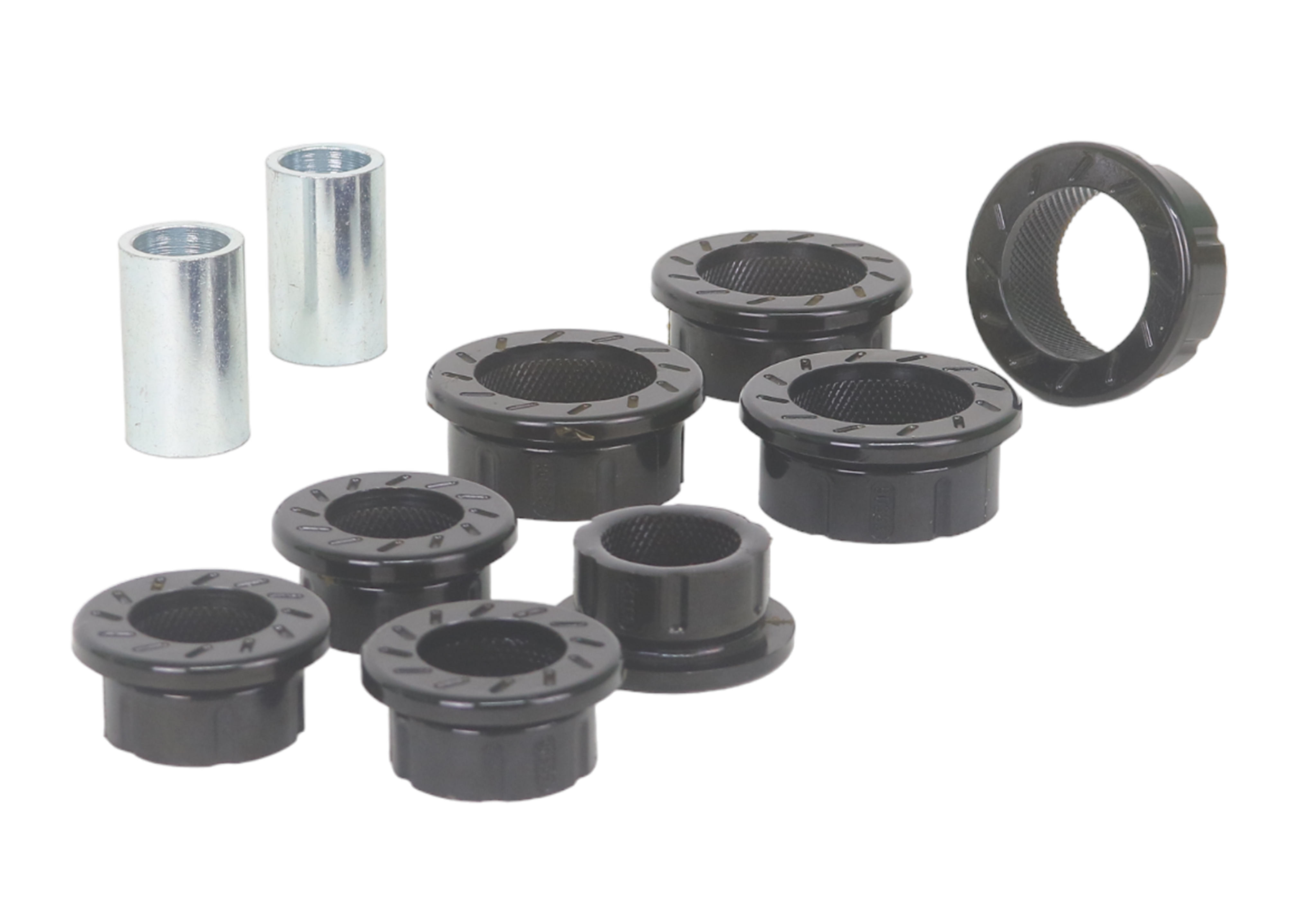
Transmission - Mount Bushings
✅ Fits 1980 Jeep CJ5 Golden Eagle Pre-OrderAvailable for Preorder. Stock due on 21-Nov-2026.Available for Preorder. Stock due on 21-Nov-2026.SKU: W93574Transmission - Mount Bushings
✅ Fits 1980 Jeep CJ5 Golden EaglePre-OrderAvailable for Preorder. Stock due on 21-Nov-2026.Available for Preorder. Stock due on 21-Nov-2026.Qty Required 1Kit Contents 2 Bushings, Install Guide, Grease$8.88
Your vehicle
Matching vehicles
No match — try selecting it below.
Refine your search
Clear allCan’t find what you’re looking for?
Our team can help you find the right part — or tell us what was missing so we can improve the site.
Call Us +1 909-476-2860 Give Feedback (opens in a new tab)


