
 AU
AU United Kingdom
 Europe
 United States
Does a lift kit void your new car warranty in Australia
Your consumer guarantees under the Australian Consumer Law apply whether or not aftermarket parts are fitted, so a lift kit does not void a new car warranty in Australia. A manufacturer or dealer can decline a specific claim only if it establishes that the modification caused that specific fault.
More Australian owners stay on standard suspension over this question than over price, and the folklore is stronger than the facts. A service advisor says "that will void your warranty" and the conversation ends there. It should not. We sell Whiteline 4x4 lift kits to owners who intend to keep their factory coverage intact, so here is how the Australian position works, what to document before your Crosstrek or RAV4 goes on the hoist, and what we put behind our own parts. We build suspension rather than practise law, so take anything contentious to the ACCC.
What the Australian Consumer Law gives you
New vehicles sold here come with two separate things, and owners routinely conflate them. One is the manufacturer's express warranty, the printed promise in the booklet. The other is the set of consumer guarantees under the Australian Consumer Law, which apply automatically and cannot be contracted out of.
Those guarantees include acceptable quality and fitness for purpose. They are not switched off because you fitted a suspension kit, a towbar, a roof rack or all-terrain tyres. The guarantee attaches to the vehicle as supplied, and a defect that was always there does not stop being one because you changed something unrelated.
Where a modification does matter is causation. If your modification caused the fault you are claiming for, that is not a failure of the vehicle's acceptable quality. The obligation to establish that link sits with the manufacturer or dealer, not with you. The ACCC publishes the authoritative position on consumer guarantees and aftermarket parts, worth reading before any difficult conversation at a service counter.
A blanket refusal is not a legitimate refusal
Two very different things get called warranty denial.
A legitimate refusal is specific: It names the component that failed, describes the mechanism by which your modification caused that failure, and refers to the inspection findings. A torn constant velocity boot with grease thrown through the wheel arch, on a heavily raised vehicle with no geometry correction, is a case a manufacturer can argue on the evidence.
A blanket refusal is general: It cites "the modifications" without naming one, identifies no mechanism, and often arrives before anyone has looked at the failed part. Air conditioning, infotainment, paint, an oil leak, a hybrid battery module: none has a plausible connection to ride height.
Ask for any refusal in writing, with the failed component and the causal finding named. That request settles many of these conversations, because a written position has to survive scrutiny in a way a verbal one never does. If it does not settle, escalate to the manufacturer's customer relations team, then to your state or territory consumer affairs body or the ACCC.
What a dealer can decline, what it cannot, and what evidence helps you
|
Claim scenario |
Can it be legitimately declined |
What evidence helps you |
|
Infotainment, air conditioning or electrical fault |
No, there is no plausible link to ride height |
Service history showing the fault is unrelated to the fit date |
|
Engine or hybrid system fault |
No, absent a stated causal mechanism |
Fit date and odometer, fault diagnosis in writing |
|
Constant velocity joint or boot failure on a heavily raised vehicle |
Possibly, on the facts |
Modest lift height, geometry hardware fitted, alignment printout |
|
The factory strut or spring itself |
Yes, once the part has been removed from the vehicle |
Not applicable, the component is no longer fitted |
|
Anything at all, refused on sight because the vehicle is raised |
No, this is the blanket refusal the ACL does not support |
The refusal in writing, naming the part and the causal finding |
The pattern is consistent. The nearer a failed component sits to the suspension, and the further your build sits from standard, the more room a manufacturer has to argue. A conservative height with the right hardware and a documented alignment leaves very little.
What to document before and after the install
Paperwork converts an argument into a non event, so build the file as you go.
Before the vehicle goes on the hoist, photograph the odometer, all four corners of the suspension and the underside, with the date recorded. Note the build date and VIN, and put any existing complaint on the service record first.
Afterwards, keep the parts invoice showing the kit part number, the fitting invoice showing the workshop and date, the odometer reading, and the front and rear wheel alignment report. That printout does more work than owners expect: camber, castor and toe inside specification is direct evidence the vehicle was returned to standard geometry, which removes the easiest causal argument a dealer has. We specify that alignment on both kits, and the Crosstrek GU kit includes front camber correction and a rear subframe spacer kit, so a correctly fitted car produces the printout as a matter of course. The RAV4 A50 kit includes front camber correction too, without the subframe spacer.
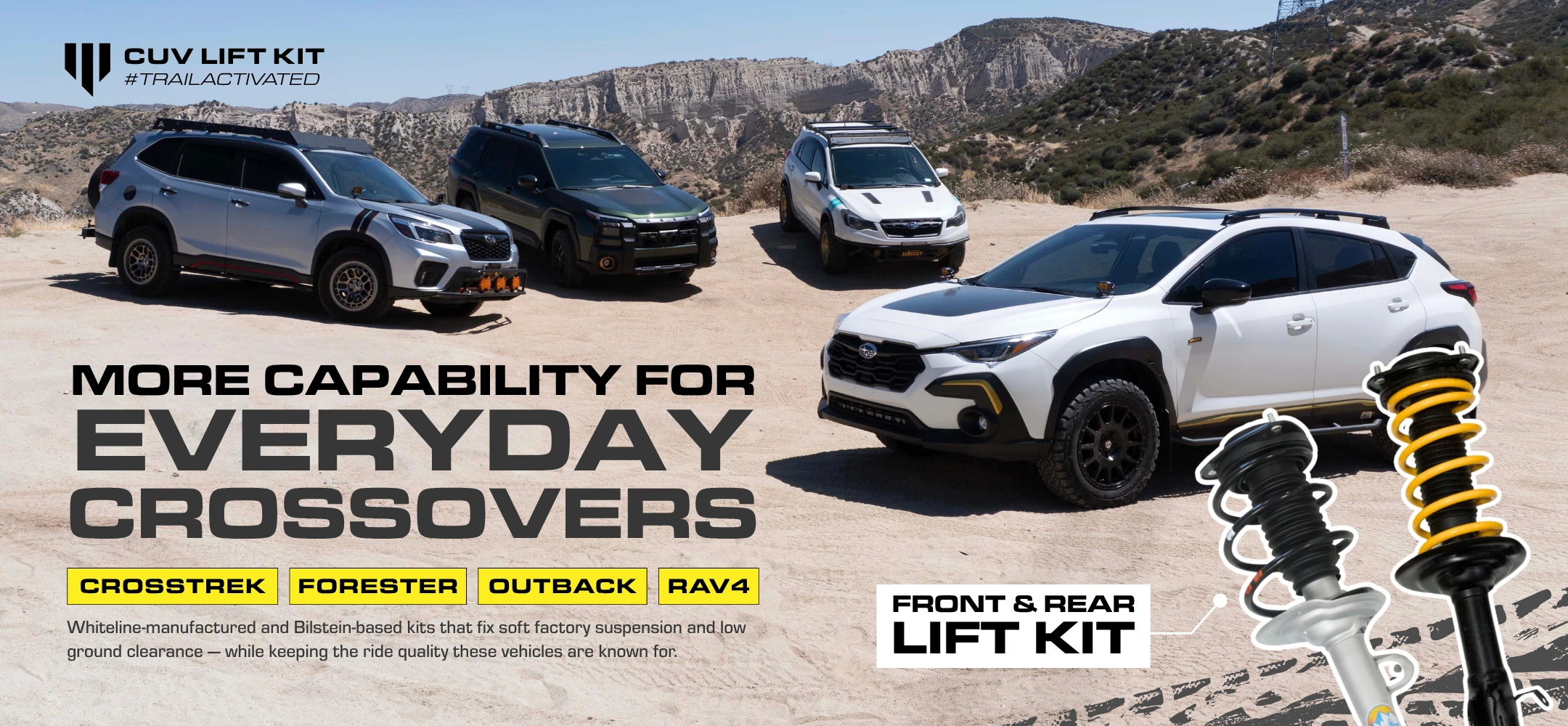
The warranty we put behind our own kit in Australia
The other half of the question is what happens if our parts fail, and that is on us rather than Subaru or Toyota.
|
Kit |
Vehicle |
Lift |
Australian warranty |
|
Subaru Crosstrek GU 2024 to 2026, excludes Hybrid |
30 mm front and rear |
3 years or 60,000 km |
|
|
Subaru Crosstrek GU 2024 to 2026, excludes Hybrid |
30 mm front and rear |
3 years or 60,000 km |
|
|
Toyota RAV4 A50 2019 to 2025, standard and hybrid |
30 mm front and rear |
3 years or 60,000 km |
|
|
Toyota RAV4 A50 2019 to 2025, standard and hybrid, excludes PHEV |
30 mm front and rear |
3 years or 60,000 km |
Every kit is 30 mm front and rear, requires a front and rear wheel alignment, and carries 3 years or 60,000 km, whichever comes first. Crosstrek Hybrid variants are excluded from the listing and recorded at 20 to 30 mm. The RAV4 A50 application covers standard and hybrid variants, while PHEV is not covered. We publish lift height, install time, alignment requirement and warranty on every kit, because a spec you can read before you buy is what protects you afterwards.
The HD variants add heavy duty linear rear springs with a constant 200 kg load rating, which is the answer for a permanently loaded tourer rather than a different lift height. Heavy duty kits are designed for consistently loaded vehicles and are not intended for regular unloaded use. Fit one to a wagon that spends most of its life empty and the rear will feel firm, so if the car is normally unladen the standard kit is the one to buy. Both specifications carry identical cover, so the choice is about how you use the vehicle rather than how well it is backed.
FAQs
Looking for more information about lift kits and new car warranties in Australia? Below we answer the most commonly asked questions
Does a lift kit void a new car warranty in Australia?
Can a Subaru or Toyota dealer refuse a warranty claim because my car is lifted?
What should I document before fitting a lift kit?
Does the alignment report really matter for a warranty claim?
Where can I check the official position?
Are Hybrid and PHEV models covered?
Should I take the standard or the heavy duty kit?
Keep your cover and gain the clearance. See our 30mm kit with the heavy duty options alongside it for a permanently loaded car.


