
 AU
AU United Kingdom
 Europe
 United States
What all-terrain tyres fit a Subaru XV or Crosstrek without a lift
Most owners fit Subaru XV all terrain tyres one size up on the standard wheel, staying inside about three percent of factory overall diameter. On a 17 inch car that usually means 225/65R17. Push past roughly five percent and you start chasing clearance at full lock and full compression.
The badge changed but the question did not. Australia sold the XV until the Crosstrek name arrived, and owners still search both, so this covers Subaru XV all terrain tyres and the current Crosstrek on the same terms: what fits a standard car, what rubs, and where Whiteline springs and struts stop being optional. Our 4x4 lift kits answer the second half, and a tyre that fouls a guard liner on a corrugated road is worse than one size less rubber.
The within ten percent rule, and why it is the number that matters
Standard guidance for tyre upsizing is to stay within ten percent of factory overall diameter. That is the outer boundary rather than the target, and it exists because diameter drives your speedometer reading, final drive ratio, stability control inputs, and how close the tread sits to the guard liner and strut.
Work in diameter rather than section width. A 235 section tyre is 10 mm wider but only 12 mm larger in diameter at the same profile, whereas moving from a 60 to a 65 series adds around 22 mm. Width costs you clearance sideways, at the strut and inner guard on full lock. Diameter costs you clearance upward, at the top of the arch under compression, and raises the vehicle by half the increase, which is what compliance measurement counts.
Tyre sizes owners run, and what each one asks for
These figures come from the size designation itself, using 225/60R17 as the reference at roughly 702 mm. They are sizes XV and Crosstrek owners report running rather than sizes we have tested.
|
Tyre size |
Approx. diameter |
Diameter change |
Ride height gain |
What it needs |
What it costs you |
|
225/60R17 (factory) |
702 mm |
Reference |
Nil |
Nothing |
Nothing |
|
235/60R17 |
714 mm |
+12 mm, +1.7% |
+6 mm |
Check strut clearance |
Heavier parking effort |
|
225/65R17 |
724 mm |
+22 mm, +3.2% |
+11 mm |
Standard wheels, factory offset |
About 3% speedometer under read |
|
235/65R17 |
737 mm |
+35 mm, +5.1% |
+18 mm |
Liner contact reported at full lock, some owners trim |
About 5% under read, more inertia |
|
225/55R18 (factory) |
705 mm |
Reference |
Nil |
Nothing |
Nothing |
|
235/60R18 |
739 mm |
+34 mm, +4.9% |
+17 mm |
Same clearance checks as 235/65R17 |
About 5% under read |
Read the pattern rather than the rows. Up to roughly three percent, an all-terrain fits a standard XV or Crosstrek with no drama. Between three and five percent individual cars differ, and the answer depends on offset, tread block height and how far you turn the wheel under load. Past five percent, the tyre wants clearance a standard car does not have.
Offset, backspacing and where the rubbing happens
Diameter is only half the geometry. Offset sets how far the tyre sits inboard or outboard of the hub face, and reducing it pushes the tyre toward the guard lip while pulling it away from the strut. Owners chasing a wider stance often drop offset by 10 to 20 mm on aftermarket wheels, trading an inner clearance problem for an outer one. Backspacing measures the same relationship from the inner rim edge. Contact then shows up in two places.
At full lock
Turn the steering to the stop in a car park and the front tyre swings toward the inner guard liner and the leading edge of the arch. Width bites first here, so test it loaded: four adults and a packed boot means the car sits lower and turns tighter into the liner.
At full compression
Load the suspension over a driveway lip or a dip and the tyre rises into the top of the arch and toward the liner's forward corner. Corrugations do the same repeatedly at speed, which is where a marginal fit becomes a shredded liner over a few hundred kilometres of dirt road. Trimming the plastic liner is common and the liner is replaceable. Rolling the metal guard lip is a different proposition, and once you are considering it you have outgrown the tyre size.
Load rating, touring weight and corrugations
An all-terrain that fits and then fails on a trip has cost you more than the tyre. Match or exceed the load index and speed rating on your tyre placard, and remember that a tourer carrying a roof rack, water, recovery gear and passengers works the rear tyres far harder than the commute does.
Light commercial casings resist sidewall damage on sharp rock and corrugations, at the cost of unsprung weight, road noise and rolling resistance. On a light wagon that trade is not automatic, and many owners are better served by a passenger construction all-terrain in the correct load index.
Corrugations test the whole package rather than the tyre: standard dampers on a loaded car heat up, lose control of the spring, and the vehicle skates across the tops of the ridges.
Where our Crosstrek kit picks up
Everything above assumes a standard car. Once you want a 235/65R17 or larger, or you tour with weight in the back, you want clearance and damping the factory setup was never specified to give.
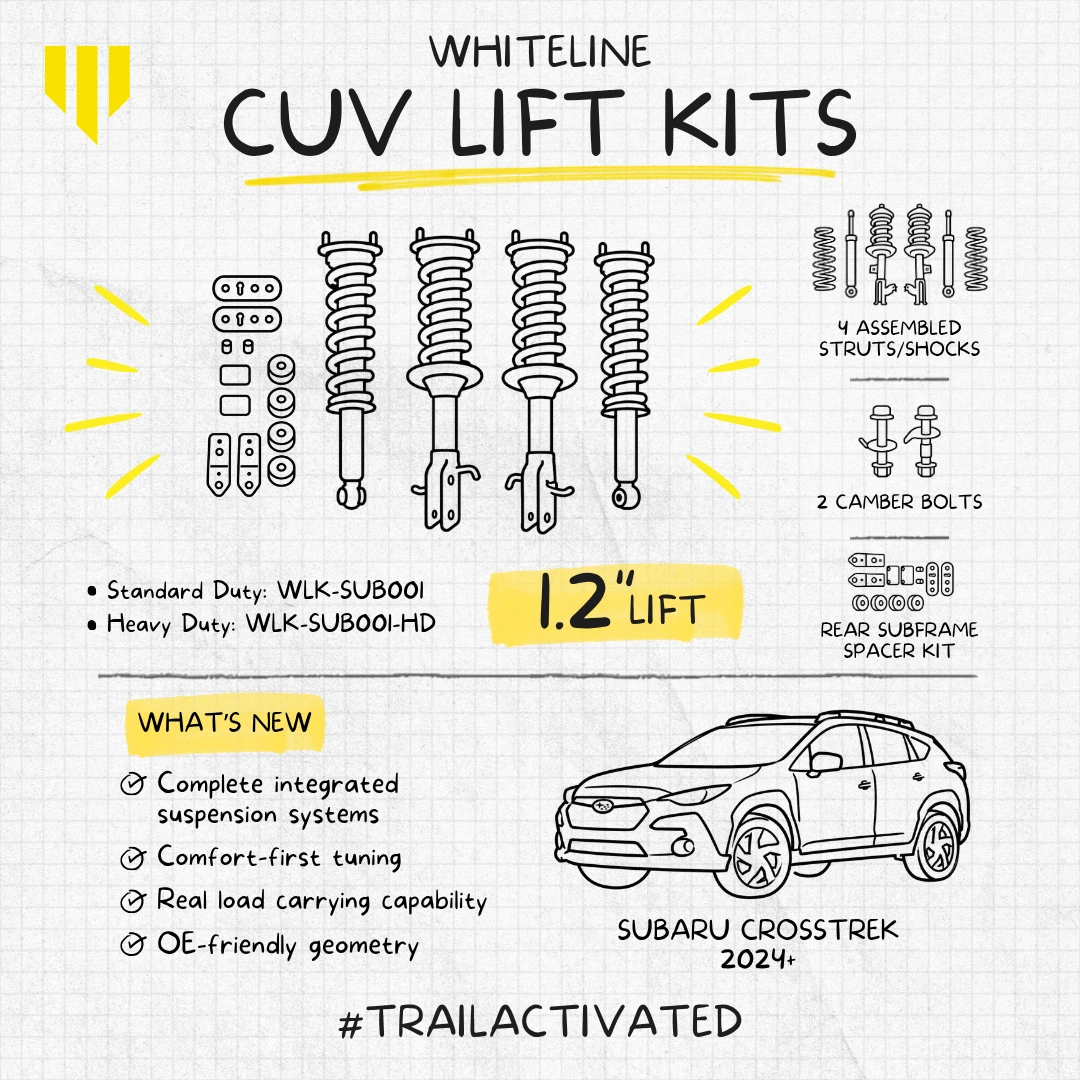
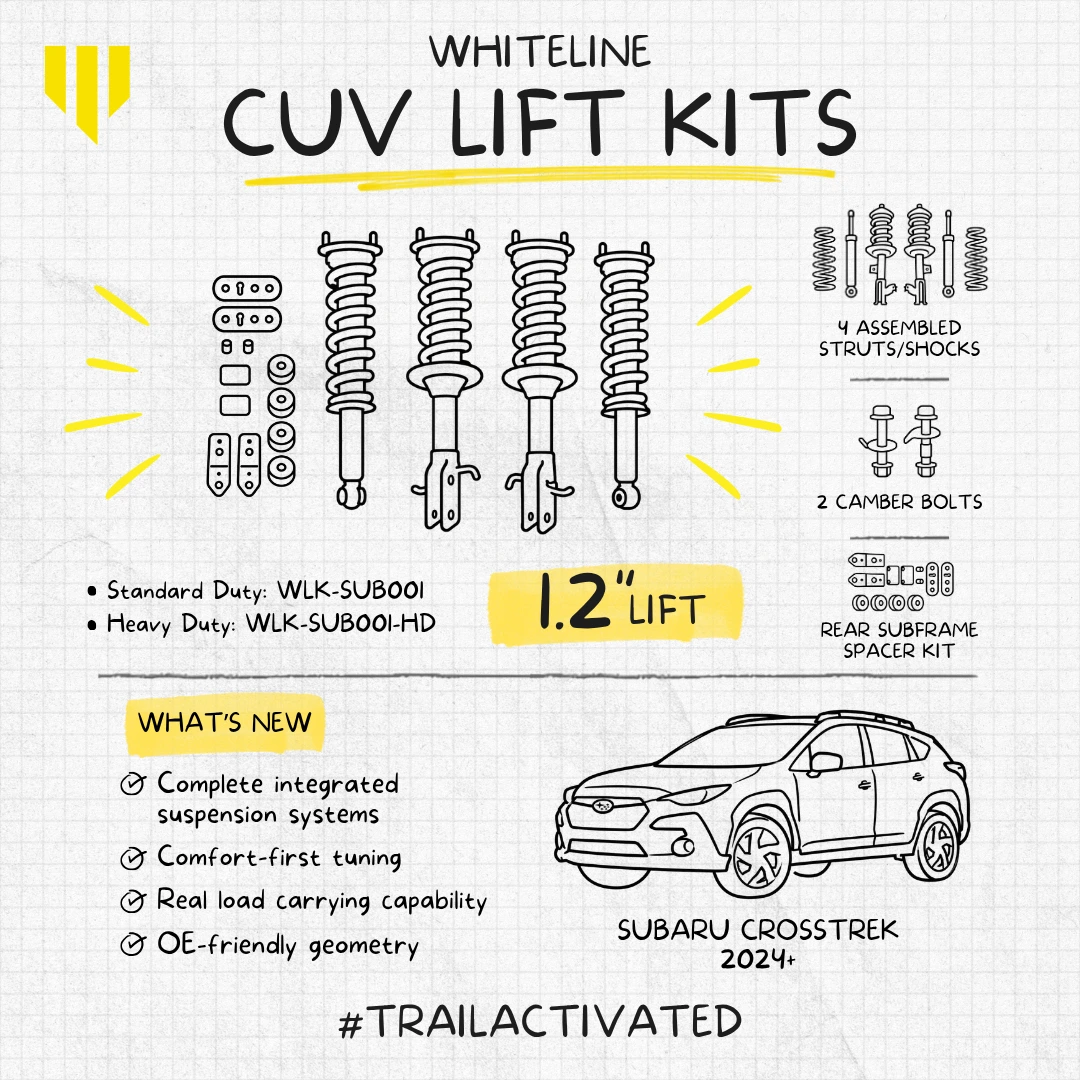
Our WLK-SUB001 kit for the Subaru Crosstrek GU 2024 to 2026 gives 30 mm front and rear from King springs and Whiteline tuned shocks, supplied as four assembled strut and shock units so your fitter never compresses a spring. It includes a rear subframe spacer kit and front camber correction, which keeps geometry near where the factory put it, and a front and rear wheel alignment is required. Spring rate is up 20 lbs/in front and rear, rear load capacity is 150 to 200 kg, and it is AUD $1,994.85 parts only or AUD $3,632.85 fitted, on pre-order at 4 to 6 weeks with 3 years or 60,000 km of warranty and an 8 hour install. The listing excludes Hybrid, with Hybrid variants recorded at 20 to 30 mm.
It is a complete engineered suspension system for a modern crossover platform rather than a spacer under the standard strut, and it retains factory droop travel. That matters on a tyre question, because clearance is tested at both ends of the travel.
A suspension that runs out of extension early on a rutted track stops following the surface and throws more compression at the other corner, which is where a marginal tyre meets the top of the arch.
If you tour loaded, look at WLK-SUB001-HD. Its heavy duty linear rear springs carry a constant 200 kg load rating, holding rear ride height with the boot packed instead of letting the back settle onto the bump stops on every corrugation.
Pick the variant honestly though. Heavy duty kits are designed for consistently loaded vehicles and are not intended for regular unloaded use, so they suit a wagon that permanently carries drawers, water and a tent. If your car is normally empty and only gets packed a couple of times a year, the standard duty kit is the one you want.
One clarification: our kit is listed for the Crosstrek GU 2024 to 2026. If you run an earlier XV, the sizing above still applies, but we do not list a lift kit for it on the Australian store.
FAQs
Looking for more information about all-terrain tyre sizing and lift kits? Below we answer the most commonly asked questions
What all-terrain tyre size fits a Subaru XV without a lift?
Will 235/65R17 fit a Crosstrek without a lift?
How much speedometer error does a bigger tyre cause?
Do all-terrain tyres use more fuel?
What load rating should I choose for touring?
Do you make a lift kit for the older Subaru XV?
Is the heavy duty kit right for a car I usually drive empty?
Fit the tyre you actually want. See our 30 mm front and rear kit for the 2024 to 2026 Subaru Crosstrek GU (WLK-SUB001)


