
 AU
AU United Kingdom
 Europe
 United States
Carrying touring weight on a lifted RAV4 or Crosstrek without rear sag
Rear sag under load is a spring rate problem, not a ride height problem. Our Standard Duty kits carry 150 to 200 kg at the rear and suit touring, camping and occasional cargo. Heavy Duty adds a rear spring rated for a constant 200 kg, built for permanently loaded wagons and not for a car that is normally empty.
Load a wagon for a fortnight in the bush and you find out what its rear springs are worth. Boot packed, drawers in, water aboard, a platform on the roof: the back settles, the nose lifts, your headlights light the treetops, and the ride turns into crashes over corrugations. That is rear sag, the complaint we hear most from Australian tourers. Our Whiteline 4x4 lift kits for the Crosstrek GU and the RAV4 A50 come in two rear spring specs for exactly that reason, and choosing the wrong one is the quickest way to be unhappy with a very good kit.
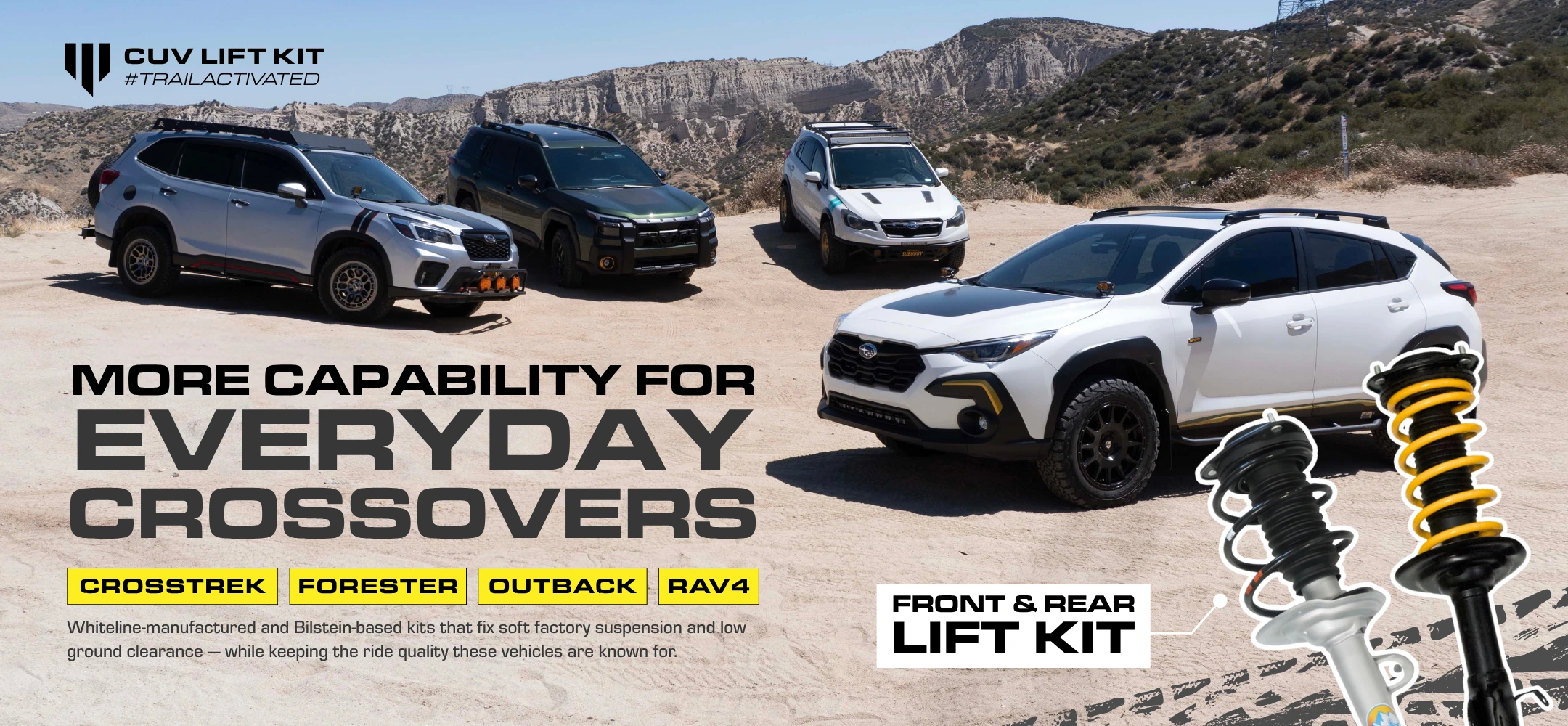
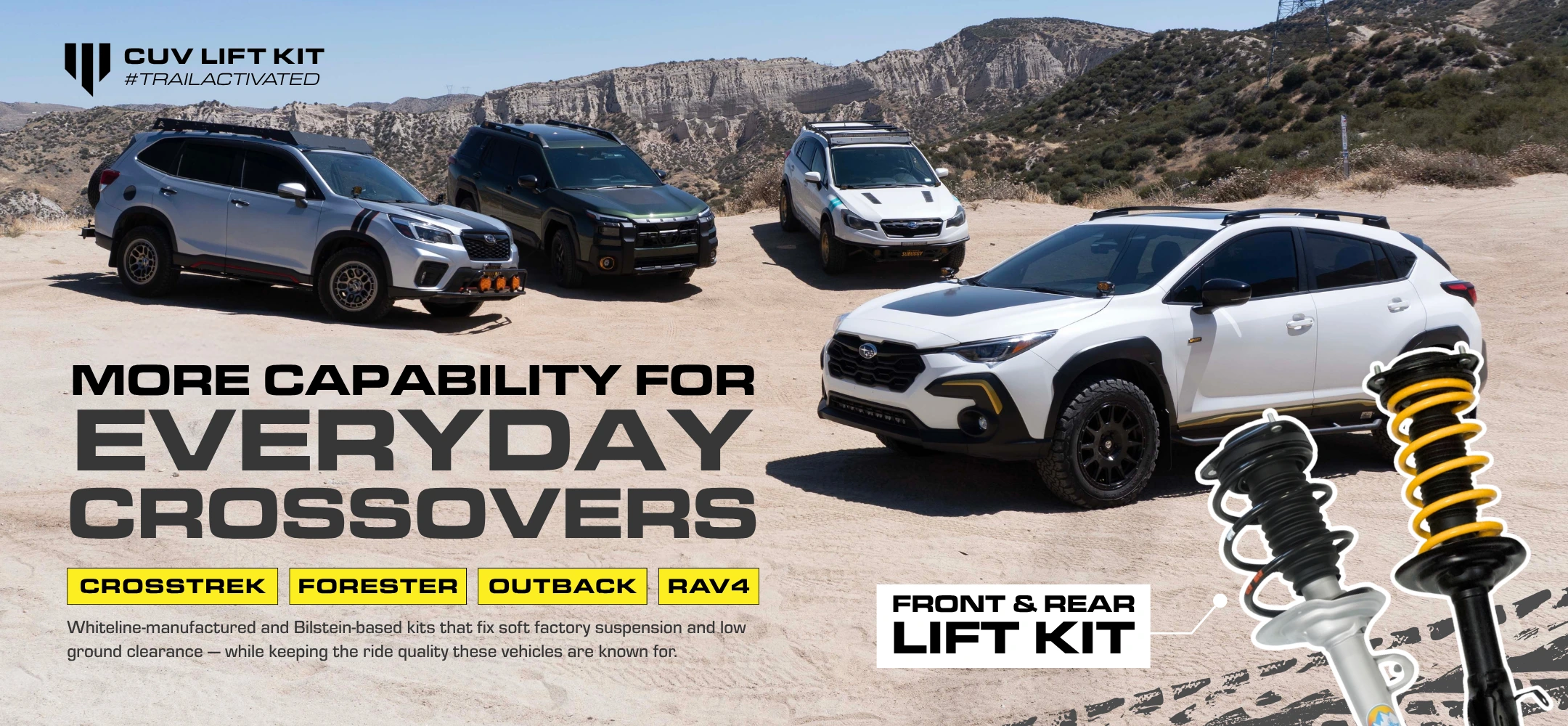
Standard Duty or Heavy Duty, and how to tell which one you need
Read this before anything else, because it decides which kit goes in your cart.
Standard Duty is the right kit for most owners. It is tuned comfort first, keeps balanced on-road handling and adds improved load support, with rear load capability of 150 to 200 kg. Daily driving, touring and camping, weekend adventure use and the occasional heavy boot all sit inside that.
Heavy Duty is a specialist spec for a wagon that lives loaded: overland builds, trade vehicles, permanent cargo setups, rooftop tents and drawer systems that never come out. Its rear spring supports a constant 200 kg and holds ride height under permanent load, so the car sits and steers the same in October as in April.
Heavy Duty kits are designed for consistently loaded vehicles and are not intended for regular unloaded use. If your wagon is normally empty, fit the Standard Duty kit.
An HD rear spring is holding up weight it cannot find in an empty car, so the back end feels firm over corrugations and speed humps. Loaded, that firmness is the entire point.
|
|
Standard Duty |
Heavy Duty |
|
Kits |
WLK-SUB001, WLK-TOY001 |
WLK-SUB001-HD, WLK-TOY001-HD |
|
Built for |
Daily driving, touring and camping, weekend adventure use, occasional cargo |
Overland builds, trade vehicles, permanent cargo setups, rooftop tents and drawer systems |
|
Rear load |
150 to 200 kg capability |
Constant 200 kg support, holds ride height under permanent load |
|
Tuning |
Comfort first, balanced on-road handling, improved load support |
Stability with a permanently equipped vehicle |
|
Not suited to |
Nothing to warn about |
A wagon that is normally empty. Do not fit HD to an unloaded daily driver |
Still deciding? Open the boot. If what is in there today is what is in there most weeks, and it is heavy, take Heavy Duty. If it is bare carpet until the night before a trip, Standard Duty is correct and rides better the rest of the year.
What rear sag does, and why a taller spring will not fix it
A spring holds the body at a height set by its rate and the load on it. Add 150 kg behind the rear axle line and the rear springs compress until the force balances, and everything you dislike about a loaded wagon follows from that movement. Bump travel goes first, because static sag spends part of the compression stroke before you have moved, and on a corrugated station road the wheel needs that travel to follow the surface. Attitude changes next: the nose rises as the tail drops, your headlight beam projects above the road, and the steering goes light.
Ride height and load capacity are separate properties. Free height sets where the car sits empty, while rate sets how far it moves per unit of load added, so a taller spring at the standard rate raises the empty car and leaves the loaded one sagging exactly as it did. Our Standard Duty kits publish a rate increase of 20 lbs/in front and rear alongside the 30 mm of lift, and camping gear plus a full family lives inside their 150 to 200 kg without drama. Both HD kits fit heavy duty linear rear springs with a constant 200 kg load rating, designed around carrying that weight all the time rather than surviving it occasionally, and linear rate keeps the response predictable as the boot fills.
What you load, where it sits, and what the law says
|
What you load |
Roughly what it weighs |
Where it sits |
Why that matters |
|
Water, 40 L |
40 kg, plus the tank |
Low in the boot, at or behind the rear axle |
Dense and unavoidable, first to push a standard spring too far |
|
Drawer or storage system |
The supplier's figure, before you fill it |
Boot floor, behind the rear axle |
Permanent, so the spring lives with it daily |
|
Roof platform and tent |
Platform, tent and cargo, inside your roof limit |
Highest point on the car |
Raises the centre of gravity, loads both axles |
|
Rear bar or wheel carrier |
Manufacturer's published weight |
Furthest point behind the rear axle |
Worst position for sag, every kilogram acts on a lever |
Weight behind the rear axle does more damage than the same weight between the axles, because the axle acts as a fulcrum and levers the nose up. The column that picks your kit is the third one rather than the second: gear that comes out after the trip points to Standard Duty, while gear bolted in for good points to Heavy Duty.
Payload and GVM are separate, legal limits published on your compliance plate. Read them, weigh the loaded car and stay inside them, and understand that a car can sit inside its legal payload and still sag, run out of bump travel and steer vaguely. Legal and composed are different tests, and the spring decides the second.
What is in the kit, and why we still specify a four-wheel alignment
Both specs are a complete engineered suspension system for a modern crossover platform rather than a stack of spacers. You get matched Whiteline dampers and King Springs supplied as assembled units, so nobody in the workshop is compressing a spring, and the suspension retains factory droop travel instead of losing it to a packer sitting on a standard length damper. Retained droop keeps a rear wheel loaded on a rutted track rather than topping out early.
Changing ride height moves camber and toe at both ends, and loading the car moves them again, so we specify a front and rear wheel alignment on every kit and include front camber correction to bring the front back into range. The Crosstrek GU kit also carries a rear subframe spacer kit, holding rear geometry closer to factory once the body comes up, while the RAV4 A50 kit does not use one. Both platforms work with a Whiteline sway bar upgrade, worth considering if you carry weight high.
Which kit for your wagon, and what it costs
All four kits lift 30 mm front and rear, publish an 8 hour install time, require a front and rear wheel alignment, ship as four assembled struts and shocks and carry our 3 year or 60,000 km warranty, at 4 to 6 weeks pre-order. The rear spring separates the two specs.
For the Subaru Crosstrek GU 2024 to 2026, WLK-SUB001 and the heavy duty WLK-SUB001-HD are AUD $1,994.85 parts only or AUD $3,632.85 fitted. Both listings exclude Hybrid, which is recorded at 20 to 30 mm.
For the Toyota RAV4 A50 2019 to 2025, WLK-TOY001 and the heavy duty WLK-TOY001-HD are AUD $1,841.40 parts only, with the HD kit at AUD $3,479.40 fitted. The application covers standard and hybrid variants, and PHEV is not covered. Confirm your model year, trim and drivetrain on the product page before ordering.
FAQs
Looking for more information about choosing between standard duty and heavy duty kits? Below we answer the most commonly asked questions
Should I buy the standard or the heavy duty kit?
Is a heavy duty kit a bad idea on an empty car?
Why does my wagon sag at the rear when loaded?
Will a lift kit stop rear sag?
What does a constant 200 kg load rating mean?
Does this change my legal payload or GVM?
Is my RAV4 Hybrid covered?
Is my Crosstrek Hybrid covered?
Pick the spec that matches how your wagon actually lives. Standard Duty for touring and occasional cargo, Heavy Duty for a permanently loaded build


