
 AU
AU United Kingdom
 Europe
 United States
Does a lift affect Subaru EyeSight and Toyota Safety Sense
Changing ride height changes where your forward camera and radar sit relative to the road, so EyeSight recalibration after a lift in Australia is a real question rather than fine print. Headlamp aim is a separate job again. Book both with your installer before the kit goes on.
Every competitor selling a lift for a modern wagon writes the same sentence: recalibration may be necessary. Then nothing. Nobody tells you what the system is actually referencing, who performs the work in Australia, whether a dealer will touch a lifted car, or what you risk by skipping it. On a 2024 to 2026 Subaru Crosstrek GU or a 2019 to 2025 Toyota RAV4 A50 that silence is a genuine purchase blocker, so we will answer it before you buy anything from our range of 4x4 lift kits.
What EyeSight and Toyota Safety Sense are actually looking at
Subaru EyeSight uses a pair of forward facing cameras mounted high on the windscreen, reading the road ahead in stereo to judge distance. Toyota Safety Sense pairs a forward camera with a radar module mounted low in the front of the car. Both drive the same family of functions: autonomous emergency braking, adaptive cruise, lane keeping and lane departure warning.
Neither system measures the world in isolation. Each is calibrated against a known geometry: the sensor sits at a known height above the road, aimed along a known axis, on a vehicle at a known static attitude. From that reference the software converts what it sees into distance, closing speed and lane position. Change the geometry and the reference moves with it, which is why windscreen replacement, panel repair and suspension work all appear on calibration job sheets.
What EyeSight and Toyota Safety Sense are actually looking at
Subaru EyeSight uses a pair of forward facing cameras mounted high on the windscreen, reading the road ahead in stereo to judge distance. Toyota Safety Sense pairs a forward camera with a radar module mounted low in the front of the car. Both drive the same family of functions: autonomous emergency braking, adaptive cruise, lane keeping and lane departure warning.
Neither system measures the world in isolation. Each is calibrated against a known geometry: the sensor sits at a known height above the road, aimed along a known axis, on a vehicle at a known static attitude. From that reference the software converts what it sees into distance, closing speed and lane position.
Change the geometry and the reference moves with it, which is why windscreen replacement, panel repair and suspension work all appear on calibration job sheets.
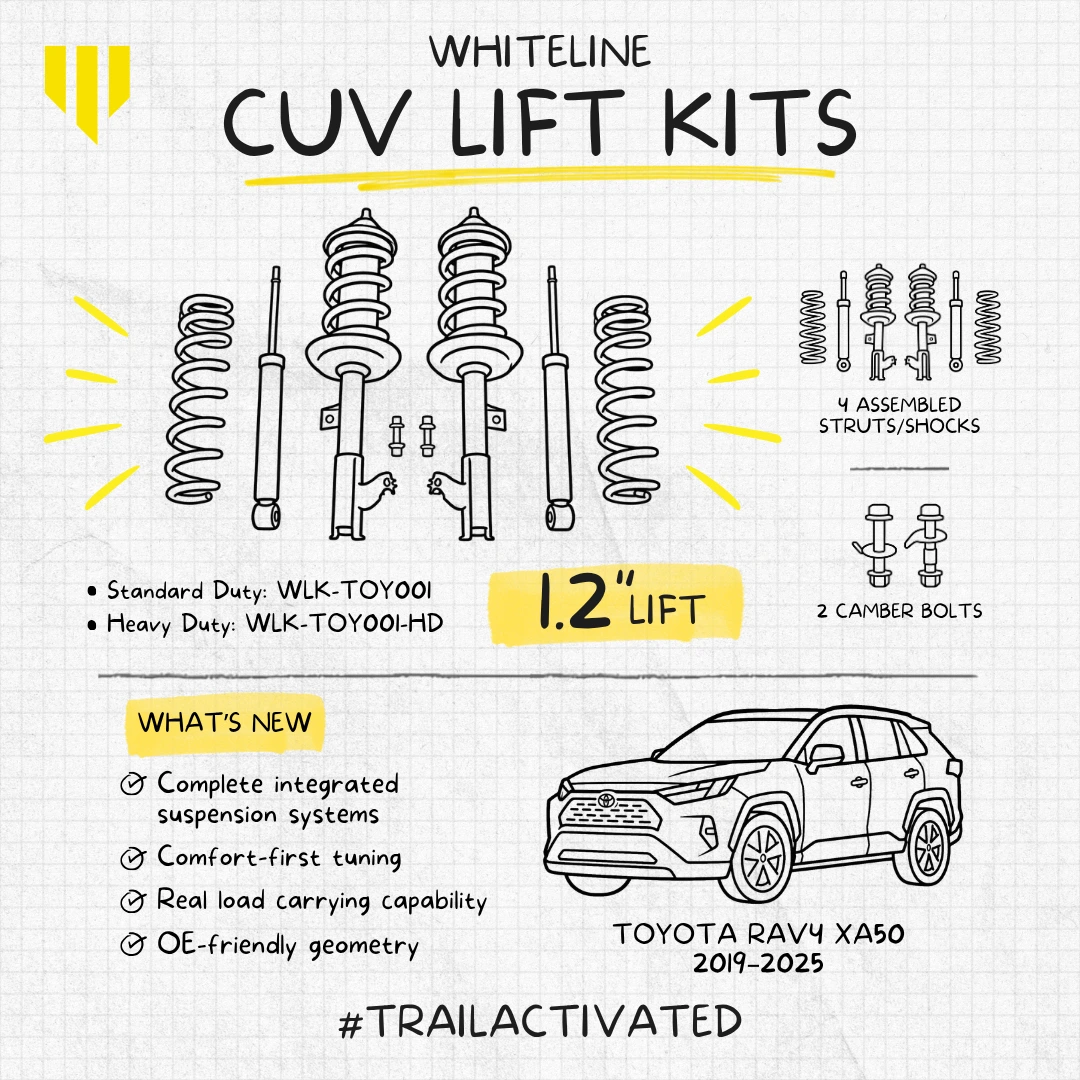
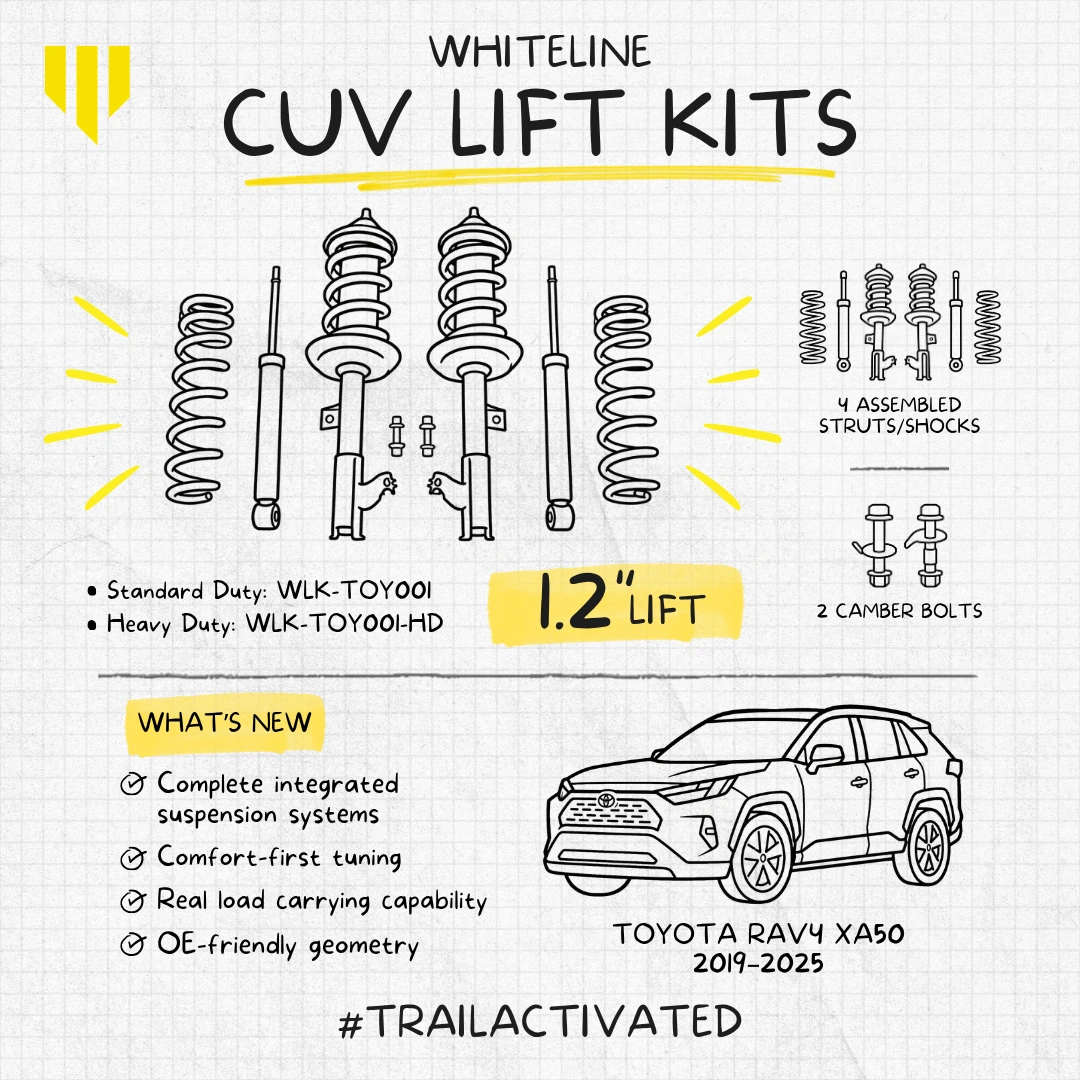
Why a 30 mm lift matters to a camera and a radar
Our Crosstrek GU and RAV4 A50 kits lift 30 mm front and rear. Even lift is the friendly case, because raising both ends equally changes the camera's height above the road while leaving the nose up or nose down attitude close to where it started.
Close to is not identical. Achieved lift varies with the mass a car carries, and we say so publicly: our Australian Crosstrek GU listing excludes Hybrid and records 20 to 30 mm achieved on Hybrid variants from identical hardware. If a car settles differently at one end than the other, static rake changes, and rake is what a forward sensor uses to work out where the horizon and the road surface sit in its field of view. A radar aimed a fraction of a degree higher looks over traffic. A camera sitting higher and pitched back reads lane markings against a reference that has moved.
Loading the car makes the same point. A boot full of touring gear pitches the nose up on any wagon, and the system tolerates that dynamically because it was designed to. What it was not designed around is a permanent change to the static attitude it calibrates from.
Headlamp aim is a separate job, and just as real
Recalibration and headlamp aim get bundled together in conversation and they are not the same task. Headlamp aim is a mechanical adjustment of the beam pattern relative to the road, and every Australian roadworthy standard cares about it. Raise the body 30 mm and the beam projects further out, which puts your low beam into the treeline and into the mirrors of the car ahead. Vehicles with self levelling headlamps still reference a sensor tied to suspension position, so a lift can leave that system working from the wrong baseline as well. A driver assistance recalibration will not correct your headlamp aim, and a headlamp aim will not recalibrate anything. Ask for both by name when you book.
What changes after a lift, and what to do about it
|
What changes |
Does it affect EyeSight or Toyota Safety Sense |
What to do about it |
|
Camera height above the road |
Yes. The camera references a known mounting height |
Ask whether a static recalibration applies to your model year, and who performs it |
|
Static rake, front to rear attitude |
Yes. Pitch is part of how the system maps the road surface |
Have the car measured at both ends once it settles, loaded the way you drive it |
|
Forward radar aim, Toyota Safety Sense |
Yes. Radar is aimed vertically and a small angular change matters at distance |
Ask about radar aim specifically. It is separate from camera calibration |
|
Headlamp aim |
No, this is a separate system |
Book an aim adjustment as part of the install. Compliance, not optional |
|
Wheel alignment, camber and toe |
Indirectly. Steering geometry feeds lane keeping |
We specify a front and rear wheel alignment on every kit. Do it the same day |
|
Taller tyres, if you fit them |
Yes. Rolling diameter changes the speed signal both systems use |
Stay within the standard guidance of 10 percent of factory rolling diameter |
What a responsible install looks like in Australia
We publish an 8 hour install time on the Crosstrek GU and RAV4 A50 kits, and we specify a front and rear wheel alignment on both. Treat the calibration conversation as part of that booking rather than a problem for later.
Ring the workshop before you commit. Ask whether they perform driver assistance calibration in house or subcontract it, whether they will calibrate a vehicle with a lift fitted, what equipment and floor space the procedure needs, and what it costs on your model year. Ask a Subaru or Toyota dealer the same if you would rather the work happened there. Policy, availability and price vary genuinely between dealers and between independent workshops, and anyone quoting a single national figure is guessing.
We will not invent a height threshold below which calibration is unnecessary, and we will not publish a price we cannot stand behind. The question has a clear answer at your installer, and it should be in hand before the kit is fitted rather than discovered on the Hume. Skip it and the systems usually do not switch themselves off. They keep operating against a reference that no longer matches the car, which is worse than a warning light, because you carry on trusting them.
FAQs
Looking for more information about lift kits and driver assistance recalibration? Below we answer the most commonly asked questions
Does a lift kit require EyeSight recalibration?
Does a lift affect Toyota Safety Sense on a RAV4 A50?
How much does recalibration cost in Australia?
Will a dealer recalibrate a lifted car?
What happens if I skip recalibration?
At what lift height does calibration become necessary?
Do I need a headlamp aim adjustment as well?
See the RAV4 kit, then talk to us about lining up alignment and calibration with your install.


