
 AU
AU United Kingdom
 Europe
 United States
Strut spacers or a full strut and spring kit on a Subaru XV or Crosstrek
Strut spacers vs a lift kit on a Subaru XV is a choice between raising the body and rebuilding the corner. Spacers lift cheaply, leave the factory spring and damper untouched and spend droop travel doing it. A complete assembled strut and spring kit changes ride height, spring rate and damping together, retains factory droop travel and is the only option that adds load capacity.
Search strut spacers vs lift kit subaru xv and the first page is mostly forum threads, plus the occasional brand page arguing hard for whichever method that brand happens to make. We build complete assembled strut and spring units at Whiteline, so our bias is on the table from the first line, and we will still tell you where a spacer is the honest answer for the way you actually use your car. Our Australian 4x4 lift kits range sits alongside two crossover kits, one for the Subaru Crosstrek GU and one for the Toyota RAV4 A50.
The three ways to raise a Subaru XV or Crosstrek
Every product sold into this space belongs to one of three families. They are not three price points for one outcome, because each alters a different part of the suspension.
Strut top spacers
A spacer is a machined plate that sits between the top of the strut assembly and the strut tower. Bolt it in and the body sits higher relative to the wheel, with nothing else changed. The spring is the factory spring at the factory rate, and the damper keeps its factory valving and stroke, so sealed road ride quality stays close to untouched. That is the genuine appeal, and we will not pretend otherwise.
The catch sits in the droop travel, and it is the part nobody selling a spacer tends to spell out. Droop is the downward travel a wheel has when the ground falls away from it, and it is what holds a tyre into the surface through a washout, a rut lip or the outside of a corrugated bend. A spacer raises the body on a damper that is still standard length, so the height comes out of droop rather than being added to the suspension. The damper reaches full extension before the suspension does, which is topping out, and it announces itself as a metallic thud through the floor. The inside wheel goes light sooner on rough ground for the same reason, because there is less travel left to keep it loaded. Compression travel is unchanged, so you have gained no bump clearance, and static driveline angles increase.
Lower lift brackets
Brackets work at the other end of the strut, sitting between the base of the assembly and the steering knuckle to lengthen the whole unit rather than drop it in the tower. Rear packages sometimes add subframe or trailing arm hardware to hold rear geometry closer to where it started, and the damper does not give up its own extension travel the way it does with a top spacer. The trade is a loaded structural component in the steering and hub path, so bracket quality and torque procedure genuinely matter. Spring rate, damping and load capacity all stay factory.
Complete assembled strut and spring units
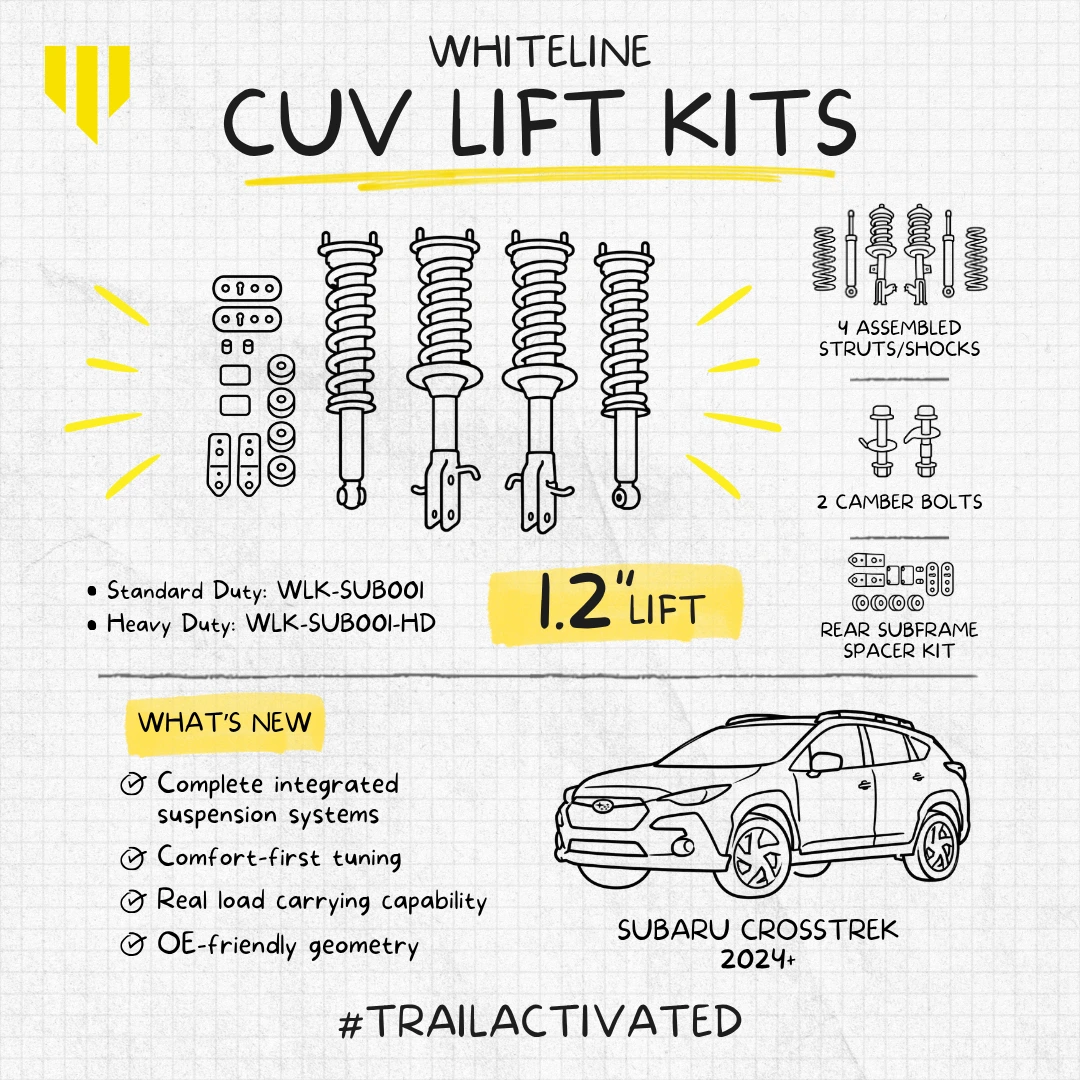
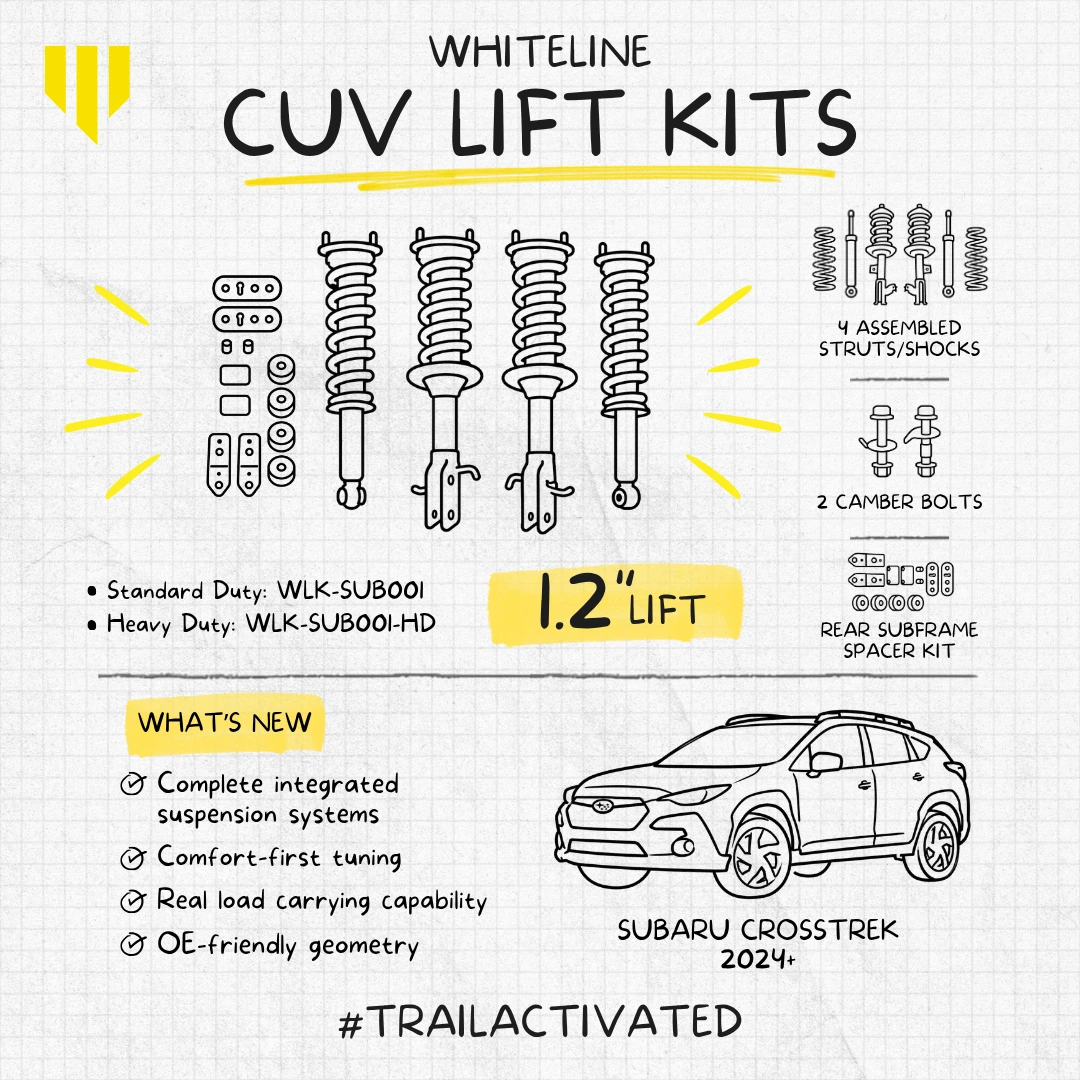
This is what we ship. Our Crosstrek GU kit arrives as four assembled corners: King springs wound for the new ride height, Whiteline tuned shocks valved to suit them, already built into complete units. Your fitter unbolts the factory strut and bolts ours in, so nobody is putting a spring compressor on a workshop bench with your car in the air. Because the spring is a different spring, ride height and rate move together, and that is the mechanism that makes a heavy duty variant possible at all. We publish a spring rate increase of 20 lbs/in front and rear, a rear load capacity of 150 to 200 kg on the standard kit, and heavy duty linear rear springs with a constant 200 kg load rating on the HD version.
The engineering answer to the spacer question sits underneath all of that. We design these kits to retain factory droop travel. Damper length, valving, spring rate and ride height are developed as one package, so lifting the car does not come out of the wheel's downward travel the way it does when a plate is stacked on top of a standard strut. That is a design property of the system rather than a promise about ride quality, and we publish no travel figure in millimetres. Front camber correction is included so your wheel aligner has the range to bring the numbers back toward standard, and the kits are designed to work with a Whiteline sway bar upgrade when you want to take body roll further. Think of it as a complete engineered suspension system for modern crossover platforms rather than a height adjustment.
The heavy duty version carries one caveat we would rather state ourselves. It is built for consistently loaded vehicles and is not intended for regular unloaded use, so if your car is normally empty, the standard duty kit is the correct one.
The three approaches side by side
|
|
Strut top spacers |
Lower lift brackets |
Whiteline complete strut and spring kit |
|
Cost band |
Lowest |
Low to middle |
AUD $1,994.85 parts only for the Crosstrek GU, AUD $3,632.85 fitted |
|
Retained factory droop travel |
No. The lift comes out of droop, so the damper tops out early on rough ground |
Partly. The damper keeps its own extension travel, but nothing else is retuned |
Yes. Engineered to retain factory droop travel as part of the package |
|
Changes spring rate |
No, factory spring retained |
No, factory spring retained |
Yes, published at 20 lbs/in more front and rear |
|
Adds load capacity |
No |
No |
Yes, 150 to 200 kg rear on the standard kit, constant 200 kg rating on the HD rear springs |
|
Geometry parts included |
None beyond the spacer |
Varies by maker |
Front camber correction on both kits, plus a rear subframe spacer kit on the Crosstrek |
|
Standard duty or heavy duty |
Single specification only |
Single specification only |
Standard duty for a normally empty car. Heavy duty only for a vehicle that is consistently loaded |
|
Sway bar upgrade path |
None offered |
None offered |
Designed to work with a Whiteline sway bar upgrade |
|
Alignment required |
Any ride height change moves camber and toe |
Yes |
Yes, front and rear wheel alignment, published on the listing |
|
Install time |
Shortest of the three |
Moderate |
8 hours, published |
|
Warranty |
Varies by maker |
Varies by maker |
3 years or 60,000 km |
Where a spacer is genuinely the right call
We would rather point you at the correct answer than the dearer one. A spacer earns its place when your dampers are healthy, your goal is a little clearance for a slightly taller all-terrain tyre, and the car lives on bitumen and graded dirt rather than surfaces that unload a wheel quickly. It buys tyre room for a modest outlay and leaves the factory ride intact. Droop travel only becomes the deciding factor once the surface starts falling away underneath you, so a car that never sees that will not miss what the spacer took.
The picture changes the moment weight enters it. Roof platforms, a rooftop tent, drawers, water, recovery gear and a loaded boot all press the rear down onto a spring that never got any stiffer, and neither spacers nor brackets do a thing about that. If your XV or Crosstrek carries touring weight for weeks at a time, spring rate is the variable you need, and the heavy duty kit is where that lives. If the car is normally empty and loads up twice a year, stay with the standard duty kit, because heavy duty springs are tuned around a load that never leaves the vehicle.
What our Crosstrek kit includes that a spacer cannot
The Crosstrek GU kit for 2024 onward ships with four assembled struts and shocks, one rear subframe spacer kit and front camber correction, for 30 mm of lift front and rear at AUD $1,994.85 parts only or AUD $3,632.85 fitted, on pre-order at 4 to 6 weeks.
That subframe spacer kit is what separates a considered package from a stack of plates, because it repositions the rear subframe to hold driveline geometry closer to where Subaru put it.
The camber correction hardware then gives your wheel aligner the adjustment range to bring the numbers back toward standard. The listing excludes the Hybrid, and records 20 to 30 mm on Hybrid variants.
Which Subarus we actually cover in Australia
Straight answer, because it saves you an email. In Australia we build this style of kit for the Subaru Crosstrek GU from 2024 onward, excluding the Hybrid. If you drive an earlier XV, a spacer or bracket may be your only route to extra height, and we would rather say that than sell you something that does not fit. Confirm your model year, trim and drivetrain before you order either kit.
FAQs
Looking for more information about strut spacers and full lift kits? Below we answer the most commonly asked questions


