
 AU
AU United Kingdom
 Europe
 United States
Lifting a RAV4 Hybrid in Australia: what fits and what does not
Our A50 application for the 2019 to 2025 RAV4 covers petrol and Hybrid variants on the same hardware, at the same 30 mm. Plug-in is the exception: our heavy duty A50 listing excludes PHEV, so treat a plug-in RAV4 as outside the application. Confirm build year, variant and drivetrain before ordering.
Hybrid is an enormous share of the Australian RAV4 parc, yet ask about a RAV4 Hybrid lift in Australia and you mostly get petrol advice with a hybrid photo attached. We will be straighter than that. Our 2019 to 2025 A50 application covers the petrol car and the Hybrid, and the plug-in is the only variant we hold the line on. A hybrid A50 is still a different car under the boot floor, and that shows up the moment you load touring weight. Here is what changes and what to confirm before ordering from our 4x4 lift kits.
What is mechanically different on a hybrid AWD RAV4
On a petrol AWD A50, drive reaches the rear wheels the conventional way: a transfer unit takes torque from the transaxle, a propshaft runs the length of the car, and a rear differential feeds the rear halfshafts.
Hybrid AWD deletes that path completely. There is no propshaft. An electric drive unit sits at the back of the car on the rear subframe and turns the rear wheels through its own short halfshafts, so the axles are linked electronically rather than mechanically.
The rest of the difference is mass and where it sits. A battery pack fills part of the floor, the drive unit adds weight behind the rear axle line, and kerb weight is higher than the equivalent petrol car with distribution shifted rearward. That does not change whether our kit fits. It changes which variant you order, and it is why hybrid owners report a soggy rear end long before petrol owners do.
Why hybrid mass changes what a lift feels like
Here we can show you evidence from inside our own range rather than a theory. Our Australian Crosstrek GU listing publishes 30 mm front and rear and records 20 to 30 mm achieved on the heavier Hybrid variant from identical hardware. Same springs, same shocks, same procedure, less settled height. The only variable that moved was the mass the spring holds up. That Crosstrek Hybrid stays excluded on the Subaru as a separate application question, but the physics lesson travels.
Take the lesson across to the RAV4, where hybrid is covered. A heavier rear end compresses a given spring further at rest, so the car starts closer to its bump stop before you put anything in the boot. Our kits retain factory droop travel rather than lifting the body on a standard length damper, which matters most on the car already sitting deeper in its stroke. Ride height is the symptom, spring rate is the variable, and that is why the heavy duty option exists.
The rear driveline question owners keep asking
Australian RAV4 forums circle the same question: does raising the rear upset the electric drive unit. On a petrol AWD car, changing rear ride height alters the working angle at the rear differential input and at the halfshaft joints. A hybrid has no propshaft angle in the equation, which removes one variable outright. What remains is the geometry between the drive unit and the hubs, since that unit bolts to the rear subframe and the subframe to the body. Raise the body and the drive unit goes up while the hubs stay put, so the halfshafts sit at steeper static angles than the factory chose.
We publish no test result on hybrid rear driveline behaviour and will not invent one. What we will say plainly is that this constraint governs how much lift any unibody wagon can take, and it is why we engineer the A50 kit at 30 mm rather than chasing a headline number.
Petrol, hybrid and PHEV compared
|
|
Covered: petrol AWD |
Covered: Hybrid AWD |
Not covered: plug-in hybrid (PHEV) |
|
Our fitment position |
Covered by the 2019 to 2025 A50 application |
Covered by the same application, stated plainly |
Outside it. Our heavy duty A50 listing excludes PHEV |
|
How the rear axle is driven |
Propshaft to a rear differential |
Rear electric drive unit, no propshaft |
Rear electric drive unit, larger battery |
|
Mass versus petrol |
Baseline |
Higher kerb weight, shifted rearward |
Highest of the three |
|
At the rear when lifted |
Propshaft and halfshaft angles both change |
No propshaft angle. Halfshaft angle to the hubs increases |
Not applicable, we do not lift these |
|
Rear sag once loaded |
Baseline on the standard rate |
Sooner on the same rate, so spring choice matters more |
Not applicable |
|
Before you order |
Confirm build year and variant |
Confirm build year, variant and drivetrain |
Contact us. Do not order against a plug-in RAV4 |
Read the middle column as the headline. Hybrid is in. Plug-in is out. The two words get swapped around in conversation and they are not the same thing here, so if your RAV4 plugs into a wall socket, talk to us first.
What our RAV4 A50 kits give you in Australia
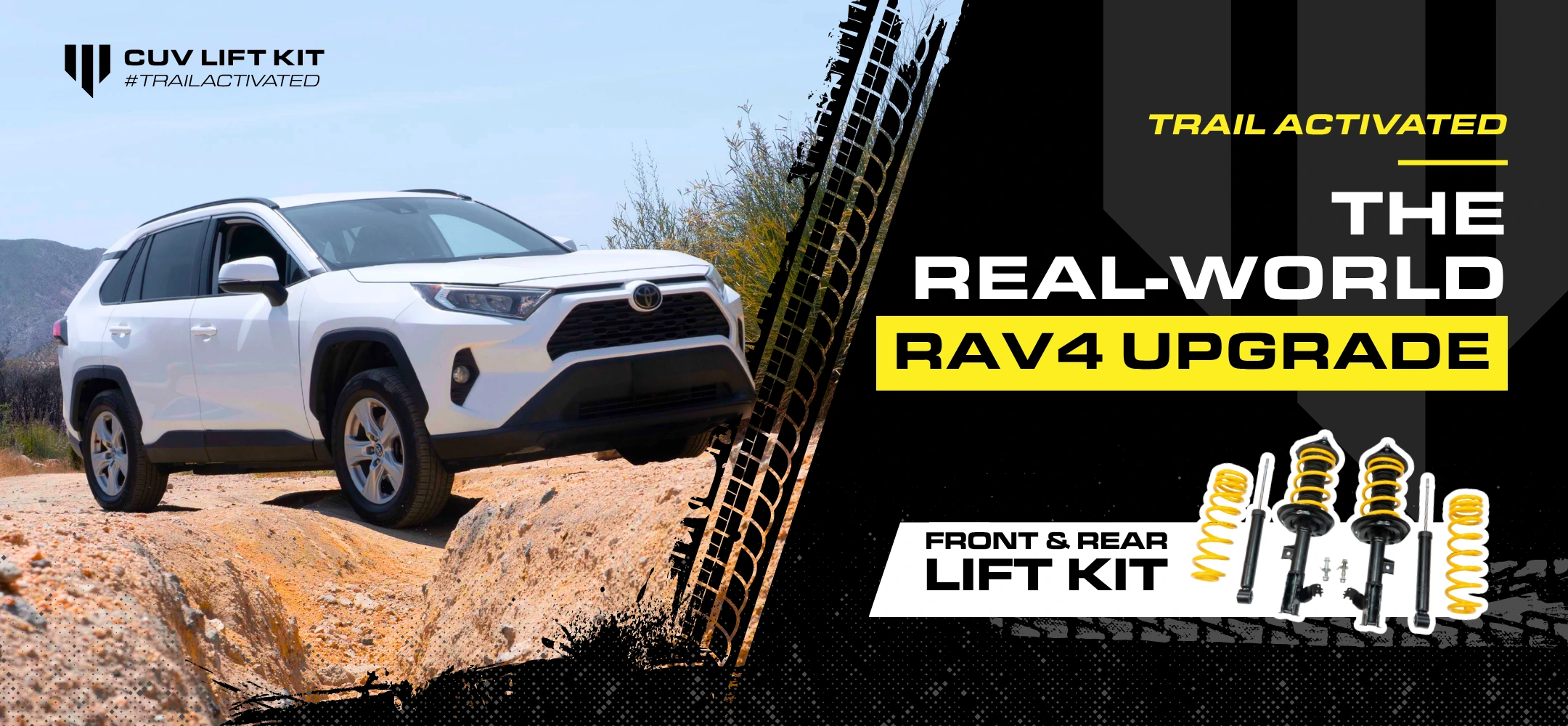
What we build is a complete engineered suspension system for modern crossover platforms, not a spacer under a factory strut. Our Trail Activated kit for the 2019 to 2025 RAV4 A50 lifts 30 mm front and rear and ships as four assembled struts and shocks, matching Whiteline tuned dampers to King springs, with front camber correction included. Install time is 8 hours, a front and rear wheel alignment is required, and it is backed by our 3 year or 60,000 km warranty. Rear load capability is 150 to 200 kg, parts only is AUD $1,841.40, and both variants are pre-order at 4 to 6 weeks. Because the corners arrive assembled, nobody is compressing springs on your car. It also works alongside a Whiteline sway bar upgrade once ride height is sorted.
The heavy-duty version, WLK-TOY001-HD, shares the lift, install time, alignment requirement and warranty, and swaps in heavy duty linear rear springs with a constant 200 kg load rating. Fitted, that is AUD $3,479.40.
Standard duty or heavy duty on a hybrid
Carrying more mass from the factory is not on its own a reason to jump to heavy duty. What decides it is whether the weight is permanent.
|
|
Standard duty |
Heavy duty |
|
Built for |
Daily driving, touring and camping, weekend adventure use, occasional cargo |
Overland builds, trade vehicles, permanent cargo setups, rooftop tents and drawer systems |
|
Rear load |
150 to 200 kg capability |
Constant 200 kg support, holds ride height under permanent load |
|
Tuning |
Comfort first, balanced on road handling, improved load support |
Stability with a permanently equipped wagon |
|
Not for |
No warning needed |
A vehicle that is normally empty |
Heavy duty kits are designed for consistently loaded vehicles and are not intended for regular unloaded use. If your hybrid tours with drawers, a tent and a full boot, the heavy duty rear spring holds ride height. If it runs empty during the week, order the standard duty kit and keep the ride quality. Send us your build year, variant and drivetrain either way and we will confirm the application before anything ships.
FAQs
Looking for more information about lifting a RAV4 Hybrid? Below we answer the most commonly asked questions
Can you lift a RAV4 Hybrid in Australia?
Is a RAV4 Hybrid the same as a RAV4 plug-in hybrid for fitment?
Does a RAV4 Hybrid have a rear propshaft?
Will a lift cause rear driveline problems on a hybrid?
Does a hybrid sit lower on its springs than a petrol car?
Does the kit include camber correction?
Does a hybrid need the heavy duty rear spring?
See the Trail Activated A50 kit for the 2019 to 2025 RAV4, petrol and Hybrid, then confirm your variant with us before ordering


