
 US
 Australia
 United Kingdom
 Europe

Radiator Bushings
IMPROVE GRIP, HANDLING & PERFORMANCE.
A radiator is a thin walled assembly of brazed tubes and fins carrying hot pressurised coolant, bolted into the most exposed part of the car. It is not mounted rigidly, and the rubber bushings holding it are doing more than keeping it quiet. What a Radiator Actually Sits On Most radiators locate on pins or tabs at the bottom that drop into the s... Read more
A radiator is a thin walled assembly of brazed tubes and fins carrying hot pressurised coolant, bolted into the most exposed part of the car.
It is not mounted rigidly, and the rubber bushings holding it are doing more than keeping it quiet.
What a Radiator Actually Sits On
Most radiators locate on pins or tabs at the bottom that drop into the support panel, with a bushing around each one.
The top is held by brackets or a cross brace, usually with a pad or bushing between the radiator and the bracket rather than metal touching metal.
That arrangement means the radiator is effectively floating in its opening. It is located precisely enough not to move around, and loosely enough to move when it needs to.
A lower radiator mount bushing carries the weight. The upper pads stop it tipping forward and take the vibration that would otherwise travel into the core.
Why a Radiator Is Isolated Rather Than Bolted Solid
Three separate reasons, and most people only know the first.
Vibration is the obvious reason of the three. Engine and road vibration traveling into a brazed core works the joints between tubes and tanks until one of them starts weeping.
Chassis flex is the second reason for it. The front of a car twists under load, and the radiator support panel twists with it. A radiator bolted rigidly into a structure that flexes gets that movement fed straight into its own frame.
Thermal expansion is the third and it is the one that catches people out. A radiator at operating temperature is physically larger than a cold one. Aluminum cores in particular grow measurably, and the mounting has to allow for that or the core is fighting its own mounting every time the engine warms up.
The bushings are what let all three happen without the radiator taking the strain.
What Perished Mounts Let Happen
The failure is gradual and the consequences arrive somewhere else.
Once the lower bushings compress or disintegrate, the radiator drops slightly and sits on the support panel directly. Every vibration now travels straight into the core, and the tank seams are where that shows up first as a slow leak.
The radiator also starts moving in its opening. That brings the inlet and outlet hoses into play, since a radiator that shifts works at the hose connections and rubs the hoses against whatever is next to them.
Fan shroud clearance suffers in the same way. A radiator sitting lower or further forward than designed can let the shroud contact the fan, which is a noise that gets diagnosed as a bearing.
On a car with an aftermarket radiator or a core that has been out and back in, worn bushings are often why it sits slightly wrong in the first place.
Why Too Firm Is Also Wrong
This is the part that separates radiator bushings from the rest of the bushing range.
Everywhere else on a car, replacing soft rubber with firm polyurethane improves control because movement is the enemy. At the radiator, some movement is the point.
A mount that holds the radiator rigidly removes the allowance for thermal growth and chassis flex, and the core ends up carrying loads it was never designed for.
What you want is a mount that holds its shape and thickness over time while still allowing the radiator to move the small amount it needs to. Material that resists perishing, oil contamination and heat cycling, without turning the mounting into a solid joint.
That is why radiator bushings are specified differently to suspension bushings even when they are made from similar materials.
Upper Pads, Lower Pins and Bracket Mounts
The positions do different jobs and they are worth identifying before ordering.
Lower pins or studs on the radiator drop into the support panel, with a bushing taking the load and locating the pin. These carry the weight and they are the ones that collapse.
Upper pads sit between the radiator top tank or frame and the retaining bracket, under clamping pressure rather than weight. These tend to harden and crack rather than collapsing.
A radiator mount bracket, or radiator bracket mount depending on the catalog, holds the top in place, and on some vehicles the bracket itself is the wear item through corrosion rather than the bushing in it.
Check which positions a listing covers, since a set of radiator mount bushings may supply the lower items only and leave the upper pads to be bought separately. A radiator support bushing is sometimes listed separately again where the panel itself carries an isolating mount.
Universal and Application Specific Mounts
Both types exist and the distinction between them matters.
Application specific bushings match the pin diameter, the hole in the support panel and the height required to sit the radiator where the vehicle intended.
A universal radiator mount bushing is sized by dimension rather than vehicle, which suits an aftermarket radiator, a custom installation or an older vehicle where the original part is no longer supplied.
Universal mounting brackets go further, providing the means to locate a radiator that was never designed for that opening, which is common on engine conversions and race car builds.
Where a universal part is being used, the height is the figure to get right. A bushing that sits the radiator too high or too low changes hose angles and fan clearance at the same time.
Radiator Mounts on Modified and Track Cars
A built car asks more of these than a standard one, and in more than one direction.
Higher power means more heat, which means the radiator spends more of its life at the top of its temperature range and the mounts see more thermal cycling.
An uprated or thicker core weighs more than the original, so the lower bushings carry load they were not sized around. A heavier radiator on compressed mounts sits lower still.
Track use adds impact loading on top of that. Kerbs, high speed bumps and the occasional off put shock through the front of the car, and the radiator mounting is the only thing standing between that and the core.
Engine conversions and aftermarket cooling setups frequently reuse factory mounting points with a radiator that was never designed for them, which is where universal bushings and brackets earn their place.
On any of those, checking the mounts is worth adding to the same inspection as the hoses and the coolant, since all three fail quietly and show up as a leak.
Checking Radiator Mounts
A quick inspection tells you most of what you need.
Push down on the radiator top tank with the engine cold and watch the lower mounts. Movement that does not return means the bushings have compressed.
Look at the lower bushings directly for splitting, flattening or material missing entirely. These sit at the front of the car in the path of road spray and they degrade from both heat and water.
Check the hose connections for signs of strain, and look at where the hoses run for rub marks. A radiator that has moved tells you so through its hoses.
Look at the support panel where the bushings sit for corrosion, since water trapped in that location is what rots the panel from the inside.
Fitting Radiator Bushings
Access is the whole job here, and the radiator usually has to come out or at least be lifted.
That means draining the coolant, which makes this a sensible job to combine with a coolant change rather than doing twice.
Support the radiator while the mounts are out. A radiator hanging on its hoses puts load into the exact connections you are trying to protect.
Check the pins or studs on the radiator itself while it is accessible. Corroded or bent pins mean a new bushing has nothing round to locate on.
Fit new upper pads at the same time as lower bushings. They have done the same heat cycles and the access is identical.
Refill and bleed the cooling system properly afterward, and check the hose routing and fan clearance before the first run.
Find Radiator Bushings for Your Vehicle
Radiator bushings sit within our bushings lineup, alongside engine mount bushings.
Select your vehicle to see the radiator bushings and mounts available for it, in upper and lower positions. If the radiator moves when you push on it or the hoses show rub marks, the mounts have gone and the core is carrying load it should not be.
2 items
-
 In StockShips within 24hrs.Ships within 24hrs.SKU: W93592
Front Radiator Mount Bushing
In StockShips within 24hrs.Ships within 24hrs.Qty Required 1Kit Contents 4 Bushings$17.89 -
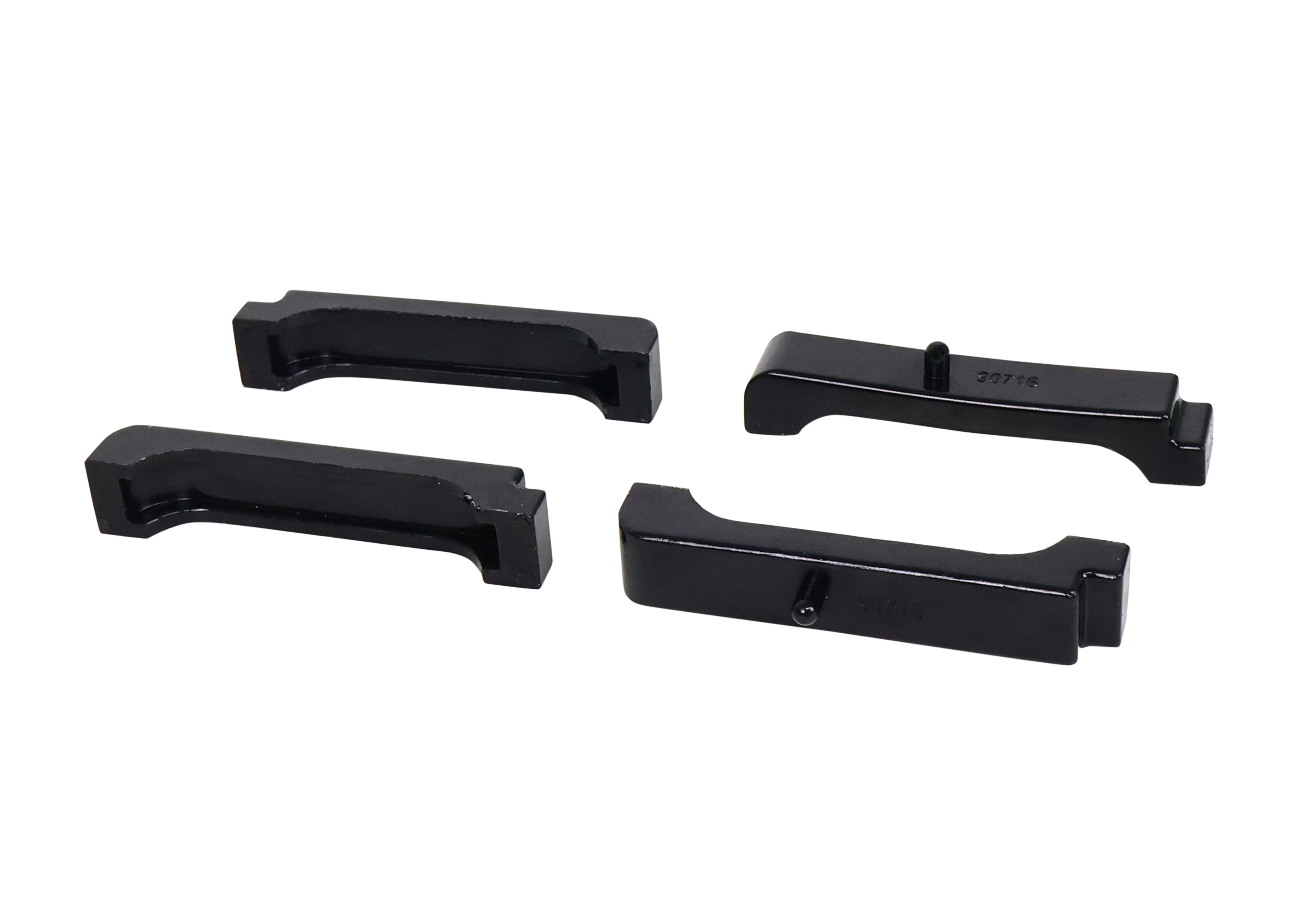 In StockShips within 24hrs.Ships within 24hrs.SKU: W93593
Front Radiator Mount Bushing Set for GM Big Block Motors
In StockShips within 24hrs.Ships within 24hrs.Qty Required 1Kit Contents 4 Bushings$18.79
Your vehicle
Matching vehicles
No match — try selecting it below.
Refine your search
Clear all- Performance Suspension Kits 22
- Lowering Springs 36
- Sway Bar & Sway Bar Kits 464
- Sway Bar Bracket 7
- Sway Bar Lateral Lock 10
- Sway Bar Support Brace 3
- Sway Bar Link 104
- Leveling Kits 2
- Lift Kits 18
- Diff Drop Kit 2
- Strut Brace 23
- Bushings 1074
- Alignment Pins and Bushings 18
- Anti Roll Bar Mount 1
- Axle Bushings 5
- Body Mount Bushings 46
- C-Bushings 2
- Coil Spring Insulators 3
- Coil Spring Spacers 21
- Control Arm Bushings 387
- Differential Bushings 50
- Door Jamb Bushing 1
- Lateral Arm Bushings 6
- Leaf Spring Bushings 15
- Leaf Spring Pads 1
- Leaf Spring Shackle Bushing 31
- Master Bushing Kits 39
- Radiator Bushings 2
- Radius Arm Bushings 14
- Shock Bushings 28
- Steering Bushings 41
- Steering Column Bushing 1
- Strut Mount Bushing 4
- Strut Rod Bushing 6
- Subframe Bushing 29
- Sway Bar Bushings 234
- Sway Bar Link Bushings 25
- Toe Link Bushing 1
- Torsion Bar Bushing 1
- Track Bar Bushings 12
- Trailing Arm Bushing 48
- Transfer Case Bushings 1
- Watts Link Bushing Kit 1
- Control Arms 160
- Ball Joint 32
- Control Arm Brace 1
- Control Arm Kit 125
- Control Arm Assembly with Ball Joint 2
- Control Arm Kit - Lower 56
- Control Arm Kit - Upper 47
- Control Arm Relocation Brackets 1
- Radius Arm 1
- Alignment Parts 31
- Camber Bolts 8
- Caster Camber Plates 23
- Transmission Parts 22
- Shifter Bushing 3
- Transmission Mount 19
- Strut Mount 3
- Strut Mount 3
- Tie Rods 9
- Roll Center Kits 8
- Tie Rod Ends 1
- Track Bar 8
- Support Brace 1
- Engine Bushings 33
- Engine Mount Bushings 33
- Car Accessories 1
- Headlight Sensor Bracket 1
- Universal Auto Parts 49
- Bushing Grease 1
- Dust Covers 3
- Spare Tire Carrier Mount 1
- Strut Mount 1
- Universal Bump Stops 19
- Valve Stem Caps 1
- Nuts, Bolts & Screws 5
- Control Arm Bolt Kit 3
- Control Arm Washer 1
- Sway Bar Link Washer 1
- Merchandise 11
- Beanie 1
- Decals 5
- Gloves 1
- Key Chain 1
- T-Shirts 3
- Workshop Tools 2
- Bushing Press Kit 1
- Wheel Alignment Tool 1
No categories match.
Can’t find what you’re looking for?
Our team can help you find the right part — or tell us what was missing so we can improve the site.
Call Us +1 909-476-2860 Give Feedback (opens in a new tab)


