
 US
 Australia
 United Kingdom
 Europe

Torsion Bar Bushing
IMPROVE GRIP, HANDLING & PERFORMANCE.
A torsion bar is the only spring on a car that is also a locating member. It stores energy by twisting along its length, and the bushings at each end are what hold it in position while it does. How Does Torsion Bar Suspension Work A torsion bar is a straight steel rod, splined at both ends, running fore and aft along the chassis. One end anchors... Read more
A torsion bar is the only spring on a car that is also a locating member.
It stores energy by twisting along its length, and the bushings at each end are what hold it in position while it does.
How Does Torsion Bar Suspension Work
A torsion bar is a straight steel rod, splined at both ends, running fore and aft along the chassis.
One end anchors into a crossmember and cannot rotate. The other end splines into the lower control arm. When the wheel moves up, the arm rotates, and because the far end is fixed, the bar twists along its whole length.
That twisting action is what forms the spring. Steel resisting torsion stores energy exactly as a coiled spring does, and releases it the same way when the load comes off.
Torsion bar front suspension was standard on a great many trucks and 4WDs for decades, because the bar packages along the chassis rail rather than needing a tower above the wheel, which leaves room for an engine sitting low and forward.
Truck torsion bar suspension still turns up widely for the same reason, and anything using it has torsion bar bushings supporting the arrangement.
Where the Bushings Sit
Two positions matter and they do different things.
The control arm pivot bushings carry the arm itself, taking the weight of the corner and allowing it to swing. These are the ones under constant vertical load.
The torsion bar mount bushings sit where the fixed end locates into the crossmember. They hold the bar against rotation while absorbing the vibration that would otherwise travel straight up the bar into the chassis.
Some arrangements add a support bushing along the bar's length where it passes through a bracket, keeping it from whipping or contacting anything.
Every one of those is holding a component that is under permanent torsional load, which is unlike anything else in the suspension.
Independent Front Suspension and the Lower Arm
Where the bar meets the suspension is worth understanding, since that is where most of the bushing wear happens.
A torsion bar system uses a conventional independent front end. Upper and lower control arms locate the hub, a damper controls the movement, and the torsion bar replaces what would otherwise be a coil spring.
The bar splines into the lower control arm, so the arm is doing two jobs at once. It locates the wheel and it acts as the lever twisting the bar.
That means the lower arm pivot bushings are carrying the vertical load of the corner and reacting the spring force through the same joint.
Compare that with a coil sprung arm, where the spring sits on the arm and pushes directly into the body. There the bushing only has to carry weight. Here it carries weight plus the torque the bar is generating.
It is the busiest joint in the suspension, which is why it wears first and why a bushing kit usually covers it alongside the anchor end.
Why These Bushings Carry Twist Rather Than Weight
This is the part that makes a torsion bar bushing different.
In a coil sprung suspension, the spring pushes and the bushings around it carry mostly linear load. The arm pivots, the bushing rotates, and the forces are reasonably predictable.
With a torsion bar, the bar is under constant twist whenever the vehicle is sitting on its wheels. That twist has to be reacted somewhere, and the anchor bushings are where it goes.
They are therefore loaded all the time rather than only when the suspension moves. A parked vehicle is still putting load through them.
That constant loading is why they compress and harden rather than wearing from movement, and why a vehicle that has sat for years can have bushings as tired as one that has covered high mileage.
Torsion Bar Suspension vs Coil Spring
The comparison explains both the appeal and the compromises.
A coil spring packages vertically and needs space above the wheel for a tower. A torsion bar runs horizontally along the chassis, which frees that space entirely.
Ride height on a coil is set by the spring. On a torsion bar it is adjustable, using a bolt that preloads the anchor end, which is why these suspensions can be raised or lowered without changing any parts.
The trade comes in how much the spring rate can be tuned. A torsion bar's rate is fixed by its diameter and length, so there is less scope to tune the spring rate without replacing bars, and adjusting ride height upward uses available suspension travel rather than adding any.
Coil springs have largely replaced them on new vehicles, which is why torsion bar bushings are most often a maintenance item on older trucks and 4WDs rather than a performance upgrade on something current.
Ride Height, Adjustment and Worn Bushings
Here is the consequence specific to this design.
Ride height is set by an adjuster bolt preloading the torsion bar at its anchor. Wind it in and the bar is twisted further at rest, which raises the vehicle.
That means the bushings at the anchor are part of the ride height mechanism, not just an isolator. As they compress and lose thickness, the effective preload changes and the vehicle settles.
Owners then wind the adjuster further to bring the height back, which increases preload on bars that are already working harder, and the suspension ends up riding on less travel than it was designed around.
A vehicle that has needed repeated adjustment to hold its height usually has bushings that have given up rather than bars that have sagged.
Replacing them restores the geometry the adjuster was designed to work within, and the adjuster should be reset afterward rather than left where it was.
What Worn Torsion Bar Bushings Produce
- A clunk from the front over bumps and driveways
- Ride height that drops and needs adjusting repeatedly
- A vehicle sitting unevenly side to side
- Vagueness or wander at highway speed
- Alignment that will not hold its settings
- Harsh ride as the suspension runs closer to its bump stops
- Visible cracking, compression or separation in the bushing rubber
- Noise that appears when the vehicle is loaded and not when it is empty
The repeated height adjustment is the most reliable of those. A torsion bar does not lose its rate quickly, so a vehicle that keeps settling is usually losing it at the mounting rather than in the bar.
Replacing Torsion Bar Bushings
The bar has to be unloaded before anything comes apart, and this is the safety point on the job.
A torsion bar under preload holds serious stored energy. Releasing the adjuster or the anchor without unloading it properly lets that energy out suddenly, and the consequences are severe.
Count and record the adjuster bolt turns before backing it off, so the ride height can be returned close to where it started.
Mark the bar's position in its splines at both ends. A bar refitted a spline out changes ride height significantly and differently to the other side.
The bushings themselves are usually a press fit, so proper tooling rather than improvisation, and the control arm frequently has to come off to reach the pivot bushings.
Reset the ride height afterward with the vehicle on its wheels, measure both sides, and have the alignment set once it has settled.
What to Check at the Same Time
Access decides what else is worth doing while you are there.
The control arm pivot bushings are accessible with the arm off and they wear on the same timeline as the anchor bushings.
Ball joints sit at the outer end of the same arm, and replacing them later means repeating most of the work.
The adjuster bolt and its anchor block are worth inspecting, since both corrode and a seized adjuster is what stops the ride height being reset properly afterward.
Check the bar itself for corrosion pitting along its length. A torsion bar is a spring, and surface damage is where a fatigue crack starts.
Find Torsion Bar Bushings for Your Vehicle
Torsion bar bushings are part of our bushings lineup.
Select your vehicle to see the torsion bar bushing kit options available for it. If the front of the vehicle keeps settling and the adjuster has already been wound in once, the bushings are where to look before touching it again.
1 item
-
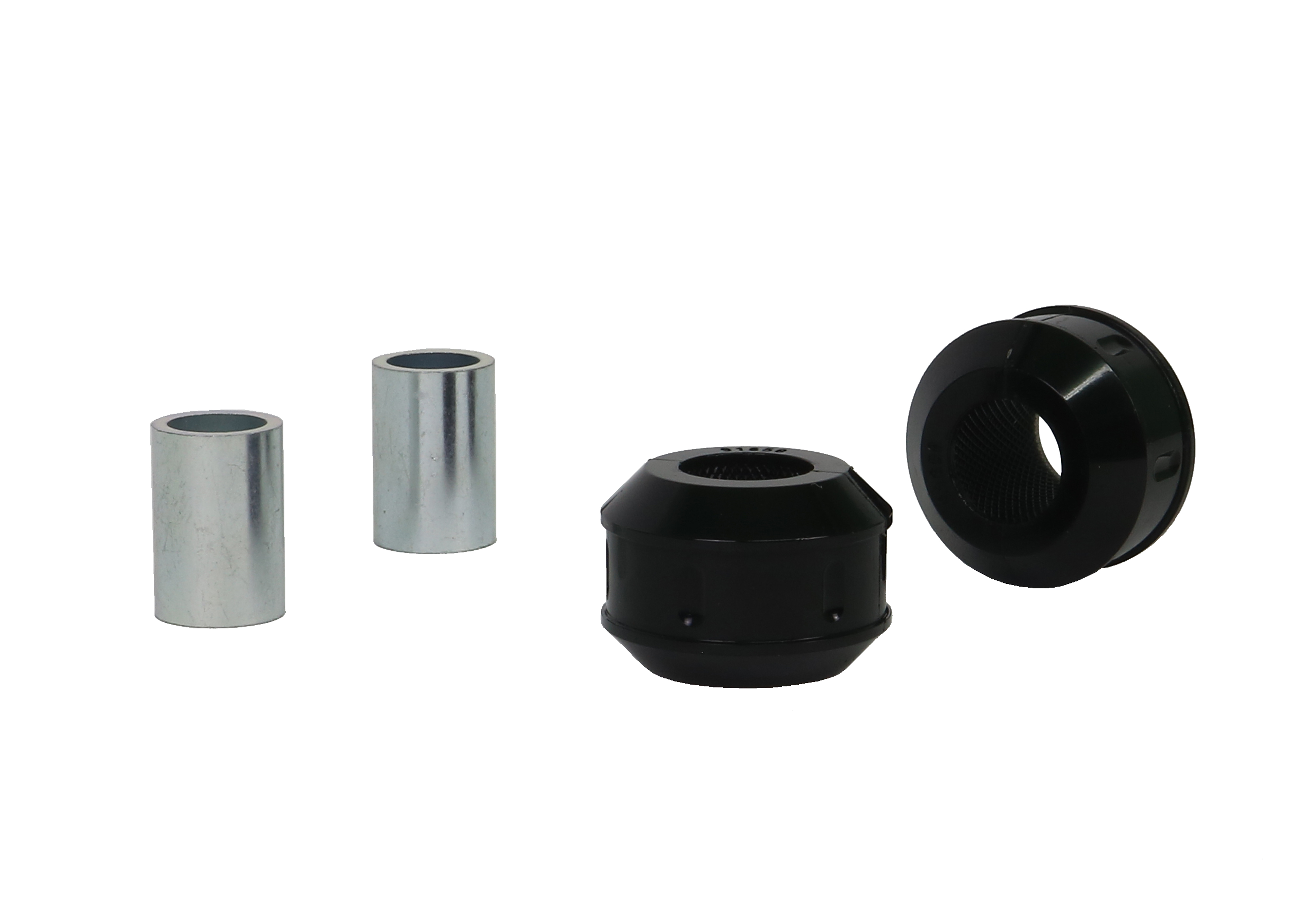 In StockShips within 24hrs.Ships within 24hrs.SKU: W93527
Torsion Bar Rear Bushings
In StockShips within 24hrs.Ships within 24hrs.Qty Required 1Kit Contents 2 Bushings, 2 Tubes, Install Guide, Grease$33.19
Your vehicle
Matching vehicles
No match — try selecting it below.
Refine your search
Clear all- Performance Suspension Kits 22
- Lowering Springs 36
- Sway Bar & Sway Bar Kits 464
- Sway Bar Bracket 7
- Sway Bar Lateral Lock 10
- Sway Bar Support Brace 3
- Sway Bar Link 104
- Leveling Kits 2
- Lift Kits 18
- Diff Drop Kit 2
- Strut Brace 23
- Bushings 1074
- Alignment Pins and Bushings 18
- Anti Roll Bar Mount 1
- Axle Bushings 5
- Body Mount Bushings 46
- C-Bushings 2
- Coil Spring Insulators 3
- Coil Spring Spacers 21
- Control Arm Bushings 387
- Differential Bushings 50
- Door Jamb Bushing 1
- Lateral Arm Bushings 6
- Leaf Spring Bushings 15
- Leaf Spring Pads 1
- Leaf Spring Shackle Bushing 31
- Master Bushing Kits 39
- Radiator Bushings 2
- Radius Arm Bushings 14
- Shock Bushings 28
- Steering Bushings 41
- Steering Column Bushing 1
- Strut Mount Bushing 4
- Strut Rod Bushing 6
- Subframe Bushing 29
- Sway Bar Bushings 234
- Sway Bar Link Bushings 25
- Toe Link Bushing 1
- Torsion Bar Bushing 1
- Track Bar Bushings 12
- Trailing Arm Bushing 48
- Transfer Case Bushings 1
- Watts Link Bushing Kit 1
- Control Arms 160
- Ball Joint 32
- Control Arm Brace 1
- Control Arm Kit 125
- Control Arm Assembly with Ball Joint 2
- Control Arm Kit - Lower 56
- Control Arm Kit - Upper 47
- Control Arm Relocation Brackets 1
- Radius Arm 1
- Alignment Parts 31
- Camber Bolts 8
- Caster Camber Plates 23
- Transmission Parts 22
- Shifter Bushing 3
- Transmission Mount 19
- Strut Mount 3
- Strut Mount 3
- Tie Rods 9
- Roll Center Kits 8
- Tie Rod Ends 1
- Track Bar 8
- Support Brace 1
- Engine Bushings 33
- Engine Mount Bushings 33
- Car Accessories 1
- Headlight Sensor Bracket 1
- Universal Auto Parts 49
- Bushing Grease 1
- Dust Covers 3
- Spare Tire Carrier Mount 1
- Strut Mount 1
- Universal Bump Stops 19
- Valve Stem Caps 1
- Nuts, Bolts & Screws 5
- Control Arm Bolt Kit 3
- Control Arm Washer 1
- Sway Bar Link Washer 1
- Merchandise 11
- Beanie 1
- Decals 5
- Gloves 1
- Key Chain 1
- T-Shirts 3
- Workshop Tools 2
- Bushing Press Kit 1
- Wheel Alignment Tool 1
No categories match.
Can’t find what you’re looking for?
Our team can help you find the right part — or tell us what was missing so we can improve the site.
Call Us +1 909-476-2860 Give Feedback (opens in a new tab)


